
Chinese Voice | Team of Academician Qiao Jie Publishes Landmark Study in Nature Communications
In April 2026, the team led by Academician Jie Qiao of Peking University Third Hospital published original research findings in the internationally renowned journal Nature Communications. Based on mouse models, the study is the first to confirm that the endogenous small molecule uridine can effectively reverse aging in oocytes and significantly enhance fertility. It elucidates the core mechanism by which uridine targets PCBP1, inhibits ferroptosis, and repairs mitochondrial function. This provides a potentially translatable, China-originated intervention strategy for addressing global female reproductive aging, garnering significant attention in the field of reproductive medicine worldwide.
Source: Nature Communications
The Dilemma of Advanced Maternal Age: Oocyte Aging as the Core Bottleneck
With the general trend of delayed childbearing, the sharp decline in both quantity and quality of oocytes in women of advanced maternal age has become a core challenge urgently needing resolution in reproductive medicine.
➱ Three Fatal Defects in Aged Oocytes:
High Incidence of Chromosomal Abnormalities: Spindle apparatus disorganization and chromosomal misalignment lead to a soaring rate of aneuploidy, directly causing miscarriage, missed abortion, and birth defects.
Mitochondrial Dysfunction: Disrupted mitochondrial distribution and collapsed membrane potential result in insufficient energy supply, unable to support oocyte maturation.
Hyperactivated Ferroptosis: Accumulation of ferrous iron (Fe²⁺), bursts of reactive oxygen species (ROS), and exacerbated lipid peroxidation trigger programmed cell damage, accelerating oocyte apoptosis.
Traditional assisted reproductive technologies struggle to fundamentally reverse aging at its root, leaving an urgent clinical need for safe, efficient, and scalable intervention strategies.
Breakthrough Discovery: Uridine Reverses Oocyte Aging and Potently Enhances Fertility
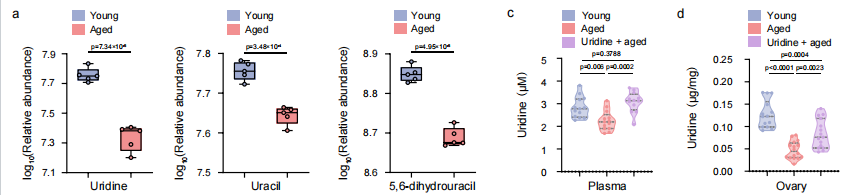
Starting with metabolomics, Academician Qiao Jie’s team made the first discovery that uridine levels in the ovaries and plasma of aged mice were significantly reduced (only 1/3 of those in young mice), suggesting that uridine deficiency is a key metabolic feature of reproductive aging. [Note: All results below are derived from mouse experiments and have not yet entered human clinical trials.]
Source: Nature Communications
01 In Vivo Experiments: Significant Boost in Fertility
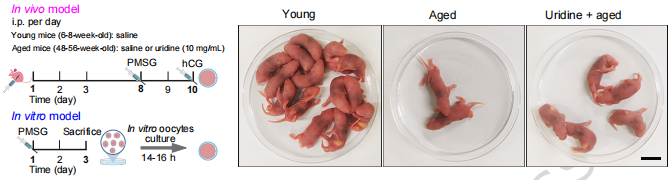
Following 10 consecutive days of uridine supplementation in 48–56-week-old female mice (equivalent to elderly humans):
Litter Size Increased by 74%: Rising from 3.13 to 5.44 pups per litter.
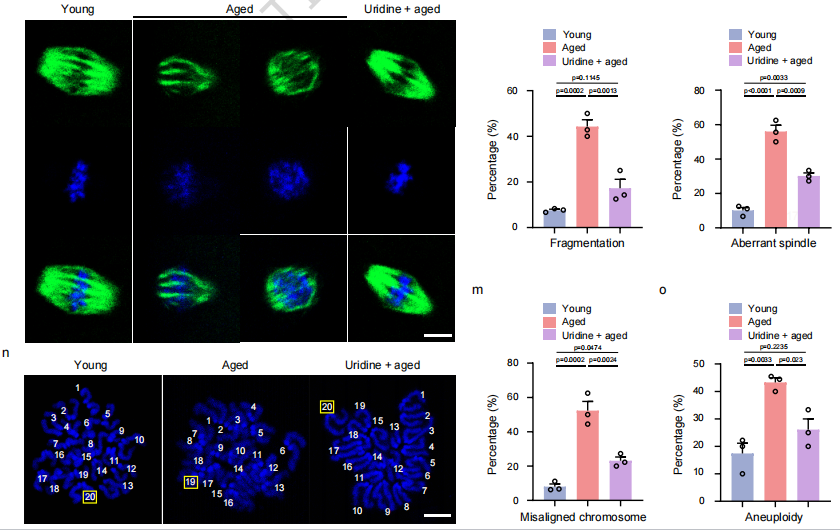
Comprehensive Optimization of Oocyte Quality: The rate of first polar body extrusion increased significantly, and the proportion of fragmented oocytes dropped substantially.
Sharp Decline in Chromosomal Abnormality Rates: Spindle abnormality rates fell from 56% to 30%, chromosomal misalignment rates dropped from 52% to 23%, and aneuploidy rates decreased significantly.
Source: Nature Communications
Source: Nature Communications
02 In Vitro Validation: Restoration of Core Oocyte Functions
In an oocyte in vitro maturation system, treatment with 100 μM uridine restored the maturation rate of aged oocytes to levels comparable to those of young oocytes:
Cytoplasmic Maturation Repair: Expression of cortical granules (CG) and ovastacin recovered, significantly enhancing sperm binding capacity.
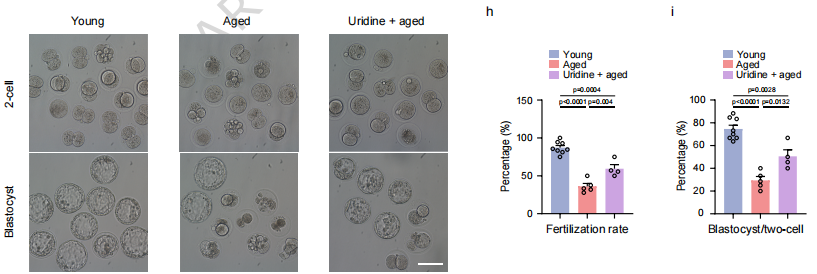
Enhanced Embryonic Developmental Potential: The rates of 2-cell embryo formation and blastocyst formation increased significantly, laying the foundation for successful embryo implantation in assisted reproduction.
Source: Nature Communications
Mechanism Decoded: Targeting PCBP1 to Block the Vicious Cycle of Ferroptosis-Mitochondrial Damage
Using multi-omics technologies—including transcriptomics, Limited Proteolysis-Small Molecule Mapping (LiP-SMap), molecular docking, and Surface Plasmon Resonance (SPR)—the team revealed for the first time the core target and molecular mechanism of uridine action.
➱ Uridine directly binds to and stabilizes the iron chaperone PCBP1, fundamentally blocking aging-related damage:
Inhibition of Ferroptosis:
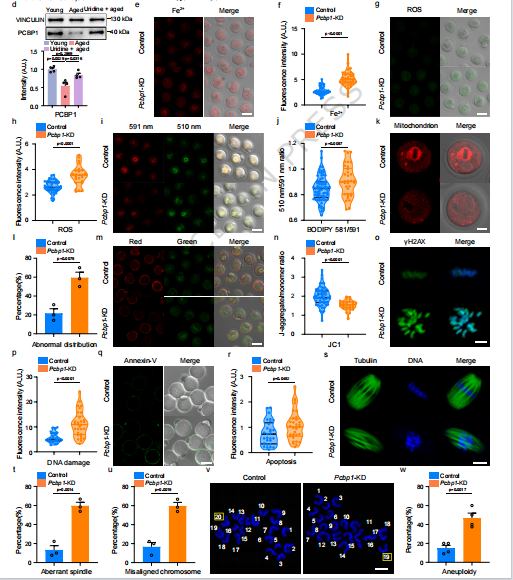
PCBP1 is a core regulator of intracellular iron homeostasis. Its expression is significantly reduced in aged oocytes. Upon binding with uridine, PCBP1 reduces Fe²⁺ accumulation, decreases ROS production, alleviates lipid peroxidation, and restores glutathione (GSH) antioxidant levels, completely halting the ferroptosis process.
Repair of Mitochondrial Function:
Stabilized PCBP1 improves disordered mitochondrial distribution, restores mitochondrial membrane potential, enhances oxidative phosphorylation capacity, and reduces DNA damage and apoptosis, providing sufficient energy for oocyte maturation.
Maintenance of Meiotic Stability:
The synergistic effect of ferroptosis inhibition and mitochondrial repair improves spindle assembly, ensures proper chromosome alignment, and lowers aneuploidy rates, fundamentally enhancing the genetic stability of oocytes.
Source: Nature Communications
Research Significance: A Chinese Solution Leading New Directions in Reproductive Aging Intervention
This study by Academician Qiao Jie’s team represents a landmark breakthrough in the field of metabolic intervention for reproductive aging, carrying triple significance:
Theoretical Innovation:
It is the first to construct the "Uridine-PCBP1-Ferroptosis-Mitochondria" regulatory axis, filling a gap in the understanding of the metabolic mechanisms of reproductive aging and providing a novel scientific perspective on oocyte senescence.
Immense Clinical Translation Potential:
As a naturally occurring endogenous small molecule in the human body, uridine boasts high safety, easy accessibility, and low cost. Pending robust preclinical and clinical trial evidence, it holds promise for optimizing in vitro culture systems in assisted reproduction and possesses research potential for development into a novel therapeutic agent. It could benefit patient groups including those of advanced maternal age, diminished ovarian reserve, and recurrent implantation failure.
Outstanding Public Health Value:
Addressing the global trend of delayed childbearing, if subsequent studies confirm its applicability to humans, this strategy offers a potential new pathway to reduce age-related infertility, adverse pregnancy outcomes, and birth defect risks. It promises to enhance reproductive health levels and alleviate the medical burden on families and society.
Currently, the study has completed comprehensive validation in mouse models. Subsequent steps will advance preclinical research and human trials to verify its safety and efficacy in human reproduction, promoting the translation of these results into clinical practice. The original achievements of Academician Jie Qiao’s team not only highlight China's top-tier scientific research strength in reproductive medicine but also contribute safe, efficient, and accessible Chinese wisdom and solutions to the global challenge of female reproductive aging.
Source: Chen, J., Shen, J., Li, D. et al. Uridine restores oocyte quality and mitigates female reproductive aging by inhibition of ferroptosis in mice. Nat Commun(2026). https://doi.org/10.1038/s41467-026-72406-8
[All data in this study are based on validation in mouse models. The intervention effect and safety of uridine on human oocyte aging have not been confirmed by human clinical trials. Its clinical application remains in the exploratory stage, provided for scientific reference only, and does not constitute any medical advice.]
Editor: Lily