
For patients with moderate to severe intrauterine adhesions, even with standardized surgical treatment, there is still a significant difference in whether pregnancy can be successfully conceived after surgery. A recent study found that the size of the intraoperative intrauterine stent — more accurately an indicator reflecting the intercoronal distance (ICD) — is significantly correlated with clinical pregnancy rates within one year postoperatively. Patients with stent size ≤ XS (corresponding to about 20-22 mm in ICDs) have more than half the chance of clinical pregnancy compared to patients with larger stent size.
This study, published in Human Reproduction Open, was completed by Professor Xu Dabao's team at Xiangya Third Hospital of Central South University, and included 560 women with moderate to severe intrauterine adhesions. All patients underwent standardized hysteroscopic treatment, including adhesiolysis, placement of uterine stenting, and planned secondary hysteroscopic examinations. The primary outcome of the study was clinical pregnancy within one year after the last hysteroscopy.
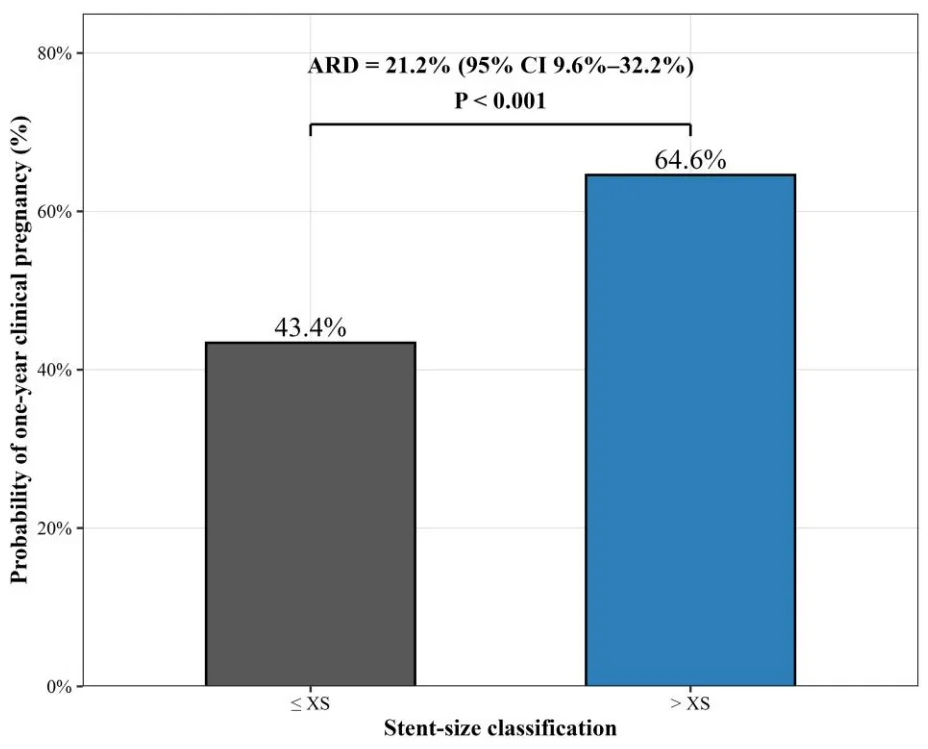
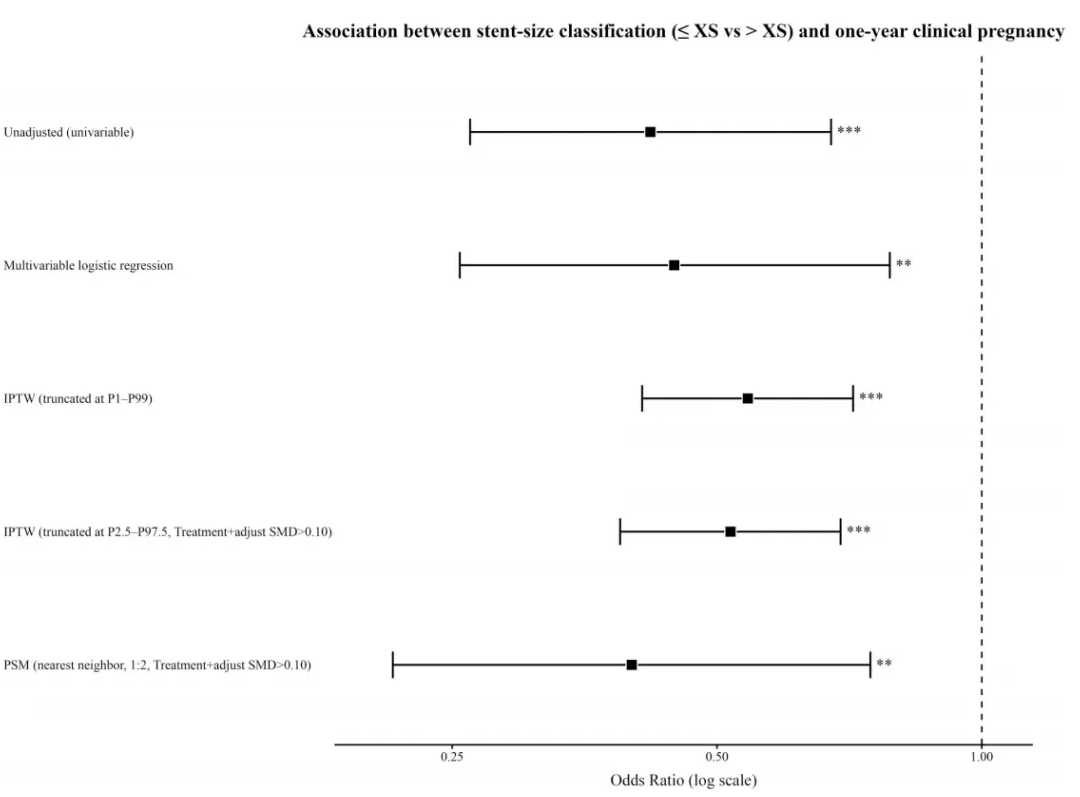
A key finding in the study was that the stent size selected intraoperatively based on the angle of the cornus was clearly associated with postoperative pregnancy outcomes. Researchers analyzed nine stent sizes (from XXXS to XXXL) into ≤ XS and > XS groups. Results showed that patients in the ≤ XS group (i.e., extremely small stent size, corresponding to ICDs about 20-22 mm) had a significantly lower clinical pregnancy rate than the > XS group. After accounting for multiple confounding factors such as age, history of uterine scarring, and previous adhesiolysis procedures, multivariate logistic regression analysis confirmed that the adjusted odds ratio (aOR) for clinical pregnancy in ≤ XS group was 0.447 (95% confidence interval 0.255-0.786, P=0.005). This means that compared to the > XS group, patients in the ≤ XS group had a 55.3% lower chance of clinical pregnancy within one year postoperatively. Figure: Evaluating candidate thresholds based on stent size categories for predicting clinical pregnancy within one year after the last hysteroscopy Although incorporating stent size classification into traditional predictive models results in limited improvement in model discrimination (AUC only increases by 0.010), its clinical value is reflected in significant differences in absolute risk. Data show that between the ≤ XS group and the > XS group, the absolute risk difference (ARD) for clinical pregnancy within one year after the last hysteroscopy was 21.2% (95% confidence interval 9.6%-32.2%, P<0.001). This means that compared to the > XS group (clinical pregnancy rate 64.6%), the ≤ XS group (clinical pregnancy rate 43.4%) had an absolute 21.2% reduction in pregnancy chances. This value corresponds to a number of people needing treatment (NNB) of 4.7, indicating that this indicator has clear clinical risk stratification value. Figure: Absolute difference in clinical pregnancy probability within one year after the last hysteroscopy between the ≤ XS group and the > XS group The study further conducted subgroup analyses based on pregnancy mode (natural pregnancy and assisted reproductive technology (ART). The results showed that whether patients attempted natural pregnancy or received ART, the association between stent size classification (≤XS vs >XS) and clinical pregnancy was statistically significant. In the natural pregnancy subgroup, the aOR was 0.394 (95% CI 0.183-0.846, P=0.017); In the ART subgroup, the aOR was 0.451 (95% CI 0.205-0.994, P=0.048). This consistent correlation suggests that the impact of ICDs may be independent of pregnancy mode. To eliminate potential confounding bias, researchers employed various sensitivity analysis methods such as Propensity Score Matching (PSM) and Inverse Probability Processing Weighting (IPTW). All analyses consistently showed that the clinical pregnancy risk in the ≤ XS group was significantly lower than in the > XS group. Figure: The forest diagram shows the association between stent size classification (≤XS vs >XS) and clinical pregnancy within one year after the last hysteroscopy The study also evaluated the consistency between intraoperative stent size classification and postoperative ultrasound measurements (ICD). The results showed that 42.9% of the two methods were completely consistent, and 84.1% were consistent within ± category (weighted κ=0.539, P<0.001), indicating moderate consistency between the two methods. This supports the rationale of using stent size as an intraoperative approximate value for ICD. For secondary outcomes, the study found a significant association between stent size classification (≤XS vs >XS) and live birth after first clinical pregnancy within one year after the last hysteroscopy (aOR=0.500, 95% CI 0.280-0.893, P=0.019). However, the association with cumulative live birth rate over 2 years was not statistically significant (aOR=0.606, 95% CI 0.339-1.083, P=0.091). Researchers pointed out that since live birth outcomes are influenced by more downstream factors (such as obstetric management and follow-up treatment decisions), these findings should be interpreted as exploratory results. In an analysis of 608 women with complete gestational time data, the Kaplan-Meier survival curve showed that the probability of cumulative clinical pregnancy within one year after the last hysteroscopy in the ≤ XS group was significantly lower than in the > XS group (log-rank P=0.002). Multivariate Cox regression analysis also confirmed that the risk ratio (aHR) for achieving clinical pregnancy in the ≤ XS group was 0.630 (95% CI 0.439-0.903, P=0.012). The authors clearly point out that this is a single-center retrospective study and may have selection bias and residual confounding, with limited extrapolation of results. Additionally, the XS threshold for stent size classification was exploratory determined in this dataset and may be overfitted, requiring validation in independent external cohorts. The study also did not collect detailed ART-related variables (such as embryo quality, male factors, etc.), which may affect interpretation of ART subgroup results. Although this metric cannot yet serve as an independent forecasting tool, it provides a practical stratified approach to postoperative risk. Researchers believe that for patients with stent size ≤ XS, closer clinical follow-up may be necessary. If pregnancy is not achieved within the expected timeframe, a comprehensive fertility assessment and further assisted reproductive support should be discussed earlier. This study provides a new and easily accessible intraoperative reference indicator for individualized management after intrauterine adhesion surgery, but its clinical application still requires validation from multicenter prospective studies.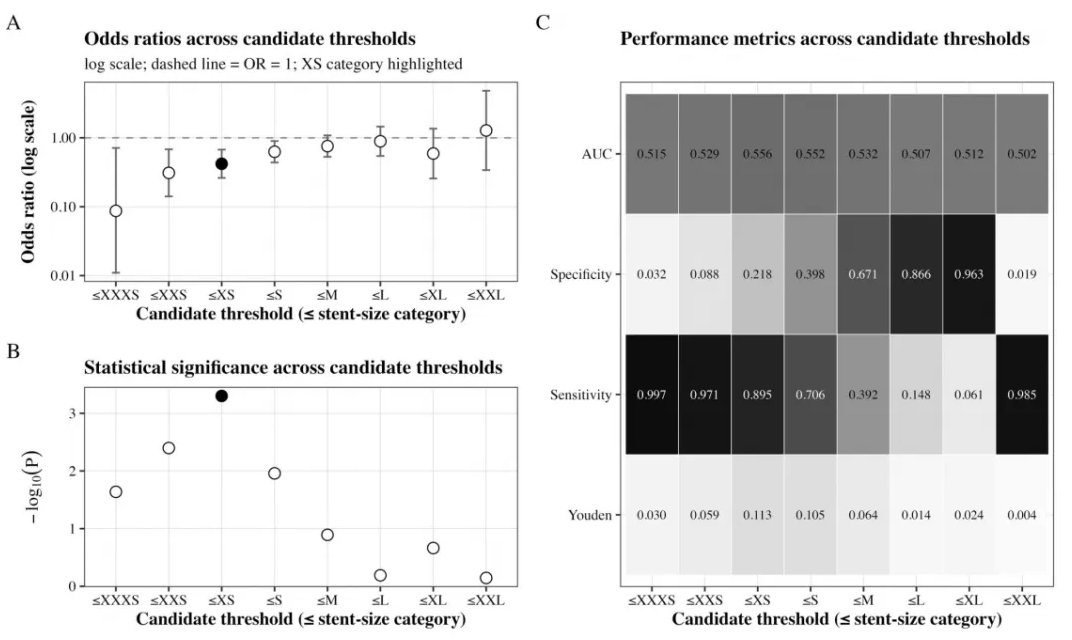
Content sources: Yifu He, Xingping Zhao, Huan Huang, Changfa Shu, Xiaoming Guan, Jia Guo, Dabao Xu, Intercornual distance and postoperative reproductive outcomes in moderate-to-severe intrauterine adhesions: a retrospective cohort study, Human Reproduction Open, Volume 2026, Issue 3, 2026, hoag038, https://doi.org/10.1093/hropen/hoag038
❖ Director of the Department of Obstetrics and Gynecology, Xiangya Third Hospital of Central South University, concurrently serving as Director of Gynecology; Professor, chief physician, doctoral supervisor ❖ Standing Committee Member of the Obstetrics and Gynecology Branch of the Chinese Medical Doctor Association and Head of the Intrauterine Disease Group ❖ Standing Committee Member of the Obstetrics and Gynecology Branch of the Chinese Medical Association, President of the Gynecological Intelligent Diagnosis and Treatment Branch of the National Health Industry Enterprise Management Association ❖ Director of the Hunan Provincial Gynecology Quality Control Center, Chairman of the Hunan Alliance for Prevention and Treatment of Major Obstetrics and Gynecology Diseases, and Director of the Hunan Provincial Engineering Research Center for Gynecological Intelligent Diagnostic and Treatment Equipment Products. Hunan Province Medical "Leading Talent" ❖ Led 2 national projects, published 105 SCI papers, and obtained 35 patents ❖ In 2009 and 2014-2015, he studied and visited Yale University and Baylor College of Medicine in the United States, respectively ❖ Winner of the 2016 American Association of Gynecologic Endoscopists (AAGL) Global Annual Meeting "Best Hysteroscopy Surgery Video Award" ❖ Patent achievement transformation: Lingbao integrated hysteroscope and Z-shaped hysteroscope, uterine stent, pump-free dilator device, water intoxication monitor, endometrial gland aperture density assessment system, quantitative morphological cervical cancer screening system, and more ❖ In 2022, awarded the title of "Health Guardian - Medical Pioneer" by the People's Health Channel of the National Health Commission ❖ Pioneer of hysteroscopic cold knife technology
Editor:lucy