





















Preterm birth accounts for approximately one-third of neonatal mortality cases, with cervical insufficiency being one of its primary risk factors. For high-risk pregnant women in whom transvaginal cerclage is unfeasible—such as those with failed prior vaginal cerclage or anatomical abnormalities following cervical conization—transabdominal cervical cerclage serves as a crucial salvage procedure. While laparoscopic minimally invasive surgery is the preferred approach, the enlarged gravid uterus and abundant pelvic vasculature during pregnancy increase the risk of disturbing the uterus and compromising uterine arterial blood flow, thereby significantly elevating surgical difficulty and risk.
Source: AJOG
Published in the April 2026 issue of AJOG, this surgical technique study introduces "Laparoscopic Trans-Broad-Ligament Abdominal Cerclage with Round Ligament Suspension (LAC-D)." By utilizing round ligament suspension to create an operative space in the pouch of Douglas and placing the cerclage tape medially to the uterine arteries, this technique achieves minimally invasive cerclage with minimal fetal disturbance and no compromise to uterine blood flow. The procedure demonstrates safety and feasibility with favorable maternal and neonatal outcomes, offering an optimized surgical solution for refractory cervical insufficiency during pregnancy.
01 Clinical Core Challenge
Disease Background: Cervical insufficiency is a key contributor to preterm birth. Transabdominal cervical cerclage is a vital intervention for severe cases or those where transvaginal cerclage has failed.
Technical Challenges: Performing laparoscopic transabdominal cerclage during pregnancy is technically demanding due to the enlarged uterus and congested pelvic vessels. Traditional approaches risk compromising uterine blood flow by operating lateral to or ligating the uterine arteries.
Objective: To introduce a novel laparoscopic transabdominal cerclage technique—LAC-D—designed for use during pregnancy to minimize disturbance to the gravid uterus while protecting uterine arterial blood flow.
02 Highlights of the Innovative Technique
LAC-D (Laparoscopic trans-broad-ligament Abdominal Cerclage): The core innovation lies in achieving a "no-touch" uterus technique through round ligament suspension and placement of the cerclage tape medial to the uterine arteries.
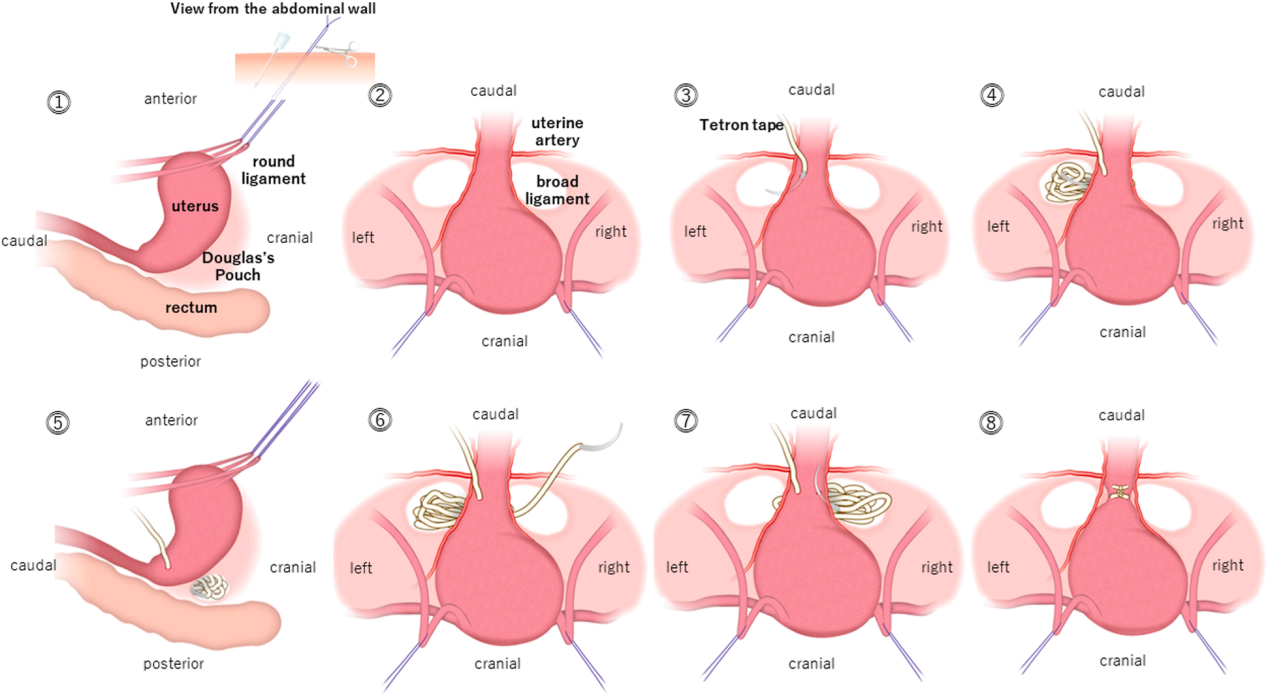
LAC-D Surgical Steps
Source: AJOG
1. Creating the Operative Space
• The patient is placed in the lithotomy position, and pneumoperitoneum is established (pressure <10 mmHg).
• Both round ligaments are suspended anteriorly to the abdominal wall using sutures, lifting the uterus. This maneuver creates additional operative space in the rectouterine pouch (pouch of Douglas), eliminating the need to directly manipulate or grasp the uterus.
2. Critical Operative Pathway
• After identifying the uterine arteries, avascular windows are created in the broad ligaments bilaterally, medial to the arteries, leading into the pouch of Douglas.
• A Tetron cerclage tape with a passer is guided sequentially from anterior to posterior on the left side and posterior to anterior on the right side, both medial to the uterine arteries, encircling the internal cervical os. The entire placement occurs within the created space without contacting the uterine corpus.
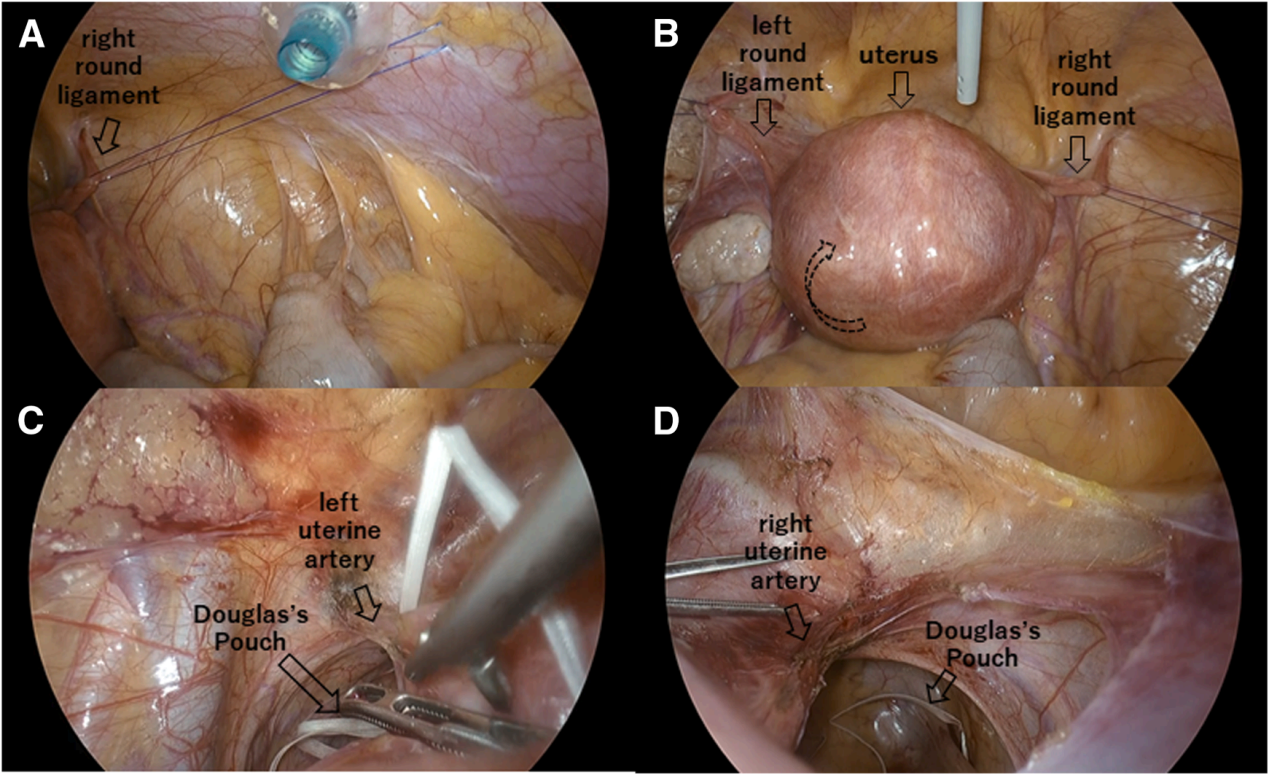
Establishing the Operative Space in the Pouch of Douglas
Source: AJOG
3. Technical Advantages
• Hemodynamic Protection: The cerclage tape traverses entirely medial to the uterine arteries, avoiding potential obstruction of uterine blood flow that may occur with lateral dissection. Consequently, routine postoperative uterine artery Doppler assessment is unnecessary; confirmation of fetal viability suffices.
• Minimally Invasive: Maximizes reduction of mechanical stimulation and injury to the gravid uterus.
03 Clinical Data and Outcomes
This single-center retrospective analysis included 12 patients.
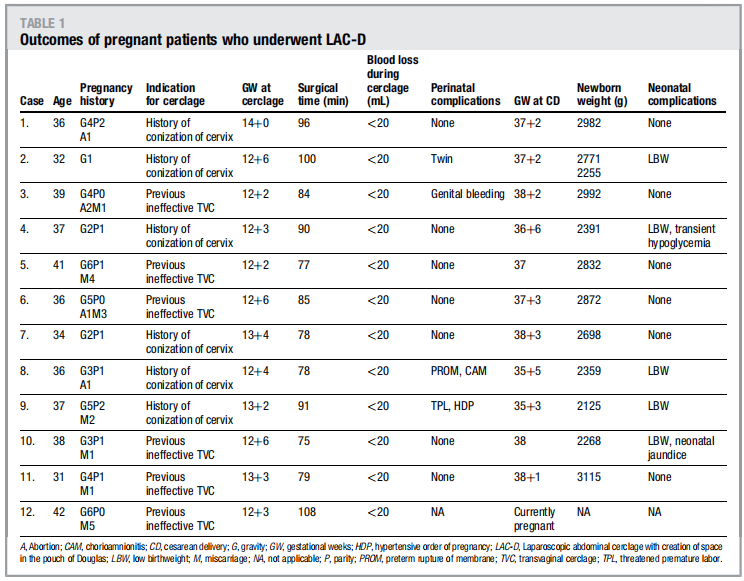
Pregnancy Outcomes of LAC-D Procedure
Source: AJOG
1. Patient Characteristics
Indications included prior cervical conization (6 cases) and history of failed transvaginal cerclage (6 cases).
2. Surgical Details
• Timing: 12–14 weeks of gestation.
• Operative Time: 75–108 minutes (median ~85 minutes).
• Intraoperative Blood Loss: <20 mL in all cases.
• Intraoperative Complications: None.
3. Pregnancy Outcomes
• As of reporting, 1 patient remained pregnant; 11 had delivered.
• Gestational Age at Delivery: All 11 deliveries occurred beyond 35 weeks (range: 35⁺³ to 38⁺³ weeks). Two cases were preterm (<37 weeks).
• Neonatal Outcomes: All neonates survived without long-term sequelae. Five were low birth weight (LBW); one had transient hypoglycemia, and one had neonatal jaundice.
• Maternal Complications: No perioperative or postoperative maternal complications occurred.
04 Summary and Clinical Implications
1. Safety and Efficacy: The LAC-D technique is safe and feasible when performed in early pregnancy. In this small series, it achieved 100% fetal survival and favorable near-term delivery outcomes (all ≥35 weeks) with no severe maternal complications.
2. Clear Technical Advantages: Through two core innovations—"round ligament suspension for space creation" and the "medial-to-uterine-artery pathway"—the procedure significantly reduces uterine disturbance and potential threats to blood flow, offering superior theoretical safety.
3. Target Population: Primarily indicated for pregnant women with cervical insufficiency who are anatomically unsuitable for transvaginal cerclage (e.g., excessively short cervix post-conization) or have a history of failed vaginal cerclage.
4. Study Limitations: The authors note that this preliminary report involves a limited sample size and potential selection bias. Larger prospective studies are required to validate its safety and efficacy.
05 Surgical Video
Surgical Video and Commentary of LAC-D During Pregnancy
As a novel laparoscopic transabdominal cerclage technique for pregnancy, LAC-D provides a physiologically sound, minimally invasive option that prioritizes uterine perfusion protection. For appropriately selected patients—particularly those concerned about intraoperative effects on uterine blood flow—this technique warrants attention and further evaluation.
Source: Nii M, Yoshida K, Kondo E, et al. Laparoscopic trans-broad-ligament abdominal cerclage with round ligament suspension to create a space in the pouch of Douglas (LAC-D) during pregnancy. American Journal of Obstetrics & Gynecology.
This article is intended for medical professionals to facilitate academic discussion and does not constitute clinical practice guidance. Clinical decisions must integrate individual patient factors, institutional capabilities, and current guidelines, with multidisciplinary consultation when necessary.
Editor: Lily