





















Vaginal hysterectomy vs laparoscopic hysterectomy for benign indications: complications and length of stay in a national analysis of contemporary data
Hysterectomy remains one of the most common procedures in gynecologic surgery. For years, the dictum “vaginal whenever feasible” has been treated as gospel in clinical guidelines and teaching—with vaginal hysterectomy (VH) long considered the default minimally invasive option, citing shorter operative time, lower cost, and fewer complications. However, this recommendation largely rests on outdated evidence from small studies conducted over a decade ago. With the widespread adoption of laparoscopic and robotic technologies and growing surgeon proficiency, laparoscopic hysterectomy (LH) has evolved far beyond its early days as a “novel” technique.
Source: AJOG
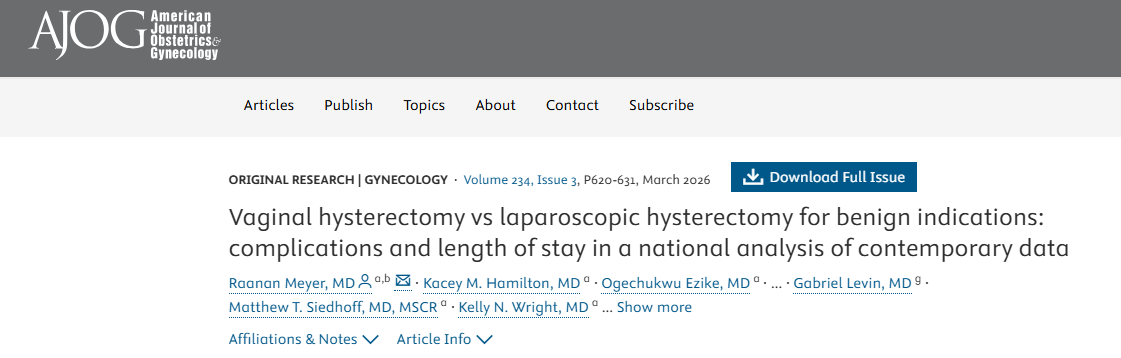
Which is truly superior—classic vaginal or modern laparoscopic? A pivotal 2026 AJOG study, encompassing 83,436 propensity-score-matched cases drawn from nationwide U.S. real-world data (2012–2022), delivers a paradigm-shifting answer.
Study Design
• Database: ACS NSQIP (prospective, standardized data from 700+ hospitals)
• Period: 2012–2022
• Population: Elective surgery for benign indications
• Groups: VH vs. LH (including robotic-assisted), 1:1 propensity score matching (n = 41,718 per group)
• Exclusions: Abdominal hysterectomy, supracervical hysterectomy, laparoscopic-assisted vaginal hysterectomy (LAVH), emergent cases, malignancy
• Primary Outcome: 30-day postoperative complications (Clavien-Dindo classification)
• Secondary Outcomes: Operative time, overnight hospitalization, length of stay
Key Results
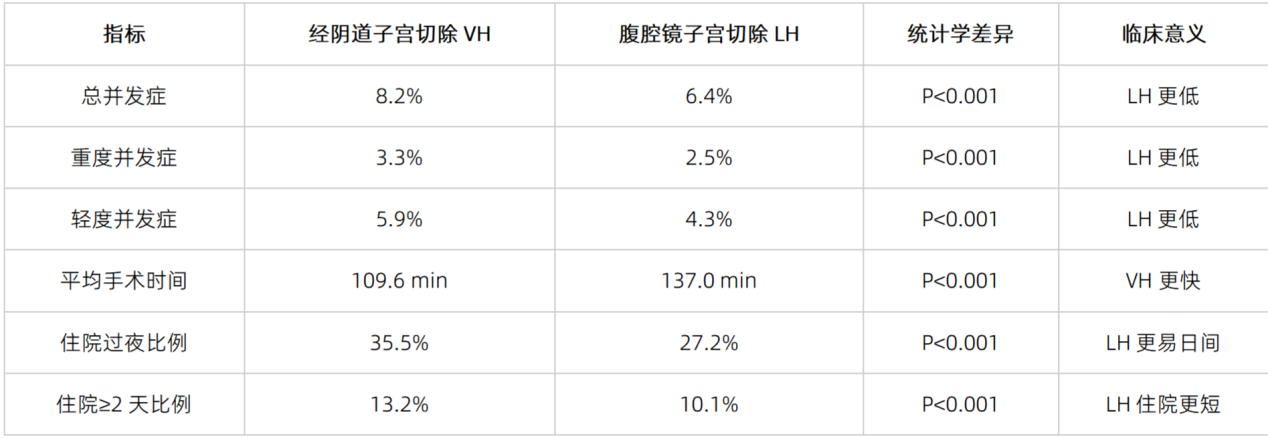
1. Primary Outcome Comparison (Overall Complications / Recovery)
2. Risk of Specific Complications

3. Key Results After Multivariable Adjustment
[Image 4.png]
Clinical Implications: Moving Beyond the “One-Size-Fits-All” Recommendation
1. Outdated Guidelines Need Updating
• Traditional View: Prioritize vaginal route whenever technically feasible.
• Contemporary Big Data: LH is associated with fewer complications and faster recovery, performing no worse than VH.
• Conclusion: VH should no longer be the unconditional “first choice.”
2. Recommendations for Surgical Route Selection

3. Guiding Principle
Avoid dogmatism and pathocentric decision-making. Embrace individualized care by considering:
• Uterine size
• Comorbidities and patient risk factors
• Surgical indication (e.g., prolapse, myoma, abnormal bleeding)
• Surgeon experience and available technology
• Shared decision-making between physician and patient
Strengths and Limitations
1. Strengths
• Very large sample size (n = 83,436), ensuring robust statistical power
• 1:1 propensity score matching for balanced baseline characteristics
• Contemporary dataset reflecting current laparoscopic standards
• Homogeneous cohort limited to elective benign cases
• Standardized Clavien-Dindo complication grading
2. Limitations
• 30-day follow-up only; lacks long-term outcomes
• Robotic and conventional laparoscopy not analyzed separately
• No data on surgeon experience, annual case volume, or cost-effectiveness
• Observational design inherently susceptible to selection bias
Summary
1. Both VH and LH are safe, low-complication minimally invasive options for benign hysterectomy.
2. LH is associated with lower overall complications, shorter hospital stays, and enhanced recovery.
3. VH offers shorter operative times and remains ideal for select cases.
4. The blanket mantra “vaginal whenever feasible” should be retired in favor of individualized selection.
5. Clinical guidelines must evolve alongside contemporary high-quality data, emphasizing precision and personalized surgical pathways.
Clinical medicine is ever advancing. Yesterday’s “gold standard” must be continuously validated—and, when necessary, revised—by today’s big data. For benign hysterectomy, the vaginal route is no longer the sole optimal choice, nor is laparoscopy merely a secondary alternative. Safety, efficacy, and suitability to the individual patient define true surgical excellence.
Source: Meyer R, Hamilton K, Ezike O, et al. Vaginal hysterectomy vs laparoscopic hysterectomy for benign indications: complications and length of stay in a national analysis of contemporary data. American Journal of Obstetrics & Gynecology. 2025;234:620-631.
This article is intended for medical professionals for academic discussion only and does not constitute clinical practice guidance. Clinical decisions must integrate individual patient factors, institutional resources, and current guidelines, with multidisciplinary consultation when appropriate.
Editor: Lily