





















Guideline Update: Interpretation of the NCCN Clinical Practice Guidelines in Oncology (Gestational Trophoblastic Neoplasia, Version 2.2026)
Gestational trophoblastic disease (GTD) represents a unique spectrum of highly curable gynecologic tumors, ranging from benign hydatidiform mole to malignant gestational trophoblastic neoplasia (GTN). Characterized by diverse subtypes and nuanced stratification, its management continues to evolve with emerging evidence. On November 21, 2025, the National Comprehensive Cancer Network (NCCN) released the NCCN Clinical Practice Guidelines in Oncology: Gestational Trophoblastic Neoplasia (Version 2.2026). Compared to the 2025.V2 version, this update introduces landmark revisions across four key areas: post-hydatidiform mole surveillance, surgical indications for low-risk GTN, management of high-risk brain metastases, and prognostic stratification of intermediate trophoblastic tumors. This article systematically reviews all updates based on the official text, algorithms, and change summaries, dissecting the underlying evidence and offering practical recommendations tailored to the Chinese clinical context to facilitate rapid adoption of standardized diagnostic and therapeutic logic among obstetrician-gynecologists and gynecologic oncologists.
I. Major Updates in Hydatidiform Mole (HM) Management
1. Integration of Standardized Distress Screening
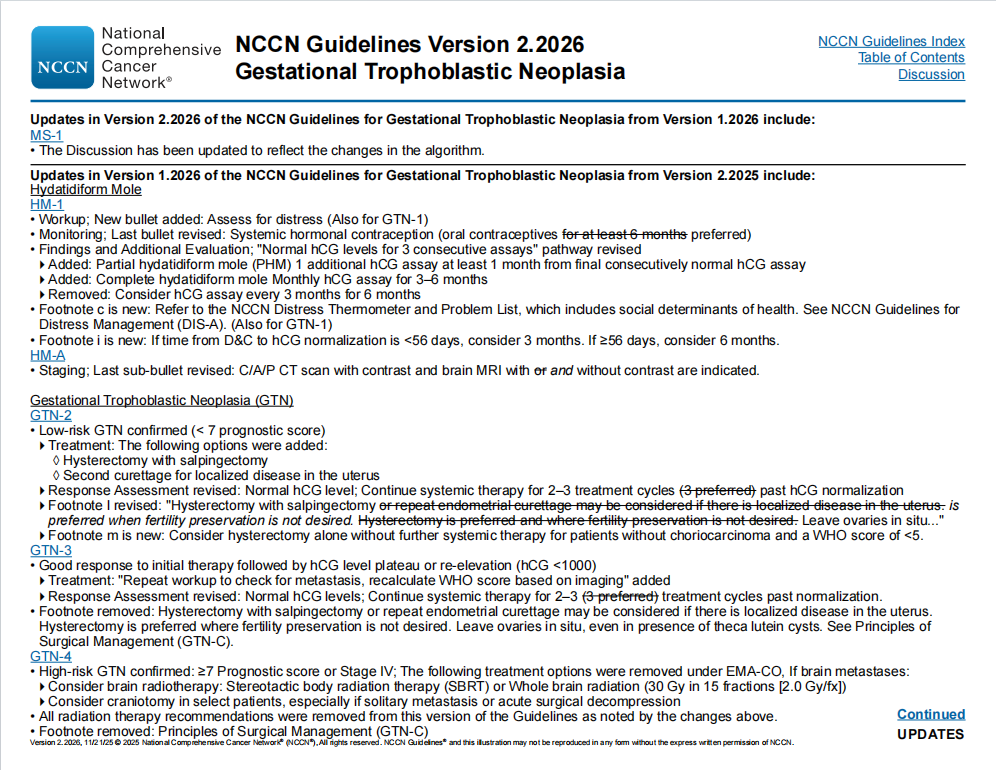
A mandatory assessment has been added to HM-1 and GTN-1 algorithms. Psychological screening using the NCCN Distress Thermometer is now required at initial diagnosis for both HM and GTN, incorporating social determinants of health. Psychological support is formally integrated into the continuum of cancer care.
2. Individualized hCG Surveillance (Core Evidence-Based Revision)
The previous fixed surveillance schedule has been abolished. Management is now stratified based on the time to hCG normalization following uterine evacuation. Baseline monitoring remains consistent: serum hCG every 1–2 weeks until three consecutive normal values are obtained. Oral combined contraceptives are preferred to suppress endogenous LH and prevent interference with low-level hCG interpretation; intrauterine devices are discouraged.
• Partial Hydatidiform Mole (PHM): Following three normal values, one final hCG test ≥1 month later concludes surveillance.
• Complete Hydatidiform Mole (CHM) Stratification (New Footnote i):
◦ Time to normalization <56 days: Monthly surveillance for 3 months.
◦ Time to normalization ≥56 days: Monthly surveillance for 6 months.
3. Clarification of PHM Diagnostic Gold Standard (New Footnote a in GTN-A)
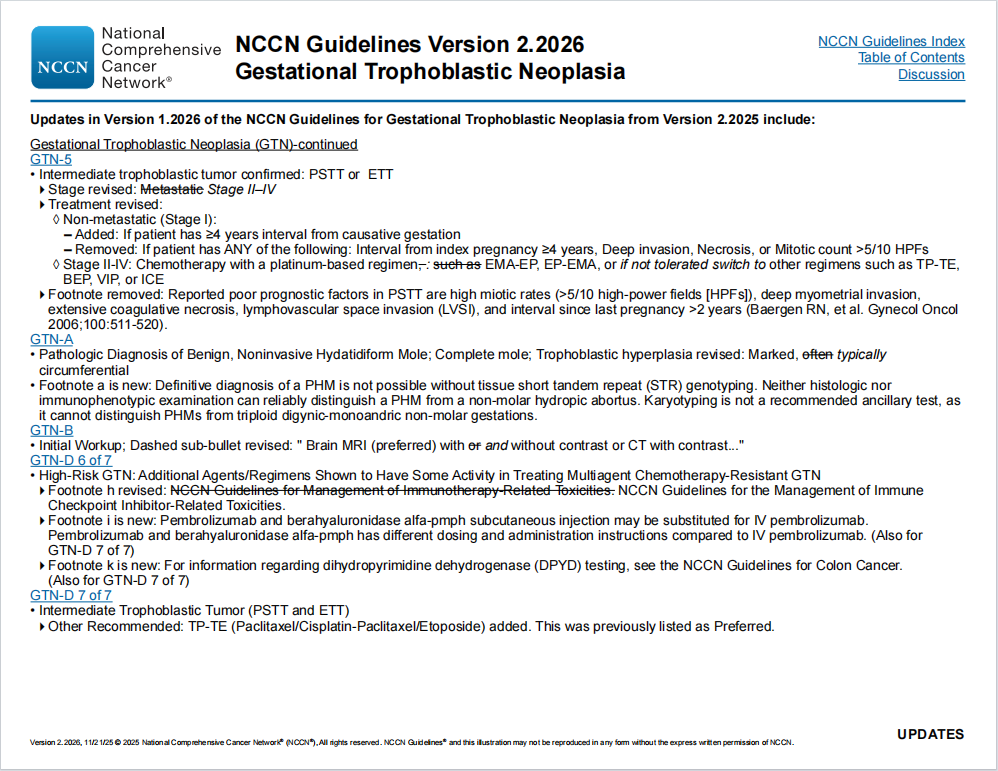
Histomorphology and p57 immunohistochemistry (IHC) alone are insufficient to distinguish PHM from hydropic abortus; karyotyping offers no discriminatory value. Short Tandem Repeat (STR) genotyping is the sole definitive diagnostic tool for PHM. In resource-limited primary care settings lacking STR capability, pathology plus IHC may serve as initial screening, with suspicious cases referred to tertiary centers for genetic testing. The pathological description for CHM is standardized: "marked, typical circumferential diffuse trophoblastic hyperplasia."
4. Diagnosis and Management of Post-Molar GTN (HM-2)
Post-molar GTN is diagnosed if any criterion is met:
① Four hCG values plateauing over 3 weeks;
② Three hCG values rising ≥10% over 2 weeks;
③ Pathological confirmation of choriocarcinoma/PSTT/ETT;
④ Radiographic evidence of extrauterine metastasis.
For patients without extrauterine disease and a FIGO score ≤4, options include repeat suction curettage, total hysterectomy with bilateral salpingectomy, or single-agent chemotherapy.
II. Expanded Management of Low-Risk GTN (FIGO Score <7)
1. Addition of Two Surgical Options as First-Line Therapy (Update to GTN-2)
Beyond traditional single-agent chemotherapy, surgery is now listed as an equally recommended first-line option:
1. Total Hysterectomy with Bilateral Salpingectomy: Preferred for patients desiring no future fertility; ovarian conservation is routine even with theca-lutein cysts.
2. Repeat Suction Curettage: Indicated for patients with localized uterine disease, preserved fertility desires, and low hCG burden.
New Recommendation (Footnote m): For patients without choriocarcinoma pathology, WHO score <5, and disease confined to the uterus, hysterectomy alone suffices without adjuvant chemotherapy.
2. Chemotherapy Regimens and Consolidation Cycles
Category 1 preferred single agents: 5-day methotrexate (MTX), 8-day MTX with leucovorin rescue, and 5-day actinomycin D. Weekly single-dose MTX is no longer a preferred regimen.
Consolidation therapy requires 2–3 cycles post-normalization (3 cycles preferred). The previous mandate for exactly 3 cycles has been removed, allowing individualization based on tolerance and tumor burden.
3. Management of Chemotherapy Resistance (GTN-3)
hCG must be reassessed every 2 weeks for response.
• Low-grade Resistance (hCG <1000, minimal fluctuation/plateau): Perform comprehensive imaging (chest/abdomen/pelvis/brain), recalculate prognostic score, switch to an alternative single agent, and consider combined uterine surgery.
• High-grade Resistance (hCG ≥1000, rising trend, refractory to multiple cycles): Transition directly to EMA-CO combination chemotherapy and evaluate for surgical resection of resistant foci.
III. Landmark Revisions in High-Risk GTN (FIGO ≥7 / Stage IV)
1. Complete Removal of Brain Radiotherapy Recommendations
All references to whole-brain radiotherapy and stereotactic body radiotherapy (SBRT) have been removed from GTN-4. Only emergent craniotomy for decompression is retained for intracranial hemorrhage, herniation, or acute intracranial hypertension; elective radiotherapy for brain metastases is no longer recommended.
2. Modified EMA-CO for Brain Metastases
For patients with brain metastases, the MTX dose in the EMA-CO regimen is escalated to 1000 mg/m² via a 24-hour continuous infusion, coupled with increased frequency of leucovorin rescue. Systemic chemotherapy is now the mainstay of treatment, eliminating the routine use of radiotherapy.
3. First-Line and Salvage Chemotherapy Framework
1. Standard First-Line: EMA-CO regimen. For scores >12, extensive metastases, or high risk of tumor lysis/hemorrhage, initiate 1–3 cycles of low-dose EP induction before transitioning to EMA-CO.
2. Relapse/Low-Level Plateau after EMA-CO: Preferred alternatives include alternating EMA-EP or EP-EMA.
3. Multi-Line Platinum-Based Salvage: Options include TP-Te, BEP, VIP, and ICE.
4. Immunotherapy Updates: Subcutaneous pembrolizumab is added (differing in dosing/schedule from IV formulation). DPYD gene testing is now recommended prior to capecitabine use to mitigate severe fluoropyrimidine toxicity. Refractory cases may utilize nivolumab ± ipilimumab.
4. Surveillance
Isolated pulmonary metastases do not require long-term radiographic surveillance. Patients with brain metastases require serial enhanced brain MRI every 2–3 years.
IV. Revised Stratification for Intermediate Trophoblastic Tumors (PSTT/ETT)
1. Simplified High-Risk Criteria for Stage I Disease (Core Change in GTN-5)
Previous risk factors (deep myometrial invasion, necrosis, high mitotic index, pregnancy interval ≥2 years) are deleted. The sole adverse prognostic factor is now pregnancy interval ≥4 years:
• Interval <4 years: Total hysterectomy with bilateral salpingectomy ± pelvic lymph node biopsy; postoperative surveillance only, no adjuvant chemotherapy required.
• Interval ≥4 years: Postoperative platinum-based combination chemotherapy is mandatory.
2. Management of Metastatic Stages II–IV
Complete surgical resection of the primary tumor and resectable metastases, combined with platinum-based chemotherapy. Preferred regimens: EMA-EP or EP-EMA; BEP, VIP, or ICE if intolerant; TP-Te is downgraded to "other recommended" status.
3. Dedicated Surveillance
PSTT/ETT often secrete low levels of hCG, rendering it an unreliable marker. Baseline post-chemotherapy evaluation requires whole-body FDG-PET/CT, followed by repeat scans every 6–12 months for 2–3 years.
V. Ancillary Updates: Pathology, Imaging, Surgery, and Chemotherapy
1. Pathology Principles (GTN-A)
Standardized IHC panel for differentiation: GATA-3 as a universal trophoblast marker. PSTT: Mel-CAM (+), hPL (+). ETT: p63, Cyclin E overexpression. Choriocarcinoma: Strong β-hCG positivity. STR genotyping remains the gold standard for PHM.
2. Imaging Protocols (GTN-B)
Baseline staging for GTN: Contrast-enhanced CT (Chest/Abdomen/Pelvis) + Contrast-enhanced Brain MRI (preferred). HM requires only chest X-ray initially; upgrade to full staging if X-ray is suggestive of metastasis. PSTT/ETT follow-up relies on PET/CT.
3. Surgical Principles (GTN-C)
Systemic chemotherapy remains the curative foundation; hysterectomy is not obligatory. Indications include: low-risk patients desiring no fertility, isolated chemorefractory disease, acute hemorrhage, and neurologic emergencies. Ovarian preservation is routine.
4. Pharmaceutical Principles (GTN-D)
Routine G-CSF prophylaxis is recommended for all etoposide-platinum combinations. Official recommendations now include subcutaneous PD-1 administration and DPYD toxicity screening. Dosing aligns strictly with the official NCCN tables.
VI. Long-Term Survivorship Care (GTN-E)
Addresses chronic sequelae including surgical adhesions, pelvic floor dysfunction, chemotherapy-induced neurotoxicity/cardiotoxicity, treatment-related premature menopause, osteoporosis, and secondary malignancies. Routine screening for anxiety and depression is mandated, with referrals to specialists (pelvic floor, sexual medicine, psychology) as needed. Subsequent pregnancy management: Early ultrasound to confirm intrauterine location; send placenta for pathology; check hCG 6 weeks postpartum. Individualized long-term survivorship care plans are recommended for all patients.
VII. Practical Tips for Clinical Application in China
1. STR Genotyping: Limited availability in primary care necessitates initial screening via pathology + p57 IHC, reserving STR for referral centers.
2. Brain Metastases: While NCCN 2026.V2 removes radiotherapy and intrathecal (IT) MTX, domestic centers with established experience in EMA/FAEV + IT MTX may continue based on institutional expertise.
3. PSTT Staging: Adopting the 4-year interval simplifies risk stratification and avoids overtreatment, though cases with deep myometrial or vascular invasion warrant intensified imaging surveillance.
4. Immunotherapy: As subcutaneous PD-1 formulations are not yet widely available domestically, intravenous immune checkpoint inhibitors remain the priority for multi-drug resistant disease.
VIII. Conclusion
The NCCN GTN 2026.V2 guidelines represent a systematic evolution toward precision stratification, de-escalation of therapy, and holistic biopsychosocial management. Key advancements include individualized hCG surveillance for hydatidiform moles, expanded surgical eligibility for low-risk GTN to spare patients from chemotherapy, the abandonment of routine radiotherapy for brain metastases in favor of high-dose systemic MTX, and simplified PSTT risk stratification. The integration of STR genotyping, DPYD testing, subcutaneous immunotherapy, and routine distress screening further refines care. Clinicians should judiciously balance these international standards with local drug availability and domestic clinical experience to advance the standardized, individualized management of GTD in China.
Source: National Comprehensive Cancer Network. NCCN Clinical Practice Guidelines in Oncology: Gestational Trophoblastic Neoplasia, Version 2.2026 [EB/OL]. (2025-11-21)[2026-07-03].
Disclaimer: This content is intended for medical professionals for educational purposes only and should not be used as a sole basis for clinical decisions. Clinical practice must integrate patient-specific factors, institutional capabilities, and the latest clinical guidelines. Multidisciplinary consultation is advised when necessary.
Editor: Lily