





















Expectant mothers often express significant anxiety regarding postoperative pain following cesarean delivery. Moderate to severe pain can disrupt rest, breastfeeding, and early mobilization, while increasing the risk of complications such as venous thromboembolism, chronic pain, and postpartum depression, ultimately prolonging hospital stays [1]. Consequently, optimizing postoperative analgesia protocols is paramount. Multimodal analgesia stands as the cornerstone of post-cesarean pain management. By combining analgesics with different mechanisms of action, this approach minimizes opioid consumption while maximizing pain relief. Drawing upon the latest 2026 guidelines from the PROSPECT Working Group of the European Society of Regional Anaesthesia & Pain Therapy (ESRA) [2], UpToDate [3], and other relevant literature, this article synthesizes pharmacological and non-pharmacological strategies for elective cesarean sections to provide clinical guidance.
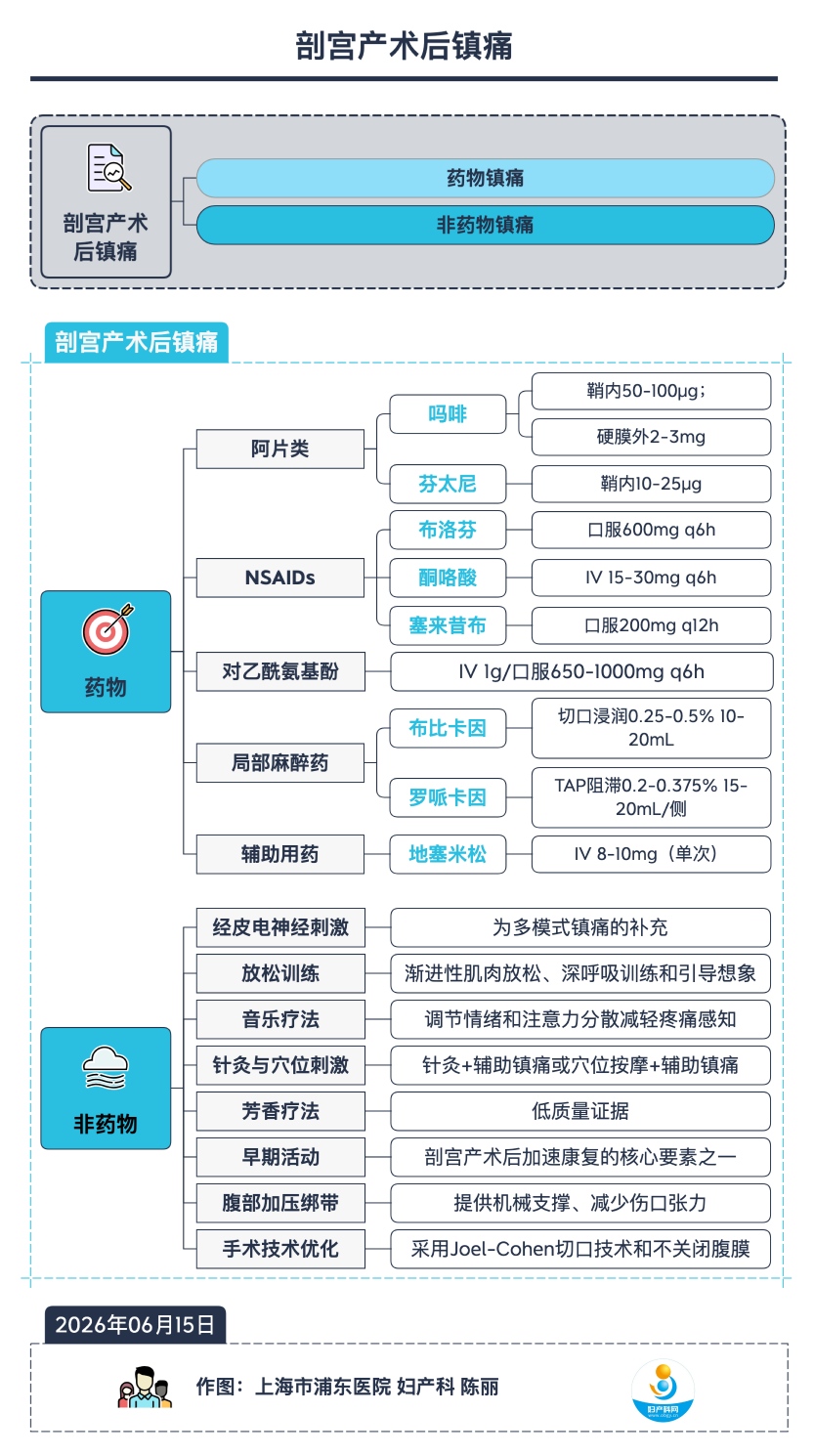
Pharmacological Analgesia
I. Non-Opioid Baseline Analgesics
01. Acetaminophen
Acetaminophen serves as a foundational drug in multimodal analgesia. Its mechanism involves central prostaglandin synthesis inhibition and modulation of descending pain pathways.
• Regimen: Intravenous 1g administered intraoperatively, followed by oral or IV doses of 650–1000 mg every 6 hours postoperatively. The maximum daily dose is 3–4 g [1].
• Notes: It boasts a high safety profile and is safe during breastfeeding. When combined with NSAIDs, it produces a synergistic effect, significantly lowering pain scores and reducing opioid requirements [3]. Clinically, failure to maintain consistent scheduled dosing often compromises overall analgesic efficacy.
02. Non-Steroidal Anti-Inflammatory Drugs (NSAIDs)
NSAIDs are pivotal in post-cesarean analgesia. They inhibit cyclooxygenase (COX), thereby reducing prostaglandin synthesis, effectively alleviating visceral and inflammatory pain.
• Regimen: Following hemostasis confirmation intraoperatively, administer IV ketorolac 15–30 mg (15 mg recommended for patients weighing <50 kg). Postoperatively, continue with oral ibuprofen 600 mg every 6 hours, or IV ketorolac 15 mg every 6 hours for 48–72 hours [1].
• Clinical Note: While diclofenac suppositories are sometimes referred to as "miracle drugs" for post-cesarean pain due to their efficacy, oral formulations are generally preferred for ease of administration and patient convenience.
• Precautions:
◦ Hypertension: In patients with preeclampsia or gestational hypertension, NSAIDs may elevate blood pressure. While not an absolute contraindication per the 2020 ACOG Practice Bulletin [4], close blood pressure monitoring is required.
◦ Bleeding Risk: Current evidence indicates that ketorolac does not increase perioperative bleeding risk [5].
◦ Lactation: NSAIDs are safe during breastfeeding due to negligible concentrations in breast milk [6].
• Selective COX-2 Inhibitors: Agents like celecoxib (200–400 mg every 12 hours) remain controversial regarding efficacy and are not yet widely adopted [1].
03. Dexamethasone
The 2026 updated PROSPECT guidelines have elevated dexamethasone to a baseline analgesic status, placing it alongside acetaminophen and NSAIDs [2]. Beyond its significant opioid-sparing effect, it effectively mitigates postoperative nausea and vomiting (PONV) without increasing the risk of surgical site infections or compromising breastfeeding safety.
• Regimen: Administer 8–10 mg IV immediately after fetal delivery, supplemented by scheduled acetaminophen and NSAIDs.
II. Opioids
Opioids remain central to managing moderate-to-severe postoperative pain, delivered via neuraxial or systemic routes.
01. Hydrophilic Opioids
(1) Morphine
• Intrathecal (IT) Morphine: This is the preferred regimen. A dose of 50–100 µg provides 12–24 hours of analgesia and is a Grade A recommendation by both PROSPECT [2] and the SOAP ERAC consensus [7]. Doses exceeding 100 µg do not improve analgesia but significantly increase the incidence of pruritus and nausea [2].
• Epidural Morphine: A dose of 2–3 mg offers a duration of analgesia comparable to intrathecal administration.
(2) Hydromorphone
• Dose: IT: 50–75 µg; Epidural: 0.4–1 mg [1].
(3) Diamorphine (Heroin)
• Note: A prodrug with no intrinsic opioid activity; it is rapidly hydrolyzed by esterases in neural tissue to active metabolites (primarily morphine).
• Dose: IT: 300–400 µg; Epidural: 2.5–5 mg [1].
02. Lipophilic Opioids
These agents are typically added to intrathecal local anesthetics to enhance intraoperative analgesia. Due to their short duration of action, they are ineffective for sustained postoperative analgesia.
• Fentanyl: IT dose: 10–25 µg.
• Sufentanil: IT dose: 2.5–10 µg.
03. Intravenous Patient-Controlled Analgesia (IV PCA)
Common agents include morphine, fentanyl, sufentanil, tramadol, and flurbiprofen axetil. While PCA allows patients to self-titrate analgesia, it carries a higher risk of systemic side effects compared to neuraxial routes, including sedation, PONV, and delayed gastrointestinal recovery.
• Note: The 2023 Chinese Expert Consensus on Cesarean Section does not recommend epidural infusion pumps as a routine analgesic regimen.
III. Regional Nerve Blocks
The 2026 PROSPECT guidelines specify that nerve blocks or wound infiltration should only be considered if long-acting neuraxial opioids are not utilized. The choice of technique—such as incisional infiltration, Transversus Abdominis Plane (TAP) block, Quadratus Lumborum (QL) block, Erector Spinae Plane (ESP) block, or Ilioinguinal-Iliohypogastric (IIH) block—should be based on the anesthesiologist's expertise and patient factors [2].
Non-Pharmacological Analgesia
Non-pharmacological interventions are vital components of multimodal analgesia, reducing reliance on medications and promoting functional recovery. Although many interventions have lower evidence grades than pharmaceuticals, they offer high safety profiles and ease of implementation as adjuncts [2, 8–14].
01. Transcutaneous Electrical Nerve Stimulation (TENS)
TENS activates endogenous analgesic systems via low-frequency electrical currents. It serves best as a supplement within a multimodal regimen rather than a standalone therapy.
02. Relaxation Training
Techniques include progressive muscle relaxation, deep breathing exercises, and guided imagery. These require no special equipment and can be nurse-led, though current evidence is of low quality.
03. Music Therapy
By modulating mood and diverting attention, music therapy reduces pain perception. It is inexpensive, easy to implement, and free of adverse effects (Low-quality evidence).
04. Acupuncture and Acupressure
When used as an adjunct to standard analgesia, acupuncture or acupressure may reduce VAS scores at 12 and 24 hours post-op. However, Cochrane reviews rate the overall evidence quality as low [8]; safety is well-established.
05. Aromatherapy
As an adjunct to analgesia, aromatherapy may decrease postoperative VAS scores at 12 and 24 hours (Low-quality evidence).
06. Early Mobilization
A core component of Enhanced Recovery After Cesarean (ERAC) pathways. Early mobilization promotes gastrointestinal recovery, reduces DVT risk, and shortens hospitalization.
07. Abdominal Binders
Newly recommended in the 2026 PROSPECT guidelines. Binders provide mechanical support, reducing wound tension and facilitating early ambulation.
08. Surgical Technique Optimization
PROSPECT recommends the Joel-Cohen incision and non-closure of the peritoneum. These minimally invasive techniques are associated with reduced postoperative pain, shorter operative times, and faster recovery.
Conclusion
Post-cesarean pain management should adhere to multimodal principles, integrating pharmacological and non-pharmacological strategies. The core protocol includes:
1. Scheduled acetaminophen and NSAIDs as baseline therapy.
2. Neuraxial opioids (Intrathecal Morphine 50–100 µg) as the primary regional analgesic.
3. Intraoperative IV Dexamethasone (8–10 mg).
4. Regional blocks (TAP/QL) or wound infiltration if neuraxial opioids are contraindicated.
5. Oral opioids reserved strictly for rescue analgesia.
6. Adjuncts: TENS and abdominal binders; Early mobilization is strongly recommended. TENS, relaxation training, music therapy, and acupuncture serve as supplementary options.
7. Minimally invasive surgery: Utilizing the Joel-Cohen incision and non-closure of the peritoneum.
Important Considerations: Recommendations from the PROSPECT guideline apply specifically to elective cesareans under neuraxial anesthesia and should not be extrapolated to emergency cases or those performed under general anesthesia. Clinicians must tailor protocols based on individual patient status and local pharmaceutical availability.
References:
1. Carvalho B, Sutton CD. Post-cesarean delivery analgesia. UpToDate. 2026. https://www.uptodate.com/contents/post-cesarean-delivery-analgesia
2. Crowe G, Atterton B, et al. Pain management after elective caesarean section under neuraxial anaesthesia: an updated systematic review and procedure-specific postoperative pain management (PROSPECT) recommendations. Anaesthesia. 2026;81(6):819-839.
3. Ong CK, Seymour RA, Lirk P, Merry AF. Combining paracetamol with NSAIDs: a qualitative systematic review. Anesth Analg. 2010;110:1170.
4. ACOG Practice Bulletin No. 222: Gestational Hypertension and Preeclampsia. Obstet Gynecol. 2020;135:e237. Reaffirmed 2023.
5. Gobble RM, et al. Ketorolac does not increase perioperative bleeding: a meta-analysis. Plast Reconstr Surg. 2014;133:741.
6. Bloor M, Paech M. NSAIDs during pregnancy and lactation. Anesth Analg. 2013;116:1063.
7. Bollag L, et al. SOAP Consensus Statement for Enhanced Recovery After Cesarean. Anesth Analg. 2021;132:1362.
8. Zimpel SA, et al. Complementary therapies for post-caesarean pain. Cochrane Database Syst Rev. 2020;9:CD011216.
9. Li M, et al. Meta-analysis of non-pharmacological interventions for post-cesarean pain. Chin J Evid Based Nurs. 2025;11(14):2813-2817. (In Chinese)
10. Wilson RD, et al. ERAS Guidelines Part 1: Antenatal and Preoperative Care. Am J Obstet Gynecol. 2026;233(6S):S153-S169.
11. Caughey AB, et al. ERAS Guidelines Part 2: Intraoperative Care. Am J Obstet Gynecol. 2026;233(6S):S170-S183.
13. Sultan P, et al. ERAS Guidelines Part 3: Postoperative Care. Am J Obstet Gynecol. 2026;233(6S):S184-S198.
14. Anesthesia Committee of China Maternal and Child Health Association. Expert consensus on enhanced recovery after cesarean anesthesia. Chin J Clin Physicians. 2022;57(7):717-722. (In Chinese)
Author Bio

Source: Provided by the author.
Editor: Lily