





















Hypertensive Disorders of Pregnancy (HDP) are one of the most common obstetric complications, including gestational hypertension, preeclampsia-eclampsia, chronic hypertension with superimposed preeclampsia and other subtypes. Its hazards are not limited to the gestational period; risks such as blood pressure fluctuations, postpartum eclampsia attacks, multi-organ injuries and long-term cardiovascular diseases persist after delivery. Therefore, close attention shall be paid after childbirth, and standardized postpartum management can effectively reduce short-term and long-term complications.
I. Routine Postpartum Management of Hypertensive Disorders of Pregnancy
1. Vital Sign Monitoring
Within 72 hours after delivery, blood pressure shall be closely monitored at least 4 to 6 times daily, and blood pressure measurement shall also be conducted during the 6-week postpartum follow-up visit. If severe hypertension is detected (systolic blood pressure ≥160 mmHg and/or diastolic blood pressure ≥110 mmHg), re-measurement shall be performed within 15 minutes.
2. Key Symptom Observation
Observe patients for epigastric pain, headache, chest tightness, dyspnea, visual disturbances and other manifestations, and stay alert to critical conditions such as postpartum HELLP syndrome and postpartum eclampsia.
3. Auxiliary Examinations
Review blood routine, liver and kidney function, electrolytes, coagulation function, urine routine/24-hour urinary protein quantification within 24 hours after delivery. For patients receiving magnesium sulfate therapy, repeat laboratory tests daily (pay attention to indicators including platelet count, serum creatinine and liver transaminase) until two consecutive complete sets of test results return to normal or trend toward normal. Severe patients shall additionally undergo myocardial enzyme test, electrocardiogram; cardiac ultrasound, fundus examination and abdominal ultrasound may be performed when necessary to dynamically assess organ involvement.
4. Prevention and Treatment of Postpartum Hemorrhage
Follow routine delivery protocols; misoprostol and ergometrine are contraindicated.
5. Fluid Infusion Control
Fluid infusion volume shall be restricted in preeclampsia patients to avoid pulmonary edema. Volume expansion therapy is generally not recommended unless severe fluid loss (e.g., vomiting, diarrhea, massive delivery hemorrhage) causes significant hemoconcentration, relative hypovolemia or hypercoagulable state. Total fluid intake during labor shall be limited to approximately 80 mL/h. Infusion volume shall be adjusted appropriately according to postpartum blood loss; blind volume expansion is prohibited. Negative fluid balance shall be maintained in postpartum intake and output. In the absence of significant blood loss, 24-hour infusion volume shall be controlled within 1000 mL with an infusion rate not exceeding 40 mL/h.
II. Pharmacotherapy
Blood pressure may drop rapidly or even return to normal after delivery, followed by a subsequent rise, peaking on postpartum day 3–6, and may be markedly higher during puerperium than antepartum or intrapartum levels. A prospective study indicated that blood pressure peaks on postpartum day 5–7, then declines rapidly until day 14, followed by slow decline or stabilization until postpartum day 42.
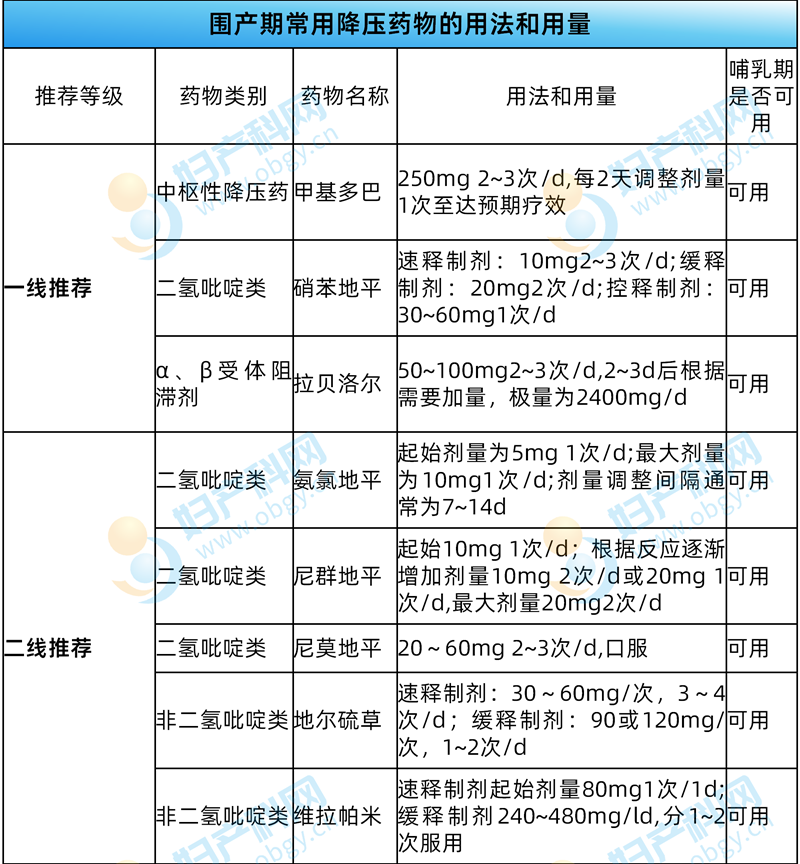
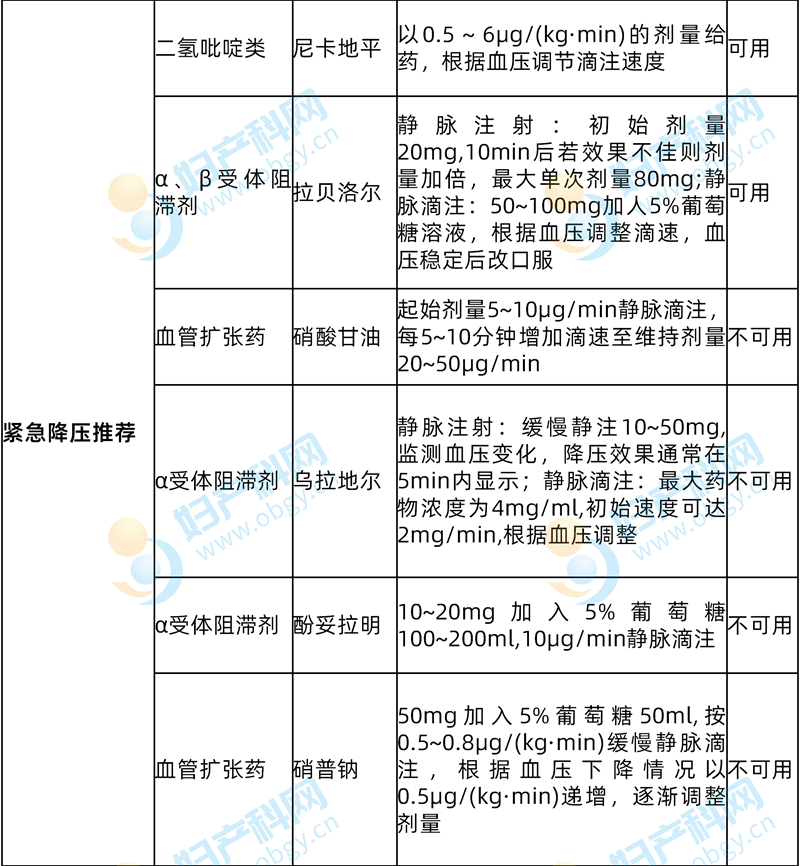
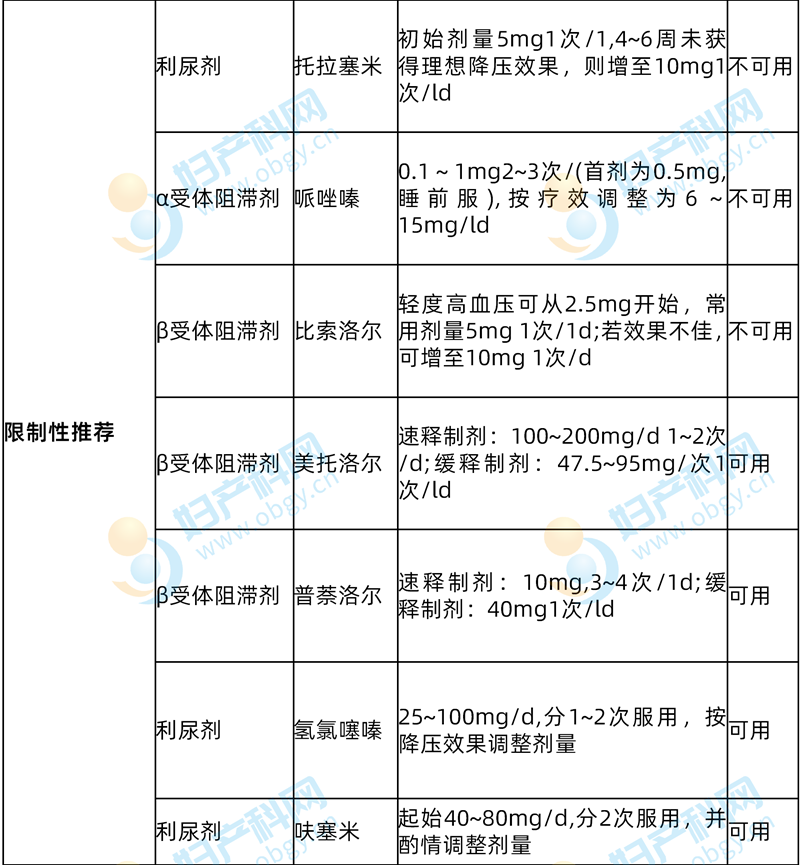
The proportion of patients requiring antihypertensive drugs to maintain blood pressure <140/90 mmHg at postpartum week 6 varies by disease type: chronic hypertension (60%), severe preeclampsia (33%), mild preeclampsia (24%), gestational hypertension (16%). For peripartum patients including postpartum women, systolic blood pressure ≥140 mmHg or diastolic blood pressure ≥90 mmHg is recommended as the indication for peripartum antihypertensive treatment. Target blood pressure is controlled below 135/85 mmHg but not lower than 110/70 mmHg. The table below summarizes the dosage and administration of common peripartum antihypertensive drugs recommended in Chinese guidelines.
III. Emergency Blood Pressure Reduction During Pregnancy
- Emergency blood pressure reduction is recommended when sustained systolic blood pressure ≥160 mmHg or sustained diastolic blood pressure ≥110 mmHg occurs during pregnancy, to rapidly lower blood pressure to a safe range.
- For patients without prior antihypertensive medication, oral nifedipine or equivalent alternative agents (labetalol, nitrendipine, etc.) are preferred; repeated administration may be performed 10–20 minutes later based on blood pressure response. If blood pressure remains poorly controlled after 3 repeated doses, switch to intravenous antihypertensive regimens.
- Intravenous labetalol, urapidil, nicardipine, nitroglycerin and phentolamine are recommended for emergency blood pressure reduction when oral antihypertensives fail to control blood pressure or severe complications require urgent intervention; these agents are safe for fetuses. Among them, labetalol and nicardipine are compatible with breastfeeding, while urapidil, nitroglycerin and phentolamine are contraindicated during lactation.
IV. Postpartum Adjustment of Antihypertensive Drugs
- Postpartum antihypertensive regimens shall be adjusted according to the severity of target organ damage and breastfeeding status.
- Calcium channel blockers (e.g., nifedipine, diltiazem, amlodipine) are recommended as first-line agents for postpartum patients with new-onset hypertension or poorly controlled blood pressure. If monotherapy fails to achieve adequate control, combination therapy with labetalol, methyldopa or Angiotensin-Converting Enzyme Inhibitors (ACEIs) (e.g., captopril, enalapril) is advised. Cardiology consultation shall be arranged for patients with refractory hypertension or wide blood pressure fluctuations to guide individualized antihypertensive regimens.
- Artificial feeding is recommended for postpartum women receiving Angiotensin II Receptor Antagonists (ARBs).
- Methyldopa is contraindicated for patients with postpartum depression or high risk of depression.
V. Postpartum Application of Magnesium Sulfate
- Magnesium sulfate therapy is generally continued until 24 hours after delivery. For patients with severe preeclampsia or eclampsia, seizure prophylaxis shall be maintained for 24–48 hours postpartum, after which the risk of seizure recurrence is low. Magnesium sulfate may be safely discontinued at 12 hours postpartum for patients with mild preeclampsia.
- Dosage adjustment for patients with renal insufficiency: Magnesium is excreted via the kidneys, and the volume of distribution remains unchanged in renal insufficiency. Standard loading doses are administered, followed by reduced maintenance doses. ACOG guidelines recommend a 4–6 g loading dose and a maintenance infusion rate of 1 g/h for patients with mild renal insufficiency (serum creatinine 1.0–1.5 mg/dL [88–133 μmol/L]) or oliguria (urine output <30 mL/h lasting more than 4 hours).
VI. Post-Discharge Management
All HDP patients shall receive routine examinations at postpartum week 6, as well as blood pressure measurement, urine routine and other laboratory tests at postpartum month 3. Pre-pregnancy body weight shall be restored within 12 months after delivery via healthy lifestyle weight management. All women with HDP require lifelong follow-up with annual physical examinations.
References
- UpToDate. Treatment of hypertension during pregnancy and the postpartum period.
- Chinese Association of 优生 Science. Early Identification of Obstetric Critical Illness Chinese Expert Consensus (2024 Edition)[J]. Chinese Journal of Practical Gynecology and Obstetrics, 2024, 40 (5): 526-534.
- UpToDate. Intrapartum, postpartum management and long-term prognosis of preeclampsia.
- Hypertensive Disorders of Pregnancy Subgroup, Society of Obstetrics and Gynecology, Chinese Medical Association. Guidelines for Diagnosis and Treatment of Hypertensive Disorders of Pregnancy (2020)[J]. Chinese Journal of Obstetrics and Gynecology, 2020, 55(4): 227-238.
- Lan Weiyi, Zheng Huirong, Yin Zhirong. Summary of Best Evidence on the Effect of Restrictive Fluid Management on Disease Control in Patients with Hypertensive Disorders of Pregnancy [J]. Contemporary Medical Symposium, 2025 (11):9-12.
- Society of Perinatal Medicine, Chinese Medical Association; Obstetrics Group, Society of Obstetrics and Gynecology, Chinese Medical Association. Clinical Application Management Guidelines for Peripartum Antihypertensive Drugs (2025)[J]. Chinese Journal of Perinatal Medicine, 2025, 28(9): 721-731. DOI: 10.3760/cma.j.cn113903-20250407-00175.
- Gestational Hypertension and Preeclampsia: ACOG Practice Bulletin, Number 222. Obstet Gynecol 2020; 135:e237. Reaffirmed 2023.
- Gou Weili, Xue Yan. International Guidelines for Hypertensive Disorders of Pregnancy and Clinical Practice in China[J]. Chinese Journal of Practical Gynecology and Obstetrics, 2017, 33(06): 559-563. DOI:10.19538/j.fk2017060103.
Author Profile

Editor-in-Charge: QinghuanReviewer: Ma Ye