





















Vaginitis is the most common infectious disease of the lower female genital tract, primarily including Vulvovaginal Candidiasis (VVC), Trichomonas Vaginitis (TV), Bacterial Vaginosis (BV), and Aerobic Vaginitis (AV). Among these, refractory recurrent cases pose significant clinical challenges. Furthermore, special physiological stages—such as pregnancy, lactation, and postmenopause—require therapeutic strategies that balance efficacy with safety due to altered physiological states. Based on domestic and international guidelines/expert consensus and evidence-based medicine, this article systematically reviews the principles, regimen selection, and precautions for managing common refractory and special-population vaginitis, providing a reference for standardized clinical practice.
Identification and Management of Refractory Recurrent Cases
01 Recurrent Vulvovaginal Candidiasis (RVVC)
RVVC is defined as four or more episodes of symptomatic, mycologically confirmed VVC within one year. Before treatment, clinicians should actively identify and correct high-risk factors for recurrence (e.g., uncontrolled diabetes, high-dose immunosuppressants, prolonged broad-spectrum antibiotics, high-dose estrogen contraceptives, tight synthetic underwear, obesity).
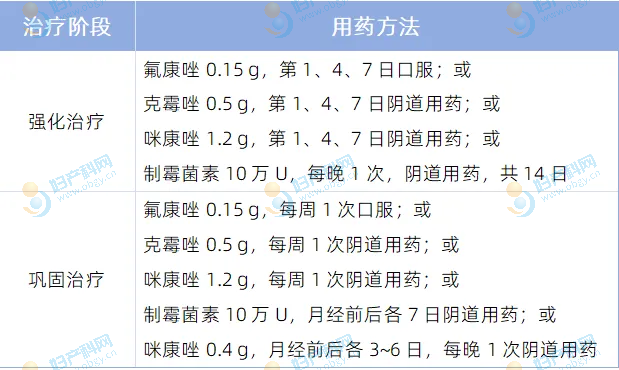
• Diagnosis: Vaginal fungal culture with sensitivity testing is recommended to identify species and resistance. Microbial ecology evaluation should exclude mixed infections.
• Principles: Treatment involves intensive induction followed by maintenance (consolidation) therapy.
• Regimens: According to the 2024 Chinese VVC Guidelines, consolidation therapy should last for 6 months after achieving mycological cure. For regular cyclical episodes, prophylactic medication is given pre-emptively; for irregular episodes, weekly medication is advised.
Alternative Consolidation Regimens:
If standard regimens fail, high-quality clinical trial data suggest the following alternatives:
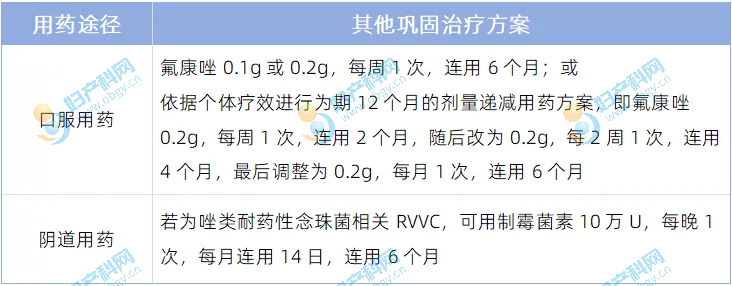
Regimen Type Dosage
Fluconazole 150 mg weekly for 6 months
Itraconazole 400 mg monthly for 6 months
Topical Azoles Weekly application for 6 months
New Agents (Oteseconazole):
The 2024 Guidelines note that new antifungal agents like Oteseconazole show efficacy in RVVC.
• Dosage: Day 1: 600 mg (4 caps); Day 2: 450 mg (3 caps); Week 2 (Day 14): 150 mg (1 cap); Weeks 3–12: 150 mg weekly.
• Warning: Informed consent is mandatory. Due to its extremely long half-life, it is strictly contraindicated in pregnancy or in patients planning pregnancy within the next 3 years.
02 Recurrent BV
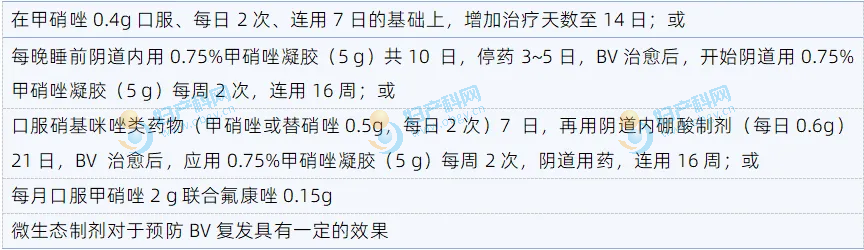
Currently, there is no universally accepted definition or optimal management protocol for recurrent BV. Management strategies include extended metronidazole regimens or combination therapies (see table below).
Strategy Dosage
03 Persistent TV
Persistent TV refers to treatment failure due to nitroimidazole resistance, inadequate absorption, or insufficient drug delivery. Re-infection must be excluded.
• First-line for failure: Tinidazole 2 g orally once daily for 7 days.
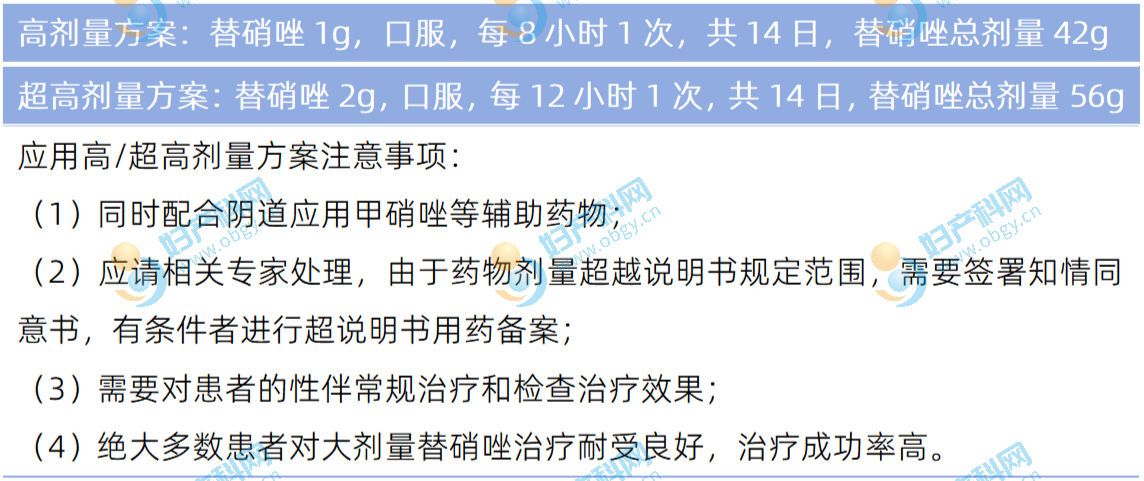
• Second-line (Resistance suspected): Perform susceptibility testing if available. Consider high-dose or ultra-high-dose regimens:
Regimen Dosage
High-Dose Metronidazole 2 g daily for 7 days
Ultra-High-Dose Metronidazole 2 g BID for 7 days
Pulsed Tinidazole 1 g BID for 5 days, repeated monthly for 3 cycles
04 Recurrent AV
As AV was only recognized in 2002, definitions for "recurrent AV" are still evolving.
• Management: Empiric antibiotics based on microscopy (targeting Gram-negative rods or Gram-positive cocci). Adjust based on culture/sensitivity if refractory.
• Adjunctive Therapy: Microecological preparations (lactobacillus supplements) can prolong recurrence intervals. Traditional Chinese Medicine (TCM) may offer gentler efficacy with less resistance.
Management Strategies for Special Populations
The principle for special physiological stages is Safety First, Benefit-Risk Assessment, and Individualized Therapy.
01 Pregnancy
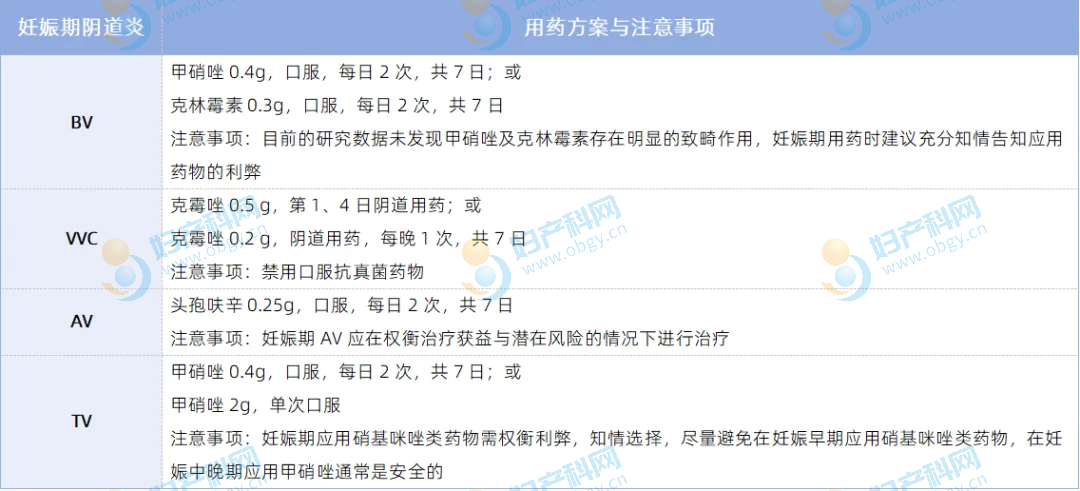
All symptomatic BV, VVC, and AV require treatment. Asymptomatic cases remain controversial, though high-risk patients (history of preterm birth, PPROM) should be treated. TV requires treatment regardless of symptoms.
Condition Recommended Regimens Contraindications/Warnings
02 Lactation
Regimens are similar to non-pregnant adults, but consider drug excretion into breast milk.
• Preference: Topical therapy.
• Precautions: If oral Metronidazole is required, suspend breastfeeding for 12–24 hours after the dose. For Tinidazole, suspend breastfeeding for 3 days.
03 Postmenopause
Characterized by Atrophic Vaginitis (part of the Genitourinary Syndrome of Menopause - GSM), presenting as dryness, burning, and dyspareunia.
• Principles: Increase vaginal resistance and inhibit pathogens.
• Hormonal: Vaginal estrogen (Estriol cream, Conjugated Estrogen ointment, Promestriene) is first-line, provided no contraindications exist (breast cancer, endometrial cancer, unexplained bleeding). Systemic MHT is an option if needed.
• Non-Hormonal: Vaginal moisturizers, lubricants, and microecological regulators.
• Note: If BV/VVC/TV/AV occur, standard regimens apply, but adjust oral doses for hepatic/renal function in elderly patients.
Conclusion
Managing refractory recurrent vaginitis requires pathogen-specific strategies, incorporating drug susceptibility testing, microecological restoration, and individualized protocols. For pregnant, lactating, and postmenopausal populations, safety and benefit-risk assessment are paramount. Clinicians must abandon blind empiricism, standardize workflows, remove high-risk triggers, and reconstruct the vaginal microecology. Off-label drug use requires strict informed consent procedures. By ensuring efficacy while controlling risks, we can effectively reduce the recurrence of vaginitis and improve patient outcomes.
References
1. Obstetrics and Gynecology Infectious Disease Collaboration Group, Chinese Medical Association. Chinese Guidelines for the Diagnosis and Treatment of Vulvovaginal Candidiasis (2024 Edition). Chin J Obstet Gynecol. 2024;59(7):499-504.
2. Obstetrics and Gynecology Infectious Disease Collaboration Group, Chinese Medical Association. Guidelines for the Diagnosis and Treatment of Trichomonas Vaginitis (2021 Revision). Chin J Obstet Gynecol. 2021;56(1):7-10.
3. Obstetrics and Gynecology Infectious Disease Collaboration Group, Chinese Medical Association. Guidelines for the Diagnosis and Treatment of Bacterial Vaginosis (2021 Revision). Chin J Obstet Gynecology. 2021;56(1):3-6.
4. Obstetrics and Gynecology Infectious Disease Collaboration Group, Chinese Medical Association. Expert Consensus on the Diagnosis and Treatment of Aerobic Vaginitis (2021 Edition). Chin J Obstet Gynecol. 2021;56(1):11-14.
5. Xue F, Han C, Wang C. Challenges in reproductive tract infections during pregnancy. Chin J Pract Gynecol Obstet. 2021;37(10):985-991.
6. Wang C, Wang Y, Xue F. Prevention and treatment of recurrent vulvovaginal candidiasis. Chin J Pract Gynecol Obstet. 2022;38(5):487-491.
7. Workowski KA, et al. Sexually Transmitted Infections Treatment Guidelines 2021. MMWR Recomm Rep. 2021;70:1-187.
8. Sherrard J, et al. 2018 European (IUSTI/WHO) guideline on the management of vaginal discharge. Int J STD AIDS. 2018;29(13):1258-1272.
Author: Dr. Wang Chen
Disclaimer: This article is intended for healthcare professionals as a reference for clinical knowledge and practice. It does not constitute medical advice, diagnosis, or official guidelines. Non-medical personnel should not rely on or disseminate this content. This platform assumes no responsibility for any consequences arising from non-professionals' use of this information.
Editor: Lily