





















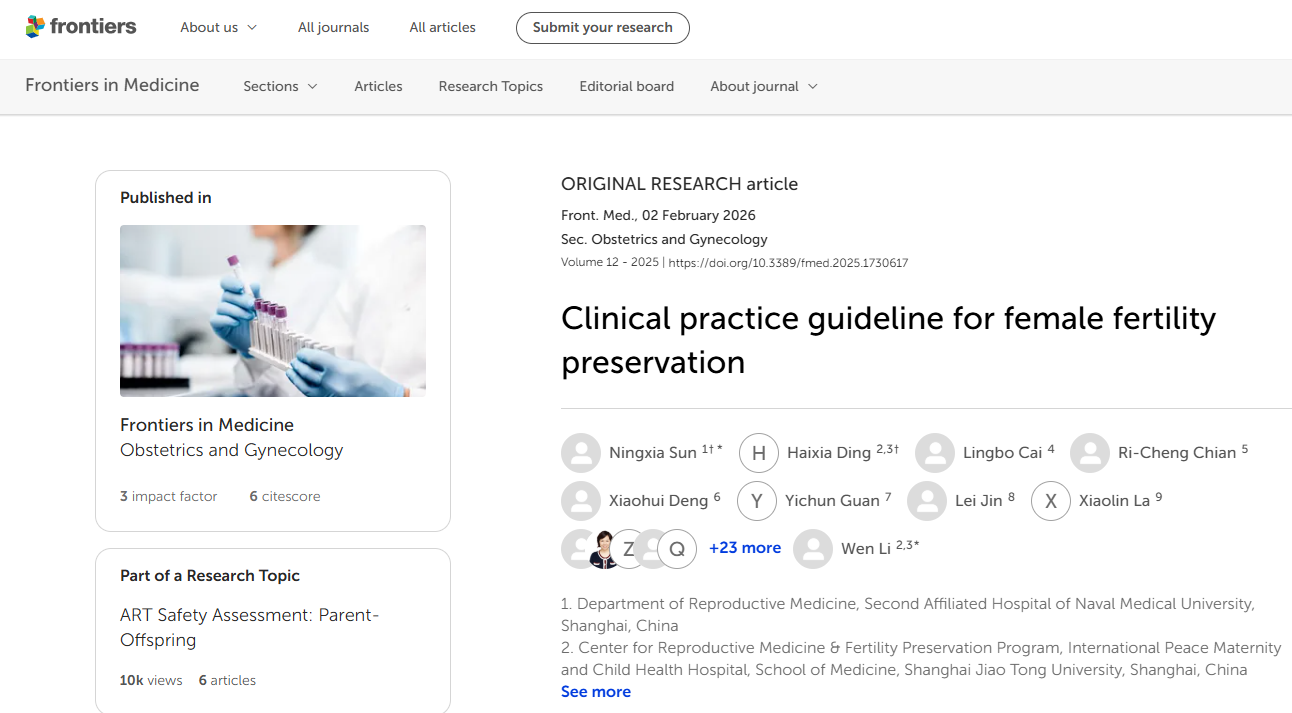
Female Fertility Preservation (FFP) has become a clinical priority due to the increasing application of gonadotoxic therapies for cancer and benign diseases, which may lead to irreversible ovarian insufficiency. Published in Frontiers in Medicine, the Clinical Practice Guidelines for Female Fertility Preservation provide evidence-based recommendations for women at high risk of iatrogenic infertility regarding fertility assessment, oocyte/embryo cryopreservation, and ovarian tissue cryopreservation and transplantation.
Methodology
This clinical practice guideline was developed following the World Health Organization (WHO) Handbook for Guideline Development. A multidisciplinary Guideline Development Group (GDG) identified nine key clinical questions in the field of FFP and conducted systematic reviews according to Cochrane standards for each question. The GRADE approach was used to assess the quality of evidence. Critical outcomes included live birth rate, clinical pregnancy rate, time to pregnancy, delay in cancer treatment, and severe Ovarian Hyperstimulation Syndrome (OHSS). The GDG formed final recommendations based on the GRADE Evidence-to-Decision frameworks.
Summary of Recommendations
Clinical Question 1:
For women undergoing fertility preservation, should a random-start protocol be used instead of a conventional start protocol for controlled ovarian stimulation (COS)?
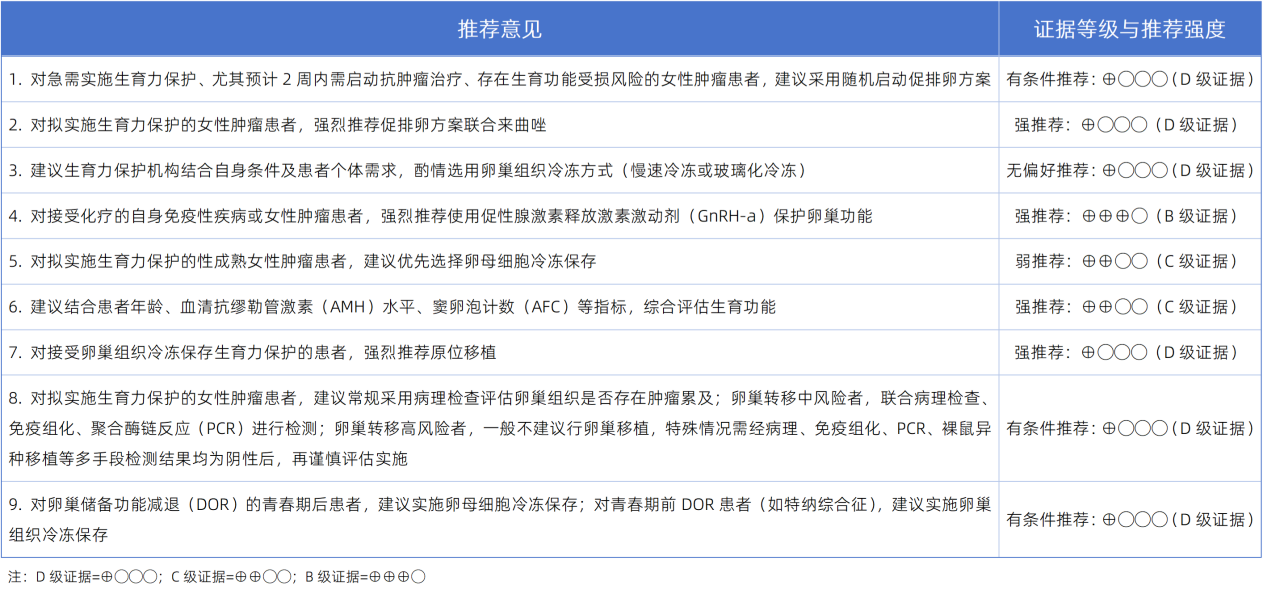
Recommendation: For cancer patients requiring urgent FFP, especially those needing to commence cancer treatment within 2 weeks, a random-start protocol is suggested (Conditional recommendation, Grade D evidence).
Implementation: For women requiring oocyte cryopreservation (OC) who must complete FFP within 2 weeks, a random-start protocol should be selected based on the primary disease, ovarian reserve, and follicular development. If cancer treatment can be delayed, either a conventional or random-start protocol is acceptable.
Clinical Question 2:
Is letrozole recommended in COS protocols for women undergoing fertility preservation?
Recommendation: Letrozole should be added to the COS protocol for women undergoing FFP (Strong recommendation, Grade D evidence).
Implementation: Letrozole is recommended for hormone-sensitive cancers (e.g., breast cancer). It is also recommended for high responders to reduce the risk of OHSS. For non-hormone-sensitive cancers, letrozole may be considered based on individual circumstances.
Clinical Question 3:
Is vitrification recommended over slow freezing for ovarian tissue cryopreservation (OTC)?
Recommendation: Fertility centers should select the appropriate OTC method (slow freezing or vitrification) based on resource availability and patient needs (No recommendation for or against; Grade D evidence).
Implementation: Centers performing slow freezing must evaluate equipment and ensure operators receive rigorous training. Centers without slow-freezing capabilities should ensure personnel performing vitrification have received specialized FFP training.
Clinical Question 4:
Is GnRH agonist (GnRH-a) recommended for ovarian protection in patients receiving chemotherapy?
Recommendation: GnRH-a should be used for ovarian protection in women with autoimmune diseases or cancer receiving chemotherapy (Strong recommendation, Grade B evidence).
Implementation: A long-acting GnRH-a is recommended every 4 weeks. Alternatively, clinicians may adjust the dosage and formulation based on the chemotherapy schedule and disease status.
Clinical Question 5:
For post-pubertal cancer patients, is oocyte cryopreservation (OC) or ovarian tissue cryopreservation (OTC) recommended?
Recommendation: OC may be used for post-pubertal cancer patients requiring FFP (Weak recommendation, Grade C evidence).
Implementation: For patients needing immediate anticancer therapy where COS is not feasible, OTC is recommended. For hormone-sensitive tumors (e.g., specific breast cancers), clinicians must carefully weigh the potential impact of COS on the primary disease against the benefits of FFP.
Clinical Question 6:
How should fertility status be assessed in women planning COS?
Recommendation: Fertility assessment should integrate age, Anti-Müllerian Hormone (AMH), and Antral Follicle Count (AFC) (Strong recommendation, Grade C evidence).
Implementation: AFC should be assessed via ultrasound in the early follicular phase. AMH can be tested at any point in the menstrual cycle. Clinicians should synthesize these results with age and other clinical factors.
Clinical Question 7:
For patients undergoing OTC, is orthotopic or heterotopic autotransplantation recommended?
Recommendation: Orthotopic autotransplantation is recommended (Strong recommendation, Grade D evidence).
Implementation: Orthotopic transplantation is the standard. Heterotopic transplantation may be considered if severe pelvic adhesions, prior pelvic radiation, or other contraindications exist. Follicular development should be monitored post-transplantation, and IVF services provided.
Clinical Question 8:
Should a combination of assays (IHC, PCR, nude mouse xenograft) be used to detect tumor cell contamination in ovarian tissue?
Recommendation: Histopathological examination is mandatory. For intermediate-risk ovarian metastasis, combine histology with IHC and PCR. For high-risk patients, OTC transplantation is generally not recommended; if unavoidable, it should only proceed after negative results from histology, IHC, PCR, and nude mouse xenograft assays (Conditional recommendation, Grade D evidence).
Implementation: Routine histopathology is required at the time of retrieval. Low-risk malignancies require histology only; intermediate-risk requires combined histology, IHC, and PCR; high-risk patients should generally not undergo OTC.
Clinical Question 9:
For patients with Diminished Ovarian Reserve (DOR), is OC or OTC recommended?
Recommendation: Post-pubertal patients with DOR should consider OC; pre-pubertal patients (e.g., Turner syndrome) should consider OTC (Conditional recommendation, Grade D evidence).
Implementation: OC is recommended for post-pubertal DOR. OTC is recommended for pre-pubertal DOR or high-risk DOR (e.g., Turner syndrome). Women over 38 with severe DOR (AMH < 0.5 ng/mL) should be advised to attempt natural conception rather than pursue FFP.
Consensus Statements
Consensus Question 1: What are the age limits for female fertility preservation?
General Limits: 2020 ESMO-ESHRE guidelines suggest avoiding FFP for women over 36. The 2021 Chinese Consensus sets the upper limit for OTC at 35 years and for OC at 40 years.
Breast Cancer: The 2018 Hunan Expert Consensus suggests an upper limit of 40 years for fertility preservation and ovarian protection.
Endometrial Cancer: The 2019 Early-Stage Endometrial Cancer Consensus suggests an upper limit of 40 years, extendable to 45 years after multidisciplinary evaluation for strong fertility desire.
Cervical Cancer: The Chinese Expert Consensus on Early Cervical Cancer suggests an upper limit of 45 years.
Ovarian Tumors: The 2022 Malignant Ovarian Tumor Consensus states patients must be under 40 years for early-stage epithelial, malignant germ cell, or sex-cord stromal tumors.
Lymphoma: The 2023 Chinese Lymphoma Consensus recommends FFP only for Hodgkin lymphoma and low-grade non-Hodgkin lymphoma patients under 40 years.
Consensus Question 2: Infrastructure recommendations for institutions offering FFP.
Multidisciplinary Team (MDT) & Expertise:
Collaboration: Requires oncologists, reproductive endocrinologists, urologists, and reproductive surgeons trained in FFP.
Psychological Support: Dedicated psychologists are required to assist patients with difficult decision-making.
Genetic Counseling: Genetic counselors are needed for patients with hereditary diseases.
Counselors: Communication can be led by pediatric oncologists, endocrinologists, reproductive specialists, or specialist nurses based on local resources.
Facilities: Institutions must have the capacity for immediate COS, a mature ART platform (embryo/testicular tissue freezing), operate year-round, respond rapidly, counsel minors, and prioritize equipment for gonadal tissue cryopreservation.
Financial Considerations: Given the high cost and lack of insurance coverage, institutions should provide financial counseling and flexible funding schemes to alleviate economic burdens.
Conclusion
Over the past decade, the field of FFP has developed rapidly; however, global disparities in application persist, and many clinical issues lack unified consensus. Developed using rigorous methodologies, this guideline provides explicit, evidence-based recommendations on COS protocols, medication combinations, and preservation methods, effectively guiding clinical practice. By integrating domestic clinical realities and tailoring strategies to patient age, tumor type, and treatment urgency, this guideline offers more detailed and practical dimensions compared to international counterparts.
Most recommendations in this guideline are conditional. Clinical application should emphasize shared decision-making between doctors and patients, fully integrating individual circumstances, reproductive desires, and personal preferences. Further research is needed to continuously refine the FFP diagnostic and therapeutic system.
Source:
Sun N, Ding H, Cai L, Chian R-C, Deng X, Guan Y, Jin L, La X, Lin G, Ling X, Lou Z, Lu W, Lv Q, Ma F, Pei X, Quan S, Shen J, Tao M, Wang L, Wang X, Xiong G, Xu J, Xu P, Xu W, Yao Y, Yuan X, Zhang F, Zhang Q, Zhang Q, Zhang X, Zhou P and Li W (2026) Clinical practice guideline for female fertility preservation. Front. Med.12:1730617. doi: 10.3389/fmed.2025.1730617
Editor: Lily