





















Key Clinical Points of the Expert Consensus on the Clinical Application of Dydrogesterone(2026 Edition) with a Quick Reference Table
Dydrogesterone is a progestogenic agent with a chemical structure most closely resembling natural progesterone. It exhibits high selectivity for progesterone receptors and demonstrates minimal binding affinity to estrogen, androgen, or glucocorticoid receptors. Since its introduction in 1961, dydrogesterone has been used clinically in over 100 countries worldwide. With more than six decades of clinical practice, extensive real-world data have accumulated, widely validating its safety and clinical efficacy. In recent years, driven by advances in evidence-based medicine, the applications of dydrogesterone in obstetrics, gynecology, and reproductive medicine have continued to expand.
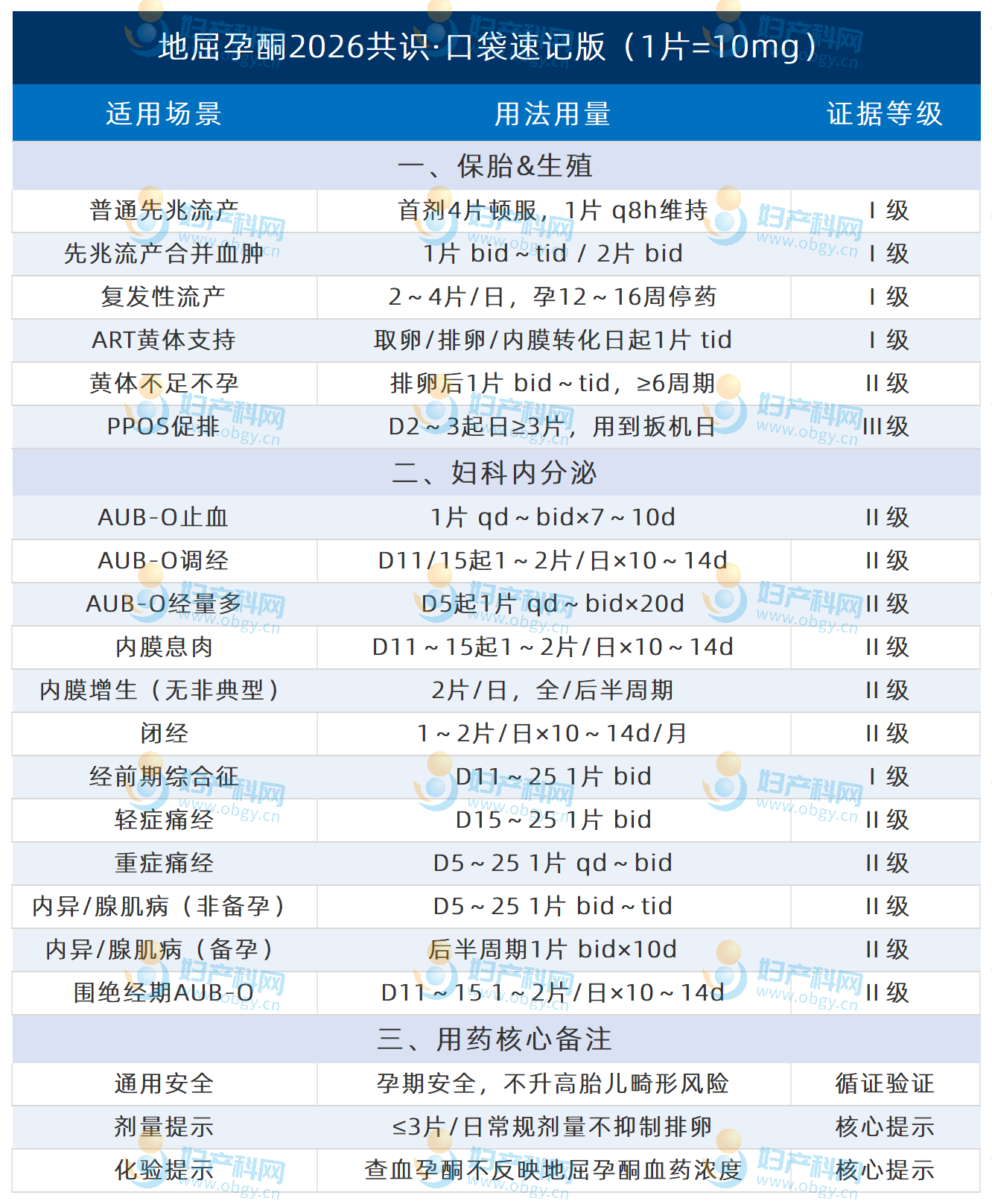
To further standardize clinical prescription protocols, unify diagnostic and therapeutic standards, and guide rational drug use, the Fertility Preservation Branch of the Chinese Preventive Medicine Association and the Perinatal Medicine Branch of the Chinese Medical Association organized relevant experts to formulate the Expert Consensus on the Clinical Application of Dydrogesterone(2026 Edition). Referencing the Oxford Centre for Evidence-Based Medicine (OCEBM) evidence grading standards, the committee systematically reviewed evidence and standardized medication regimens for reproductive, obstetric, and gynecological conditions, ultimately forming 13 specific clinical recommendations. This article refines the core content based on the original consensus, streamlining redundant discussions to focus on practical clinical value, facilitating rapid reference, learning, and standardized application for clinicians.
Clinical Applications of Dydrogesterone
01 Pregnancy Maintenance
Progesterone is a key hormone involved in regulating the entire process of pregnancy. Beyond progestogen supplementation for threatened abortion and Assisted Reproductive Technology (ART) populations, dydrogesterone supports pregnancy maintenance through multiple pharmacological mechanisms:
Upregulating the expression of Progesterone-Induced Blocking Factor (PIBF) to mediate maternal immune tolerance.
Promoting nitric oxide synthesis in umbilical vein endothelial cells to improve uterine blood supply.
Optimizing endometrial receptivity.
Relaxing uterine smooth muscle.
Clinical Note: Standard serum progesterone assay kits cannot detect dydrogesterone and its active metabolites. Therefore, routine monitoring of serum progesterone levels is unnecessary during dydrogesterone therapy; measured values represent only endogenous progesterone secretion.
(I) Reducing Abortion Risk
Clinical Question 1: How should dydrogesterone be used in threatened abortion?
Dosage & Administration:
Initial dose: 40 mg (4 tablets) as a single oral loading dose.
Maintenance: 10 mg (1 tablet) orally every 8 hours.
After symptom improvement, continue at an effective dose of 30 mg/day for no less than 1 week, then gradually taper to 10–20 mg/day (1–2 tablets) for maintenance. If symptoms recur, resume the initial dosage regimen.
For Threatened Abortion with SCH:Oral dydrogesterone 10 mg once or twice daily, or 20 mg twice daily, continuing for 1–2 weeks after vaginal bleeding ceases.
[Recommendation 1] Dydrogesterone significantly reduces abortion risk and increases live birth rates in patients with threatened abortion. It is well absorbed, offers high patient compliance, and has a low incidence of adverse effects. (Evidence Level: I)
Clinical Question 2: How should dydrogesterone be used in recurrent spontaneous abortion (RSA)?
Dosage & Administration: Oral dydrogesterone 20–40 mg/day (2–4 tablets/day), continued until 12–16 weeks of gestation, or 1–2 weeks beyond the gestational age of previous miscarriages. Discontinuation is permitted if asymptomatic and embryonic development is normal on imaging.
[Recommendation 2] Dydrogesterone significantly reduces the risk of recurrence and increases live birth rates in patients with unexplained recurrent spontaneous abortion (URSA). (Evidence Level: I)
(II) Assisted Reproductive Technology (ART)
Clinical Question 3: How should dydrogesterone be used for luteal support in ART?
Dosage & Administration:
Fresh Embryo Transfer Cycle: Start on the day of oocyte retrieval: 10 mg (1 tablet) orally three times daily. Continue until 12 weeks of gestation upon confirmation of pregnancy.
Frozen-Thawed Embryo Transfer (FET) Cycle:
Natural Cycle:For natural ovulation or HCG-triggered ovulation, start 10 mg three times daily post-ovulation.
Artificial Hormone Replacement Cycle:Start 10 mg three times daily from the date of endometrial transformation; may be combined with other forms of progesterone.
[Recommendation 3] Dydrogesterone for luteal support in ART reduces abortion rates, increases live birth rates, and optimizes pregnancy outcomes. Its oral convenience, good compliance, and suitability for individualized therapy make it a preferred choice. (Evidence Level: I)
Clinical Question 4: How should dydrogesterone be used for infertility caused by luteal phase deficiency (LPD)?
Dosage & Administration: Start 10 mg orally, 2–3 times daily, from day 1–3 post-ovulation. Course of treatment should be no less than 6 menstrual cycles.
[Recommendation 4] Dydrogesterone corrects luteal defects and supports early pregnancy maintenance in infertile patients with LPD. (Evidence Level: II)
Clinical Question 5: How should dydrogesterone be used in Progestin-Primed Ovarian Stimulation (PPOS) protocols?
Dosage & Administration: Start oral dydrogesterone (10–20 mg per dose, total daily dose ≥ 30 mg) from days 2–3 of the menstrual cycle, continuing until the day of HCG triggering.
[Recommendation 5] Dydrogesterone effectively inhibits premature LH surges in PPOS protocols. Compared to Medroxyprogesterone Acetate (MPA) PPOS protocols, both yield similar oocyte counts and pregnancy outcomes, while dydrogesterone demonstrates fewer adverse effects and superior safety. (Evidence Level: III)
02 Applications in Gynecological Endocrinology
In the management of gynecological endocrine disorders, exogenous progesterone antagonizes estrogen-induced endometrial proliferation, promoting the transition from the proliferative to the secretory phase. Dydrogesterone can be administered via two schedules:
Full-cycle regimen: Starting from day 5 of menstruation for endometrial protection and reduction of abnormal bleeding.
Post-menstrual/half-cycle regimen: Administered in the latter half of the cycle for menstrual rhythm regulation.
(I) Abnormal Uterine Bleeding (AUB)
Clinical Question 6: How should dydrogesterone be used for ovulatory dysfunction-related AUB (AUB-O)?
Dosage & Administration:
Hemostasis: For stable patients with Hb > 90 g/L: 10 mg once or twice daily for 7–10 days.
Cycle Regulation:
Standard:Start on day 11 or 15 of the cycle: 20 mg daily for 10 days, or 10–20 mg daily for 14 days.
Menorrhagia:Start on day 5 of the cycle: 10 mg once or twice daily for 20 days. Treat for 3–6 cycles.
[Recommendation 6] Dydrogesterone effectively achieves hemostasis, regulates cycles, and provides endometrial protection in AUB-O patients. (Evidence Level: II)
Clinical Question 7: How should dydrogesterone be used for endometrial polyps (EPs)?
Dosage & Administration: 10–20 mg daily, starting from days 11–15 of the cycle, for 10–14 days. Treat for 3–6 cycles.
[Recommendation 7] Dydrogesterone improves clinical symptoms, reduces polyp size, and lowers postoperative recurrence rates. (Evidence Level: II)
Clinical Question 8: How should dydrogesterone be used for endometrial hyperplasia (EH)?
Dosage & Administration: 20 mg daily. Either full-cycle or half-cycle regimen (days 11–15 of the cycle for 10–14 days). Treat for 3–6 cycles before reassessment.
[Recommendation 8] Dydrogesterone increases complete remission rates and reduces recurrence in non-atypical EH, protecting the endometrium without significant adverse effects. (Evidence Level: II)
(II) Amenorrhea
Clinical Question 9: How should dydrogesterone be used for amenorrhea?
Dosage & Administration: Premised on adequate endogenous or exogenous estrogen priming, administer 10 mg once or twice daily for 10–14 days per cycle.
[Recommendation 9] Dydrogesterone increases the rate of regular withdrawal bleeding, restores normal menstrual rhythm, and protects the endometrium. (Evidence Level: II)
(III) Other Menstrual Disorders
Clinical Question 10: How should dydrogesterone be used for Premenstrual Syndrome (PMS)?
Dosage & Administration: Days 11–25 of the cycle: 10 mg twice daily.
[Recommendation 10] Dydrogesterone alleviates emotional disturbances (anxiety, depression) and improves somatic/psychological symptoms of PMS. (Evidence Level: I)
Clinical Question 11: How should dydrogesterone be used for dysmenorrhea?
Dosage & Administration:
Mild:Days 15–25 of the cycle: 10 mg twice daily.
Severe:Days 5–25 of the cycle: 10 mg once or twice daily. Initiate with a full dose of 20 mg/day.
[Recommendation 11] Dydrogesterone effectively relieves pain associated with dysmenorrhea. (Evidence Level: II)
(IV) Menopausal Hormone Therapy (MHT)
Clinical Question 12: How should dydrogesterone be used in MHT?
Dosage & Administration: Early menopausal transition (without significant hypoestrogenism symptoms): 10–20 mg daily, starting from days 11–15 of the current menstruation or withdrawal bleed, for 10–14 days per cycle.
[Recommendation 12] Dydrogesterone regulates cycles, reduces abnormal bleeding, and protects the endometrium, aiding a smooth transition to menopause. (Evidence Level: II)
03 Endometriosis and Adenomyosis
Clinical Question 13: How should dydrogesterone be used for endometriosis and adenomyosis?
Dosage & Administration:
Non-pregnancy planning:Days 5–25 of the cycle or full-cycle: 10 mg 2–3 times daily. Initiate with a full dose.
Fertility desiring:Half-cycle regimen: 10 mg twice daily for 10 days.
[Recommendation 13] Dydrogesterone effectively relieves pain, reduces analgesic use, and improves abnormal menstruation. Conventional doses do not suppress ovulation, making it suitable for patients desiring fertility; it also corrects luteal insufficiency and increases natural conception rates. (Evidence Level: II)
Safety Profile of Dydrogesterone
Dydrogesterone is widely used in female reproductive health, with over 60 years of validated safety and tolerability. High-quality evidence and real-world data confirm its safety for luteal support and pregnancy maintenance. The LOTUS I and II studies indicated no statistically significant difference in adverse events or neonatal congenital anomalies compared to controls. The REASSURE I and II meta-analyses (including 6 RCTs and 3 observational studies) confirmed that first-trimester exposure does not increase the risk of fetal congenital malformations. A large retrospective cohort study involving 124,815 embryo transfer cycles and 52,175 live births similarly found no correlation between first-trimester exposure and congenital malformation risk. A systematic review of 32 studies involving nearly 1.2 million pregnancies showed dydrogesterone's safety profile is comparable to natural progesterone.
In non-pregnant populations, it is safe for menstrual disorders due to ovulation dysfunction, with a low overall incidence of mild-to-moderate adverse effects. In MHT, standard dosing is associated with a low risk of breast cancer, effectively protects the endometrium without increasing endometrial cancer risk, has minimal interference with coagulation parameters (no significant increase in VTE risk), and limited impact on glucose/lipid metabolism, preserving the cardiovascular benefits of estrogen.
Summary
Dydrogesterone is extensively used in reproductive medicine and gynecological endocrinology, covering pregnancy maintenance, menstrual regulation, ART luteal support, and menopausal management. Despite its widespread use, non-standardized prescribing remains an issue, necessitating standardized guidance to optimize safety and efficacy. With its unique progesterone backbone structure, dydrogesterone offers advantages including oral convenience, high bioavailability, no suppression of ovulation at conventional doses, and good tolerability. Over six decades of practice and numerous large-sample studies support its efficacy and safety. This consensus systematically reviews applicable regimens across various diseases to assist clinicians in standardizing medication use, promoting scientific and rational drug application throughout the female life cycle, improving patient prognosis and quality of life, and contributing to the "Healthy China" initiative and high-quality population development.
Disclaimer: The recommendations in this consensus are for reference by licensed physicians only. Prescriptions must be tailored to individual patient conditions. Patients are strictly prohibited from self-medication or dose adjustment.
Source: Fertility Preservation Branch of Chinese Preventive Medicine Association, Perinatal Medicine Branch of Chinese Medical Association. Expert consensus on the clinical application of dydrogesterone. Journal of Reproductive Medicine. 2026; 35(5):569-578.
Editor: Lily