





















Vulvar cancer is a rare but highly heterogeneous gynecologic malignancy, with squamous cell carcinoma accounting for over 90% of cases. In recent years, HPV-related cases have been increasing annually, and treatment concepts continue to evolve. The National Comprehensive Cancer Network (NCCN) released two versions of the Vulvar Cancer Guidelines in 2026 (2026.V1 and 2026.V2), with V1 representing a comprehensive update based on the 2025.V1 version. Based on the original guideline documents, this article systematically interprets the core updates of versions 2026.V1-V2, providing a reference for standardized clinical diagnosis and treatment.
(Image: NCCN Clinical Practice Guidelines in Vulvar Cancer (2026.V2))
Core Updates in NCCN Vulvar Cancer Guidelines (2026.V1)
Version 2026.V1 optimizes key content including diagnostic workflows, molecular testing, treatment regimens, and follow-up management, building upon the 2025.V1 version by integrating the latest evidence-based medicine and clinical consensus. It further refines stratified diagnosis and treatment strategies, strengthens the concept of individualized therapy, and supplements humanistic care elements such as psychological care and survivor management. This provides clinicians with a comprehensive, standardized, and actionable reference to help improve the survival prognosis and quality of life of vulvar cancer patients.
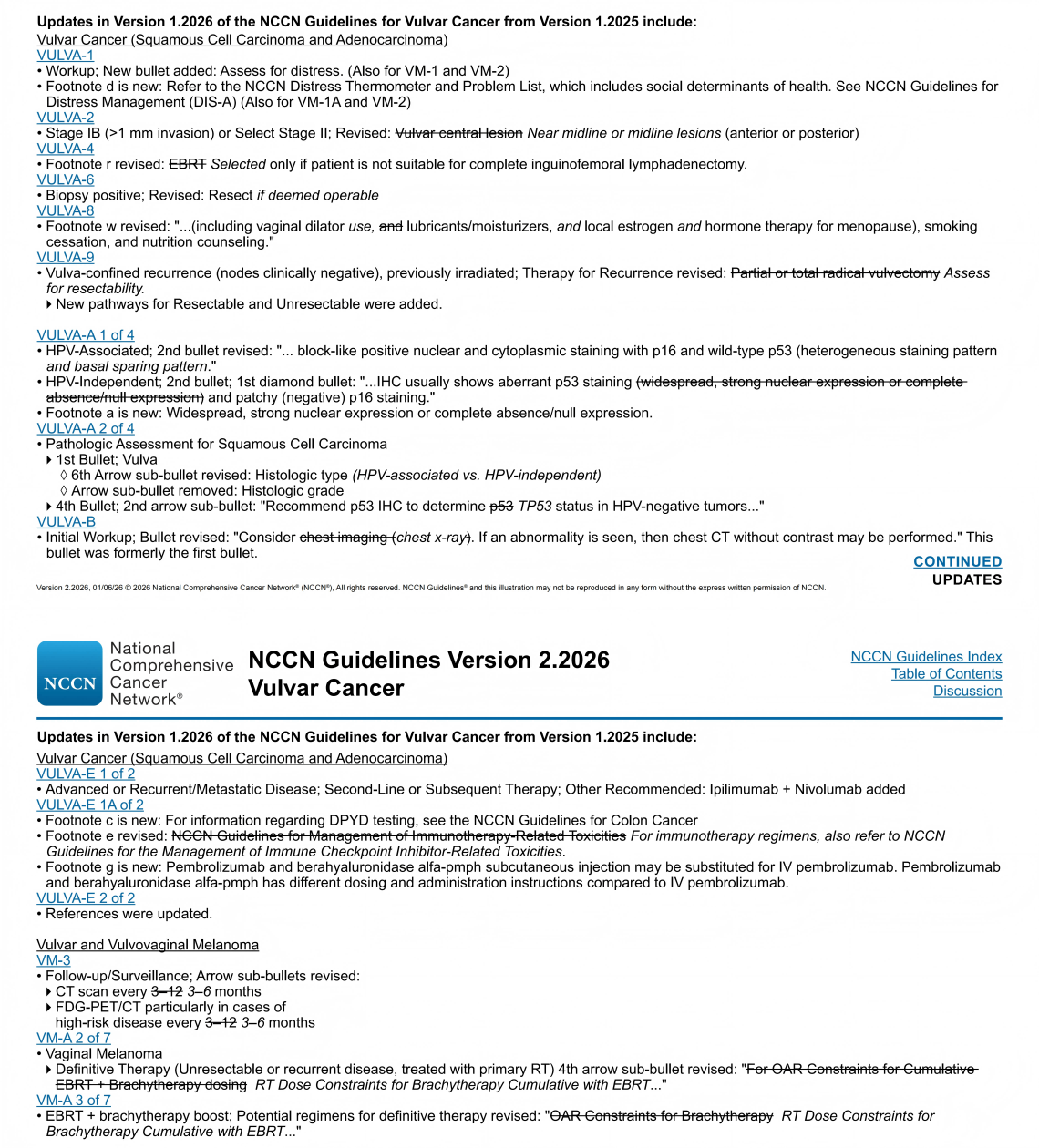
(Image: WPS Collage)
Comparison Table: NCCN Vulvar Cancer Guidelines (2025.V1 → 2026.V1) ☟
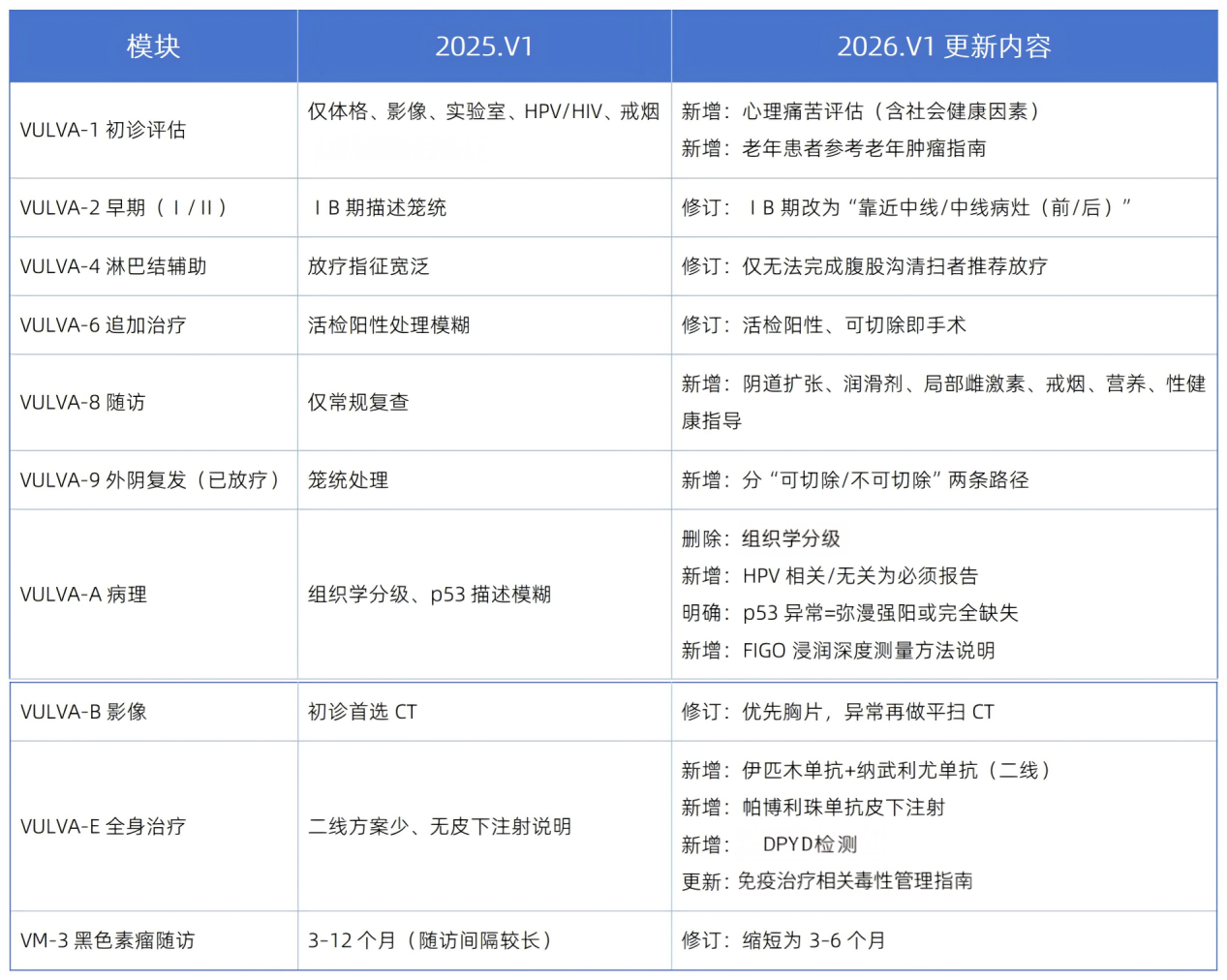
(Image: Comparison Table)
Detailed Interpretation of Key Updates in NCCN Vulvar Cancer Guidelines (2026.V1)
1. Initial Diagnosis Assessment: From "Treating the Disease" to "Holistic Care"
Version 2026.V1 formally incorporates psychological distress assessment into the initial diagnosis workflow for the first time and emphasizes the impact of social health factors, echoing the holistic concept of tumor care. Additionally, an exclusive assessment pathway for elderly patients has been added, aligning with the high incidence of vulvar cancer in the elderly population, thus enhancing clinical utility.
2. Pathological Classification: Dual-Track Precision Stratification (HPV/p53)
The new version removes histological grading items and officially shifts to HPV-related/non-related molecular classification, clarifying the interpretation criteria for p16 and p53 immunohistochemistry (IHC):
HPV-related: Diffuse block-positive p16, wild-type p53.
HPV-unrelated: Diffuse strong positive or complete absence of p53, p16 negative.
This update directly guides prognosis judgment and treatment selection. Patients with HPV-unrelated tumors and abnormal p53 status have a poorer prognosis and require more aggressive treatment strategies.
3. Imaging Workflow: Streamlining Radiation Exposure
For initial chest imaging, the recommendation changes from CT to chest X-ray as the preferred modality. Contrast-enhanced CT is only performed if abnormalities are found on the X-ray, reducing unnecessary radiation exposure.
4. Systemic Therapy: Expansion of Immunotherapy and Precision Medicine
Second-line treatment: Added the combination immunotherapy regimen Ipilimumab + Nivolumab, enriching options for advanced patients.
Administration: Supplemented with Pembrolizumab subcutaneous injection, improving medication convenience.
Safety: Added DPYD gene testing to guide Fluorouracil (5-FU) usage, mitigating toxicity risks.
Management: Updated guidelines for managing immune-related adverse events (irAEs).
5. Follow-up and Recurrence: Strengthening Long-Term Care and Stratified Management
Follow-up care now includes guidance on vaginal dilators, lubricants, local estrogen, smoking cessation, nutrition, and sexual health, emphasizing quality of life post-treatment. For recurrent cases with prior radiotherapy, resectable/unresectable dual pathways have been added, significantly improving clinical operability.
Supplementary Updates in NCCN Vulvar Cancer Guidelines (2026.V2)

(Image: NCCN Clinical Practice Guidelines in Vulvar Cancer (2026.V2))
Version 2026.V2 is a minor textual revision. It only refined the descriptions of pathological immunohistochemistry and slightly adjusted footnotes regarding immune toxicity. There were no changes to clinical treatment regimens, ensuring more rigorous phrasing in the guidelines.
Summary
The updates in the NCCN Vulvar Cancer Guidelines (2026.V1-V2) center on precision stratification, individualization, and humanistic care. Pathology has shifted from histology to molecular etiology, clinical pathways have become more detailed, and psychological and long-term survival management are integrated throughout the entire process. These updates provide clinicians with a more scientific and operable reference for standardized practice, ultimately helping to improve the survival prognosis and quality of life of vulvar cancer patients.
Source: Version 2.2026, 01/06/26 © 2026 National Comprehensive Cancer Network® (NCCN®)
Disclaimer: This article is intended for medical professionals for learning and exchange purposes only and should not serve as a basis for specific clinical operations. Clinical decisions must integrate individual patient conditions, hospital resources, and the latest guidelines. Multidisciplinary consultation is recommended when necessary.
Editor: Lily