





















Adenomyosis (AM) is a common gynecological condition affecting women of reproductive age, with an incidence rate ranging from 7% to 23%. Its primary clinical manifestations include dysmenorrhea, menorrhagia (which can lead to severe anemia in critical cases), and infertility, all of which severely impact patients' physical and mental health. The core therapeutic goals for AM are to relieve pain, reduce bleeding, and improve fertility outcomes. While several domestic guidelines for AM diagnosis and treatment have been issued, standardized guidance integrating the strengths of Traditional Chinese Medicine (TCM) and Western medicine still requires further refinement.
To establish a high-quality, standardized diagnosis and treatment system for AM, promote the organic integration and complementary advantages of TCM and Western medicine in this field, and advance the standardization of integrated care, the Chinese Association of Integrative Medicine, the China Association of Chinese Medicine, and the Chinese Medical Association have collaborated. Grounded in clinical reality, oriented toward clinical problems, and based on evidence-based medicine principles, a multidisciplinary team was formed to jointly develop these guidelines.
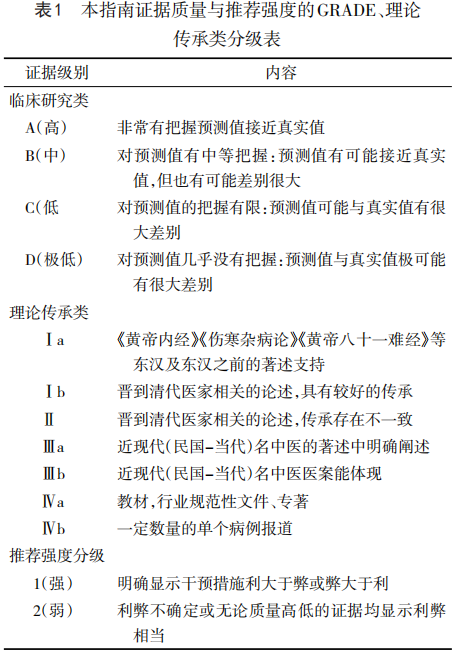
For interventions recommended by randomized controlled trials, the Grading of Recommendations Assessment, Development, and Evaluation (GRADE) working group framework was used to grade the quality of evidence (see Table 1). For interventions derived from textbooks such as Gynecology of Traditional Chinese Medicine, the theoretical inheritance evidence classification and grading evaluation method proposed by Zhong Jingbo was referenced for grading (see Table 1).
I. Pathogenesis of AM
1. Pathogenesis in Western Medicine
The pathophysiological mechanisms of adenomyosis have not yet been fully elucidated, and its clinical manifestations are highly heterogeneous. Currently, no single theory can completely explain its complex pathogenesis. Mainstream hypotheses include:
• Endometrial basal layer invagination and tissue injury repair theory;
• Müllerian metaplasia and adult stem cell differentiation theory;
• Inflammatory stimulation theory.
Additionally, epithelial-mesenchymal transition (EMT), angiogenesis, genetic factors, and immune abnormalities are also considered to be involved in its pathogenesis.
2. Etiology and Pathogenesis in TCM
The core pathogenesis in TCM is blood stasis obstruction. Etiological factors may include external pathogenic invasion, emotional distress, irregular sexual activity, improper diet, and surgical trauma. These factors lead to dysfunction of the internal organs and disharmony of Qi and blood, causing some menstrual blood to flow retrograde instead of following its normal path. The stagnant extravasated blood accumulates in the lower abdomen, obstructing the Chong and Ren meridians, the uterus, and its collaterals, thereby giving rise to the disease.
II. Diagnosis of AM
1. Western Medicine Diagnostic Criteria
Refer to the Chinese Expert Consensus on the Diagnosis and Treatment of Adenomyosis.
2. TCM Syndrome Differentiation
Clinical Question 1: What are the key points for TCM diagnosis (syndrome differentiation) of adenomyosis?
Recommendation: Based on Gynecology of Traditional Chinese Medicine textbooks, relevant literature, and expert consensus, TCM syndrome differentiation for adenomyosis is summarized into five types:
• Qi Stagnation and Blood Stasis Syndrome
• Cold Coagulation and Blood Stasis Syndrome
• Qi Deficiency and Blood Stasis Syndrome
• Kidney Deficiency and Blood Stasis Syndrome
• Phlegm-Blood Stasis Intertwined Syndrome
(1) Qi Stagnation and Blood Stasis Syndrome
• Main Symptoms: Distending or stabbing pain in the lower abdomen before or during menstruation, pain aggravated by pressure, sometimes with perineal heaviness or tenesmus; heavy menstruation or prolonged periods, dark menstrual blood with clots, pain relieved after clot passage.
• Secondary Symptoms: Usually depressed mood or irritability, worsened premenstrual irritability, accompanied by chest, hypochondriac, and breast distension.
• Tongue & Pulse: Dark red tongue, possibly with ecchymosis or petechiae, thin white coating, wiry and choppy pulse.
(2) Cold Coagulation and Blood Stasis Syndrome
• Main Symptoms: Cold or colicky pain in the lower abdomen before or during menstruation, pain aggravated by pressure but relieved by warmth; dark purple menstrual blood with clots, or dripping uterine bleeding with delayed cycles.
• Secondary Symptoms: Chilliness and cold limbs, loose stools.
• Tongue & Pulse: Pale, swollen, purple-dark tongue with ecchymosis/petechiae, white coating, deep, slow, and choppy pulse.
(3) Qi Deficiency and Blood Stasis Syndrome
• Main Symptoms: Lower abdominal pain before or during menstruation, with anal heaviness; heavy menstruation or prolonged periods, dark and dilute blood or mixed with clots.
• Secondary Symptoms: Sallow complexion, fatigue, lethargy, poor appetite, loose stools.
• Tongue & Pulse: Pale and swollen tongue with ecchymosis on the edges/tip, thin white coating, deep and choppy pulse.
(4) Kidney Deficiency and Blood Stasis Syndrome
• Main Symptoms: Lower abdominal pain before or during menstruation, irregular menstrual cycles, heavy menstruation, dark blood with clots.
• Secondary Symptoms: Soreness and weakness of waist and knees, stabbing pain in lumbar spine, fatigue, dizziness, tinnitus, dull complexion, decreased libido, frequent nocturia.
• Tongue & Pulse: Dark pale tongue, white coating, deep, thin, and choppy pulse.
(5) Phlegm-Blood Stasis Intertwined Syndrome
• Main Symptoms: Lower abdominal pain before or during menstruation, pain aggravated by pressure, heavy menstruation with clots.
• Secondary Symptoms: Obesity, dizziness, heavy body sensation, chest tightness, poor appetite, nausea with phlegm.
• Tongue & Pulse: Purple-dark tongue with ecchymosis on edges/tip, greasy coating, wiry-slippery or choppy pulse.
III. Treatment of AM
Clinical Question 2: Can TCM alone or combined with Western medicine improve adenomyosis-related pain (dysmenorrhea, chronic pelvic pain, dyspareunia)?
Recommendation 1 (Western Medicine):
Treatment should prioritize symptom relief and improvement of fertility needs. Pharmacotherapy is the preferred initial approach. Drug regimens must be individualized based on patient age, symptom severity, and fertility desires. Adverse drug reactions exist; patients must be fully informed prior to treatment. Drug efficacy is often temporary, with symptoms prone to recurrence after discontinuation; some patients require long-term maintenance therapy. Surgical indications must be strictly controlled, focusing on postoperative symptom improvement, recurrence risk, pregnancy outcomes, and the risk of uterine rupture.
1. Pharmacotherapy
Commonly used drugs include:
• Non-steroidal anti-inflammatory drugs (NSAIDs)
• Combined oral contraceptives (COCs)
• Oral progestins (Dienogest, Medroxyprogesterone acetate, Depot medroxyprogesterone acetate, Dydrogesterone, Gestrinone)
• Gonadotropin-releasing hormone agonists (GnRH-a)
• Levonorgestrel-releasing intrauterine system (LNG-IUS)
• Mifepristone
(Note: Dienogest is currently the only targeted drug specifically validated by clinical trials for AM treatment.)
• NSAIDs: GI discomfort is primary; long-term use risks gastric ulcers.
• COCs: Low overall risk; caution for thrombosis in patients >40 years with diabetes, hypertension, smoking history, etc.
• Progestins: Breakthrough bleeding, mastalgia, weight gain, GI symptoms, hepatic dysfunction.
• GnRH-a: Hypoestrogenic side effects (hot flashes, vaginal dryness, decreased libido, insomnia, mood changes); long-term use risks bone loss.
• LNG-IUS: Menstrual pattern changes (spotting, amenorrhea); high risk of expulsion/migration in AM patients.
• Mifepristone: Long-term use may cause endometrial atrophy and hepatic impairment.
2. Surgical Treatment
Total hysterectomy is curative. For reproductive-age patients intolerant or unresponsive to medical therapy, fertility-sparing surgeries are options: focal resection, diffuse lesion debulking, endometrial ablation/resection, and hysteroscopic surgery. Postoperative concerns include symptom recurrence, pregnancy outcomes, and risks of uterine rupture/placenta accreta during subsequent pregnancy.
3. Interventional Therapy
Mainly includes Uterine Artery Embolization (UAE) and High-Intensity Focused Ultrasound (HIFU) ablation, plus radiofrequency/microwave ablation. Common complications: skin blisters, lower abdominal pain, vaginal discharge/bleeding, sacral/gluteal pain, lower limb paresthesia. Strict adherence to indications and standardized operation are required.
Recommendation 2 (TCM & Integrated Therapy):
(1) Recommended: Ge Xia Zhu Yu Tang (Decoction for Removing Blood Stasis Below the Diaphragm) (Yilin Gaicuo) for Qi Stagnation and Blood Stasis Syndrome (1, Ib).
(2) Optional: Xue Fu Zhu Yu Tang (Blood Mansion Eliminating Stasis Decoction) (Yilin Gaicuo) or combined with LNG-IUS for Qi Stagnation and Blood Stasis Syndrome (2, Ib/D).
(3) Optional: Tao Hong Si Wu Tang (Peach Kernel and Safflower Decoction) (Yizong Jinjian) for Qi Stagnation and Blood Stasis Syndrome (2, D).
(4) Recommended: Gui Zhi Fu Ling Capsule or Gui Zhi Fu Ling Wan (Pill) combined with LNG-IUS for Qi Stagnation/Cold Coagulation Syndrome (1, C/D). Optional: Various combinations with Mifepristone, Gestrinone, Dienogest, Leuprorelin, or COCs (2, C/D/IVa).
(5) Recommended: Shao Fu Zhu Yu Tang (Lower Abdomen Warming and Stasis Removing Decoction) (Yilin Gaicuo) for Cold Coagulation and Blood Stasis Syndrome (1, Ib). Optional: Modified with Gestrinone (2, C).
(6) Optional: Xue Fu Zhu Yu Tang plus Codonopsis and Astragalus for Qi Deficiency and Blood Stasis Syndrome (1, Ib).
(7) Optional: Ju Yuan Jian (Origin-Lifting Decoction) (Jingyue Quanshu) combined with Tao Hong Si Wu Tang for Qi Deficiency and Blood Stasis Syndrome (2, Ib).
(8) Optional: Zhitonghuazheng Capsule combined with GnRH-a or LNG-IUS for Qi Deficiency and Blood Stasis Syndrome (2, C/D).
(9) Optional: Danhuangquyu Capsule combined with Gestrinone for Qi Deficiency and Blood Stasis Syndrome (2, D).
(10) Optional: Gui Shen Wan (Kidney-Restoring Pill) (Jingyue Quanshu) combined with Tao Hong Si Wu Tang for Kidney Deficiency and Blood Stasis Syndrome (1, Ib).
(11) Recommended: Sanjie Zhentong Capsule combined with LNG-IUS for Phlegm-Blood Stasis Syndrome (2, C). Optional: Monotherapy (2, IVa).
(12) Optional: Cang Fu Dao Tan Wan (Atractylodes and Cyperus Phlegm-Guiding Pill) (Ye Shi Nüke Zhengzhi) plus Sparganium and Curcuma for Phlegm-Blood Stasis Syndrome (2, Ib).
(13) Optional: TCM Retention Enema (2, IVa/D) using Huayu Sanjie enema solution.
(14) Optional: Acupuncture, Electroacupuncture, or combined with Mifepristone (2, C/D).
Clinical Question 3: Can TCM alone or combined with Western medicine reduce menstrual volume in AM patients?
Recommendation 1: Same as Western Medicine principles in Q2.
Recommendation 2 (TCM & Integrated): Similar to Q2, recommending formulas like Gui Zhi Fu Ling, Shao Fu Zhu Yu Tang, Ju Yuan Jian plus Tao Hong Si Wu Tang, Zhitonghuazheng Capsule, Gui Shen Wan plus Tao Hong Si Wu Tang, Cang Fu Dao Tan Wan, Sanjie Zhentong Capsule, and acupuncture based on specific syndromes (Evidence levels: 2, Ib/C/D/IVa).
Clinical Question 4: Can TCM alone or combined with Western medicine improve fertility and pregnancy rates in infertile AM patients?
Recommendation 1 (Western Medicine):
Comprehensive history, AM-specific evaluation, and full fertility assessment are mandatory. Treatment goals focus on preserving/restoring fertility. Options include ART, lesion resection, medication, combined surgery-medication ("Triple therapy": surgery + drugs + ART), HIFU, and microwave ablation. Regimens depend on uterine size, lesion type (focal/diffuse), ovarian reserve, and other infertility factors.
• GnRH-a: Standard medical therapy. For age <35 with normal ovarian function, consider natural conception after 3-6 months of GnRH-a; proceed to ART if failed. For age ≥35 with diminished reserve or large uterus (>12 weeks), consider egg retrieval/freezing first, then GnRH-a for 3-6 months to shrink the uterus, followed by frozen embryo transfer (FET).
• Microwave Ablation: Consider if ART fails.
• Surgery: Aims to create conditions for pregnancy; strict evaluation of indications and postoperative obstetric risks is required.
Recommendation 2 (TCM & Integrated):
TCM can be selected for patients desiring fertility. Treatment should distinguish between pre-ovulatory and post-ovulatory phases, integrating "Invigorating Blood and Resolving Masses" with "Tonifying Kidney and Spleen to Stabilize the Embryo." For AM-related infertility undergoing IVF-ET, TCM can be used concurrently. However, current high-quality evidence confirming superiority over Western medicine alone for improving pregnancy rates is lacking.
Clinical Question 5: Can TCM alone or combined with Western medicine inhibit postoperative recurrence of AM?
Recommendation (Western Medicine):
Long-term medical therapy (LNG-IUS, COCs) effectively controls symptoms and prevents recurrence. Postoperative GnRH-a application reduces recurrence rates and prolongs recurrence-free intervals.
Clinical Question 6: Can TCM alone or combined with Western medicine control or reduce uterine volume/lesion size in AM patients?
Recommendation 1 (Western Medicine):
Use GnRH-a, or sequential therapy with GnRH-a followed by Dienogest. Low-dose Mifepristone effectively shrinks uterine volume. Consider microwave ablation for symptomatic patients with diffuse AM (myometrial thickness ≥3cm or adenomyoma ≥3cm) or asymptomatic patients with significant psychological burden due to enlarging lesions.
Recommendation 2 (TCM & Integrated):
Based on syndrome differentiation, recommend various combinations of Gui Zhi Fu Ling, Si Ni San (modified), Shao Fu Zhu Yu Tang, Zhitonghuazheng Capsule, Danhuangquyu Capsule, Sanjie Zhentong Capsule, enemas, and electroacupuncture (Evidence levels: 1, C; 2, C/D/IVa).
Clinical Question 7: Can TCM alone or combined with Western medicine improve the quality of life for AM patients?
Recommendation:
(1) Modified Shao Fu Zhu Yu Tang combined with Gestrinone (2, C/D).
(2) Acupuncture (2, C).
Clinical Question 8: Can TCM alone or combined with Western medicine alleviate adverse reactions of Western drugs (e.g., hot flashes, decreased libido, irregular vaginal bleeding)?
Recommendation:
Recommended: Modified Zuo Gui Wan (Restore the Left Kidney Pill) combined with Livifemin Tablets for kidney-yin deficiency and hypoestrogenic symptoms induced by GnRH-a (1, D).
以下是针对“临床问题9(安全性)”及“四、长期管理”部分的英文翻译。翻译保持了医学指南的严谨性,并对中医特有的概念(如“治未病”、“三级管理”)进行了符合国际学术惯例的准确转译。
*
Clinical Question 9: What is the safety profile of TCM alone or combined with Western medicine in treating adenomyosis?
Recommendation:
The following integrated therapies demonstrate superior safety profiles compared to Western medicine monotherapy (specifically Ibuprofen Sustained-Release Capsules, Mifepristone, LNG-IUS, Dienogest, GnRH-a, and Ethinylestradiol Cyproterone Tablets) without increasing the incidence of adverse reactions:
• Tao Hong Si Wu Tang
• Gui Zhi Fu Ling Wan decoction modified combined with Mifepristone
• Gui Zhi Fu Ling Capsule combined with Leuprorelin Acetate Microspheres
• Gui Zhi Fu Ling Capsule or Gui Zhi Fu Ling Wan combined with LNG-IUS
• Gui Zhi Fu Ling Capsule combined with Dienogest
• Zhitonghuazheng Capsule combined with GnRH-a
• Zhitonghuazheng Capsule combined with LNG-IUS
• Sanjie Zhentong Capsule combined with Ethinylestradiol Cyproterone Tablets
• Fire Needling (Hao Huo Zhen) combined with Mifepristone
Furthermore, the following regimens showed a lower incidence of adverse reactions compared to their corresponding Western medicine controls (Gestrinone, LNG-IUS, Leuprorelin, Dydrogesterone) and exhibited good safety:
• Gui Zhi Fu Ling Capsule combined with Gestrinone
• Danhuangquyu Capsule combined with Gestrinone
• Sanjie Zhentong Capsule combined with LNG-IUS
• Modified Si Ni San combined with Leuprorelin Acetate Microspheres and Dydrogesterone Tablets
IV. Long-term Management
Clinical Question 10: Can integrated TCM and Western medicine be used for the long-term management of adenomyosis?
Recommendation:
The long-term management of adenomyosis should adopt a comprehensive model, including rational drug application, patient education, thorough communication regarding treatment options, attention to quality of life, psychological intervention, and consultation regarding fertility issues. The core philosophy is "integration of prevention and treatment," adhering to the TCM tradition of "preventive treatment of disease" (Zhi Wei Bing). This integrates TCM regimen practices, dietary therapy, and rehabilitation therapy into the entire long-term management process to achieve holistic and standardized intervention.
1. Goals of Long-term Management
Patients with adenomyosis are typically young women of reproductive age. The disease has a long course, potentially affecting patients for decades, classifying it as a chronic disease. By the end of 2018, the Chinese Expert Consensus on the Long-term Management of Endometriosis was officially released. As a special type of endometriosis, adenomyosis shares similar characteristics of being difficult to cure and prone to recurrence; therefore, it requires long-term or even lifelong management.
The goals of long-term management include: alleviating and eliminating pain, promoting and improving fertility, reducing menstrual volume to correct anemia, lowering recurrence rates, and enhancing quality of life. Individualized management plans must be developed to maximize benefits and minimize harm based on symptom severity, age, and fertility desires.
2. Methods of Long-term Management
Implement stratified management for different populations:
• Primary Management (Susceptible Population): Focus on reducing exposure to risk factors. Measures include strengthening doctor-patient education, minimizing intrauterine procedures, adjusting lifestyle behaviors, and preventing/reducing retrograde menstruation.
• Secondary Management (Symptomatic, Non-surgical Population): Focus on pharmacotherapy, LNG-IUS, interventional therapy, and physical therapy.
• Tertiary Management (Surgical & Post-operative Population): Focus on total hysterectomy, fertility-sparing surgery, endometrial ablation, and post-conservative surgery management.
2.1 Western Medicine Interventions
(1) Post-operative Patients:
◦ With fertility desire: Recommend GnRH-a for 4–6 months, followed by active attempts at natural conception. If infertility persists, consider Assisted Reproductive Technology (ART).
◦ Without fertility desire: After 6 months of GnRH-a, switch to sequential or alternating therapy with LNG-IUS, COCs, Gestrinone, or high-efficiency progestins (Dienogest) for long-term control. Long-term follow-up is mandatory after conservative surgery or interventional therapy.
(2) Young Symptomatic Patients (No fertility desire): Cyclic COCs or LNG-IUS placement.
(3) Young Nulliparous Patients with Large Uterus or DIE: Recommend long-term GnRH-a combined with "add-back therapy" until pregnancy is desired.
(4) Patients with Dysmenorrhea, Large Uterus, Heavy Flow (No severe anemia): Consider long-term maintenance therapy with Dienogest.
2.2 Cognitive Intervention
Health education is vital for maintaining surgical efficacy and improving conservative treatment outcomes. Patient-centered care is essential to guide active participation in treatment and establish self-health management awareness.
• Content: Menstrual physiology, AM symptoms and risk factors, necessity of examinations, pros and cons of treatments, and mental health counseling.
• Channels: Utilize hospital settings, traditional media, and new media platforms (WeChat groups, Official Accounts, Weibo, TikTok, Kuaishou, Xiaohongshu). Employ lectures, brochures, videos, and patient salons. Encourage patients to keep symptom diaries.
2.3 Psychological Intervention
The occurrence and progression of AM are closely related to emotional states. Chronic pain can lead to depression and anxiety. Mental health counseling is indispensable.
• Focus on identifying anxiety and depression in susceptible individuals.
• Establish robust social support systems involving family members.
• Provide targeted psychological疏导 (shūdǎo - psychological guidance/counseling) by specialists when necessary.
2.4 Lifestyle Intervention
Research indicates that high numbers of intrauterine procedures, pregnancies, IUD use, primary dysmenorrhea, uterine fibroids, and certain lifestyle factors (mental stress, sedentary work) are risk factors. Protective factors include delayed menstruation and amenorrhea.
• General Advice: Avoid unnecessary intrauterine operations, practice reasonable contraception, avoid intercourse during menstruation, maintain emotional well-being, reduce raw/cold/spicy food intake, keep warm, exercise moderately, and ensure adequate sleep.
• TCM-Specific Advice:
◦ Qi Stagnation and Blood Stasis: Manage emotions, avoid excessive emotional fluctuations, avoid spicy foods.
◦ Qi Deficiency and Blood Stasis: Protect spleen and stomach function, eat regularly, avoid cold/raw/greasy foods.
3. Follow-up Recommendations
(1) Frequency: Every 3–6 months.
(2) Focus: Symptom control, quality of life, adverse drug reactions, and fertility guidance.
(3) Content: Medical history, physical examination, imaging (pelvic ultrasound), and laboratory tests (CA125, CBC). For patients using GnRH-a continuously for ≥6 months, monitor bone mineral density.
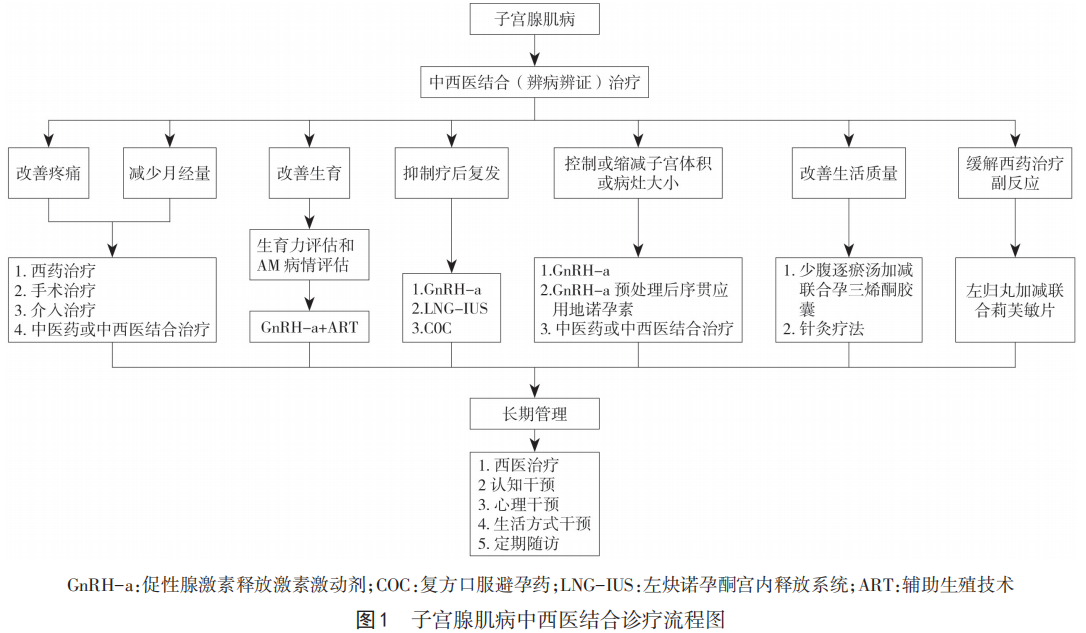
Integrated Diagnosis and Treatment Flowchart
Please refer to Figure 1 for the clinical pathway diagram.
Source:
中国中西医结合学会,中华中医药学会,中华医学会.子宫腺肌病中西医结合诊疗指南(2026年版)[J].中国实用妇科与产科杂志,2026,42(3):295-305.
DOI:10.19538/j.fk2026030109
Editor: Lily