





















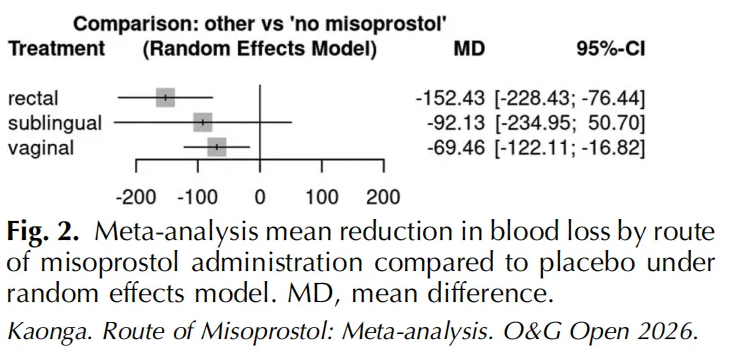
For gynecologists, one of the most worrying complications of transperitoneal myomectomy is heavy intraoperative bleeding. A recent systematic review and network meta-analysis published in O&G Open has provided a clear clinically guiding answer: the route of administration of misoprostol does affect its hemostatic effect, with rectal administration being the best in reducing intraoperative bleeding, with an average reduction of 152.43 mL, a highly statistically significant difference (P<.0001).
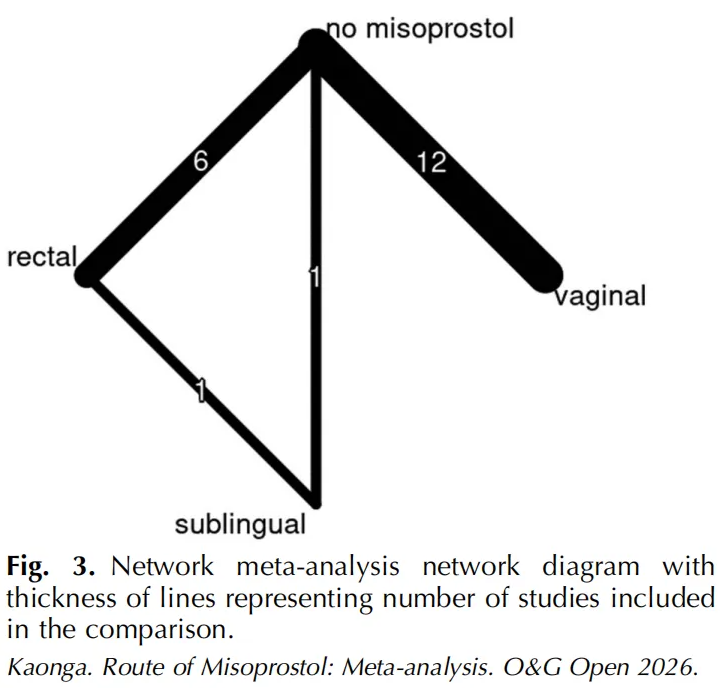
Uterine fibroids are the most common benign tumors in women of childbearing age, which seriously affects the quality of life of patients. Uterine myomectomy is an important procedure to preserve fertility, but intraoperative bleeding has always been a core problem for surgeons. Misoprostol, as a synthetic prostaglandin E1 analogue, has been shown to be effective in reducing intraoperative bleeding due to its powerful uterotonic effect and low cost. However, the three different routes of administration, sublingual, vaginal, and rectal, differ in their pharmacokinetic properties – fast sublingual absorption, high peak but short duration; High vaginal bioavailability and long-lasting effect; Rectal administration is easy and has few gastrointestinal side effects. There is a lack of high-quality evidence on which route provides the best hemostatic benefit for surgery. This study aims to fill this critical gap. The study included 26 studies for final analysis, and quantitatively synthesized data from 20 studies through network meta-analysis. Under a random-effects model, compared to no misoprostol: Figure 1: PRISMA flow chart Rectal administration: associated with the greatest mean reduction in bleeding, with a mean difference of -152.43 mL (95% CI, -228.43 to -76.44, P <.0001). Vaginal administration: equally effective, with a mean reduction in bleeding of -69.46 mL (95% CI, -122.11 to -16.82, P = .010). Sublingual administration: Although a mean reduction in bleeding of -92.13 mL was also shown, the confidence interval was wide and not statistically significant (95% CI, -234.95 to 50.70, P = .206). The network graph drawn by the research team visually shows the intensity of the comparison of each route of administration. The results showed that the number of studies on rectal administration was relatively larger, and the evidence volume was larger. Figure 3: Network meta-analysis Network diagram (the thickness of the lines represents the number of studies included in the comparison) In addition to the core bleeding measures, other key clinical outcomes were analysed. The results showed that the advantages of rectal misoprostol were continuous: Transfusion risk: only rectal administration significantly reduced the risk of postoperative transfusion (hazard ratio -0.79, 95% CI, -1.33 to -0.25, P = .004). Vaginal and sublingual administration did not show a statistically significant advantage in reducing the risk of transfusion. Operative time: rectal administration also significantly reduced operative time, with an average reduction of -18.94 minutes (95% CI, -29.48 to -8.40, P <.001). Although vaginal and sublingual administration also showed a trend towards shortening procedure time, it was not statistically significant in the random-effects model. This result is clearly illustrated by the forest plot, with significantly larger and more stable effect sizes for rectal administration. Figure 2: Forest plot of the mean reduction in bleeding by different routes of misoprostol compared to placebo under the random-effects model Notably, there was a high degree of statistical heterogeneity across multiple outcome measures in this study (e.g., I² of up to 95.2% for bleeding volume outcomes). The authors explain this by suggesting that this may stem from differences in population characteristics, dosage regimens, surgical modalities (open or minimally invasive), etc. To do this, the research team calculated the prediction interval. For example, the 95% predictive interval for rectal administration is -341.09 to 36.22 mL. The authors are cautious to note that this means that the effect may be diminished or even ineffective in some populations in similar studies in the future, but the overall direction and benefit trend is consistent, namely that rectal administration continues to show advantages in reducing bleeding, reducing transfusions, and shortening surgery time. The senior authors of the study noted that despite limitations in the study, such as limited data on the sublingual route of administration and incomplete uniformity of dose and combination regimens between studies, the results strongly support the priority of rectal misoprostol in transperitoneal myomectomy to reduce bleeding. Considering that misoprostol is inexpensive, easily accessible, and has good safety profile, this finding has important practical guiding value for healthcare institutions worldwide, especially in resource-limited areas. Future research should focus on head-to-head randomized controlled trials directly comparing different routes of administration, standardizing dosage and timing, and further exploring the best application strategies in minimally invasive procedures such as laparoscopic and robotic-assisted. At the same time, the available evidence suggests that the potential value of misoprostol in combination with other hemostatic techniques, such as vasopressin, warrants further investigation.
内容来源:Kaonga, Nadi MD, MHS, MS; Patterson, Emma MS; Sanchez-Medina, Mariana C. MD; Pete, Tionne MD; Rilo, Natalie MD; Reardon, Erin MFA, MLIS; Eugley, Scott MS; Frankenfeld, Cara PhD; Fitzgerald, Toby DO. The Route of Misoprostol in Reducing Blood Loss for Transperitoneal Myomectomies: A Systematic Review and Meta-analysis. O&G Open 3(1):e151, February 2026.
Editor-in-charge:lucy