





















ADA 2026 Guideline Update: Management of Hyperglycemia in Pregnancy
The American Diabetes Association (ADA) released the 2026 Standards of Medical Care in Diabetes in December 2025. The section on the management of hyperglycemia in pregnancy serves as a core basis for guiding perinatal endocrine practice. Compared with the 2025 guidelines, the 2026 edition maintains consistent recommendations regarding preconception screening, pre-pregnancy care, comprehensive management of hyperglycemia in pregnancy, preeclampsia prevention, and postpartum care. Major updates are concentrated in three areas: preconception counseling, glycemic targets during pregnancy, and the use of non-glucose-lowering drugs in pregnancy. Based on the latest evidence-based data, this article provides a systematic interpretation of these updates to clarify key clinical points and offer references for domestic obstetric and endocrinology practices.

(Image Source: ADA)
Hyperglycemia in pregnancy includes pre-existing type 1 or type 2 diabetes and gestational diabetes mellitus (GDM). It is closely associated with adverse outcomes such as fetal malformations, macrosomia, preterm birth, preeclampsia, and neonatal hypoglycemia. The ADA updates its diabetes care guidelines annually based on the latest evidence-based medicine, and its recommendations regarding pregnancy hold significant reference value globally. The 2026 ADA guidelines comprise eight modules: preconception screening, preconception counseling, pre-pregnancy care, glycemic targets during pregnancy, management of hyperglycemia in pregnancy, preeclampsia prevention, non-glucose-lowering drug use in pregnancy, and postpartum care. While most recommendations remain consistent with the 2025 guidelines, evidence updates and wording revisions were made specifically to preconception counseling, glycemic control strategies during pregnancy, and non-glucose-lowering drug management. This article interprets these updates to provide a basis for standardized clinical diagnosis and treatment.
I. Preconception Counseling (Key Update in 2026)
The 2026 ADA guidelines continue the safety-core principle for managing diabetes in pregnancy. Preconception counseling should be provided to all women of reproductive age, aiming for an HbA1c <6.5% and discontinuation of non-pregnancy-safe medications such as GLP-1 receptor agonists. During pregnancy, glycemic targets are set at fasting <5.3 mmol/L, 1-hour postprandial <7.8 mmol/L or 2-hour postprandial <6.7 mmol/L, with an ideal HbA1c target of <6.0%. Regarding GDM screening, universal intervention in the first trimester is not recommended; intensive management is reserved only for high-risk individuals (e.g., fasting plasma glucose ≥6.1 mmol/L). For comorbidity management, antihypertensive therapy is initiated at ≥140/90 mmHg without a strict lower blood pressure limit; lipid-lowering drugs are considered for continuation only in high-risk scenarios such as severe hypertriglyceridemia.
➱ The 2026 edition further refines the following evidence-based details:
1. Clarified Pre-pregnancy Glycemic Targets: Pre-meal glucose 4.4–6.1 mmol/L (80–110 mg/dL); 2-hour postprandial glucose <8.6 mmol/L (155 mg/dL). If the 2-hour postprandial glucose is <5.6 mmol/L (100 mg/dL), pre-meal insulin doses should be reduced.
2. GLP-1 Receptor Agonists (GLP-1 RA) and dual-receptor agonists (GIP/GLP-1 RA) must be discontinued prior to planned pregnancy, with strict contraception during use. After discontinuation, switch to pregnancy-safe regimens to achieve targets, initiating insulin therapy if necessary.
3. Comprehensive eye examinations are recommended for all women planning pregnancy. Those with existing diabetic retinopathy require close monitoring during pregnancy.

(Image Source: ADA)
II. Glycemic Targets During Pregnancy (2026 Evidence Update)
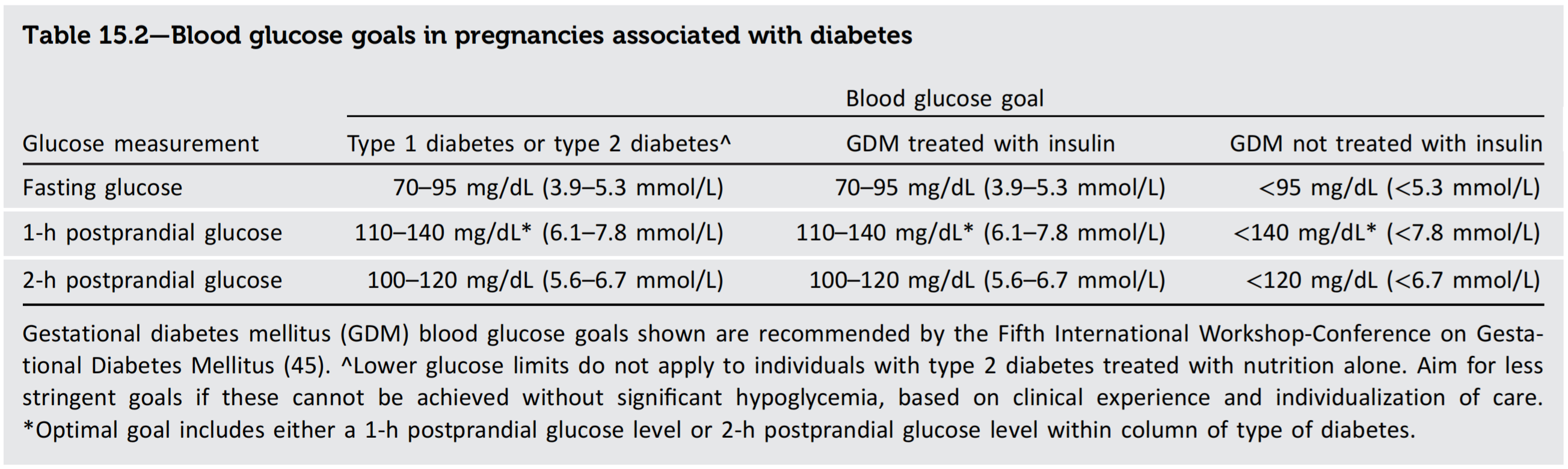
The 2026 ADA guidelines continue to recommend monitoring fasting, pre-meal, and postprandial glucose for all pregnant women with hyperglycemia. The in-target glucose goals remain unchanged:
• Fasting plasma glucose <5.3 mmol/L (95 mg/dL)
• 1-hour postprandial glucose <7.8 mmol/L (140 mg/dL) or
• 2-hour postprandial glucose <6.7 mmol/L (120 mg/dL)
When there is no significant risk of hypoglycemia, the HbA1c target during pregnancy is <6.0%; if the risk of hypoglycemia is high, this may be relaxed to <7.0%. Continuous glucose monitoring (CGM) is recommended for pregnancies complicated by type 1 diabetes to increase time in range and reduce risks of large-for-gestational-age infants and neonatal hypoglycemia. CGM can be used adjunctively with fingerstick glucose monitoring to optimize management.
(Image Source: ADA)
➱ Important New Evidence-Based Conclusion regarding First-Trimester GDM Screening and Intervention:
Despite associations between first-trimester hyperglycemia and adverse outcomes, routine universal screening and preemptive treatment for GDM in the first trimester are not recommended for all pregnant women. The large multicenter randomized controlled trial (TOBOGM) showed that first-trimester intervention only mildly improved composite neonatal outcomes but might increase the risk of small-for-gestational-age infants in hypoglycemic ranges. Therefore, the guidelines recommend focusing on nutritional counseling and regular fasting glucose monitoring before 15 weeks; if fasting glucose is ≥6.1 mmol/L (110 mg/dL), monitoring frequency can be increased to daily checks with intensified treatment, adopting a shared decision-making model for individualized plans.
Furthermore, evidence for CGM benefits is currently robust only for pregnant women with type 1 diabetes. The use of CGM in type 2 diabetes or GDM should be individualized based on treatment plans, disease severity, and patient preference.
III. Use of Non-Glucose-Lowering Drugs in Pregnancy (Key Update in 2026)
The 2026 ADA guidelines introduce important revisions to the management of hypertension and dyslipidemia during pregnancy, aligning more closely with recent clinical trial evidence.
(1) Chronic Hypertension Management
For pregnant women with diabetes and chronic hypertension, initiating or adjusting antihypertensive therapy at ≥140/90 mmHg significantly reduces the risk of adverse pregnancy outcomes; medications should be reduced or suspended if blood pressure falls below 90/60 mmHg. Based on results from the Chronic Hypertension and Pregnancy (CHAP) study group, the previous target range of 110–135/85 mmHg has been removed. There is no longer a strict lower limit target, emphasizing safer, stable blood pressure control. Recommended antihypertensive drugs during pregnancy include Methyldopa, Labetalol, and Nifedipine.
(2) Other Non-Glucose-Lowering Drug Management
1. Angiotensin-converting enzyme inhibitors (ACEIs), Angiotensin receptor blockers (ARBs), and Mineralocorticoid receptor antagonists carry potential fetal risks; they should be avoided in women of reproductive age not using contraception and are contraindicated during pregnancy.
2. Lipid-lowering drugs should generally be discontinued before pregnancy; however, continuation is permissible when benefits outweigh risks, including cases of: Familial hypercholesterolemia, Severe hypertriglyceridemia (Newly added in 2026), and Prior atherosclerotic cardiovascular disease events.
Severe hypertriglyceridemia significantly increases the risk of acute pancreatitis during pregnancy. The guidelines emphasize triglyceride monitoring, nutritional intervention, and medication if necessary for such patients, recommending management by registered dietitians and multidisciplinary teams.
IV. Core Content Consistent with the 2025 Guidelines
(1) Comprehensive Management of Hyperglycemia in Pregnancy
1. Medical Nutrition Therapy (MNT) and lifestyle intervention are the foundation of GDM treatment; most patients achieve targets through lifestyle adjustments alone. Insulin should be initiated promptly if targets are not met.
2. Insulin remains the preferred glucose-lowering drug in pregnancy. Metformin and Glyburide are not recommended as first-line agents due to placental transfer.
3. Metformin used for ovulation induction in Polycystic Ovary Syndrome (PCOS) should be discontinued by the end of the first trimester.
(2) Preeclampsia Prevention
Low-dose aspirin (100–150 mg/day) is recommended for pregnant women with type 1 or type 2 diabetes, initiated between 12–16 weeks of gestation to prevent preeclampsia.
(3) Postpartum Care
1. Postpartum insulin requirements drop dramatically; doses must be reduced promptly to prevent severe hypoglycemia.
2. All women of reproductive age with diabetes should implement effective contraception postpartum.
3. Breastfeeding is recommended as it reduces the long-term risk of type 2 diabetes in women with a history of GDM.
4. Women with a history of GDM should undergo a 75-g oral glucose tolerance test (OGTT) screening at 4–12 weeks postpartum, followed by regular glucose monitoring every 1–3 years.
Conclusion
The 2026 ADA guidelines for hyperglycemia in pregnancy largely continue the core principles of safety and practicality from previous frameworks, with updates emphasizing individualization, safe target achievement, and avoidance of overtreatment. Preconception counseling places greater emphasis on preventing hypoglycemia; glycemic management adopts a more cautious approach to first-trimester GDM intervention; and thresholds for antihypertensive initiation and lipid management are better aligned with actual clinical needs. Clinical practice should integrate guideline recommendations with the characteristics of the local population to implement full-cycle standardized management for pregestational diabetes and GDM patients, thereby improving maternal and neonatal outcomes.
Source:
American Diabetes Association Professional Practice Committee for Diabetes; 15. Management of Diabetes in Pregnancy: Standards of Care in Diabetes—2026. Diabetes Care* 1 January 2026; 49 (Supplement_1): S321–S338. https://doi.org/10.2337/dc26-S015
Editor: Lily