





















1. Introduction
Recurrent spontaneous abortion (RSA), also known as habitual abortion, refers to repeated occurrences of spontaneous pregnancy loss. Previous Chinese expert consensuses, including the "Chinese Expert Consensus on the Diagnosis and Management of Natural Abortion (2020 Edition)" and the "Expert Consensus on the Diagnosis and Management of Recurrent Spontaneous Abortion (2022)", defined RSA as two or more consecutive pregnancy losses (including consecutive biochemical pregnancies) before 28 weeks of gestation. Due to differences in definitions and study populations, the reported prevalence of RSA is 0.5% to 5.0%, showing an increasing trend in China, in part due to the rising age of marriage and childbearing among women.
The etiology of RSA is complex and heterogeneous. Known associated factors include genetics, immunity, thrombophilia, endocrine abnormalities, reproductive tract anatomical abnormalities, age, adverse lifestyle habits, and psychological state. Approximately 40% of cases are classified as unexplained recurrent spontaneous abortion (URSA). Current clinical etiological screening for RSA faces issues such as complex methodologies, overuse of tests, and over-interpretation of results, increasing financial burdens on patients and wasting medical resources. To address this, the Pregnancy Immunology Branch of Shanghai Medical Association, in collaboration with the Reproductive Immunology Professional Committee of the National Health Industry Enterprise Management Association, developed this consensus. It combines evidence-based medicine with China's practical realities, referencing the AGREE II guideline development methodology, to standardize screening content, establish a graded screening process, and provide guidance for clinical practice.
2. Consensus Development
This consensus was developed with reference to the Appraisal of Guidelines for Research and Evaluation II (AGREE II) instrument. Evidence-based medicine experts determined the evidence level and recommendation grade for each recommendation based on the Oxford Centre for Evidence-Based Medicine (OCEBM) criteria.
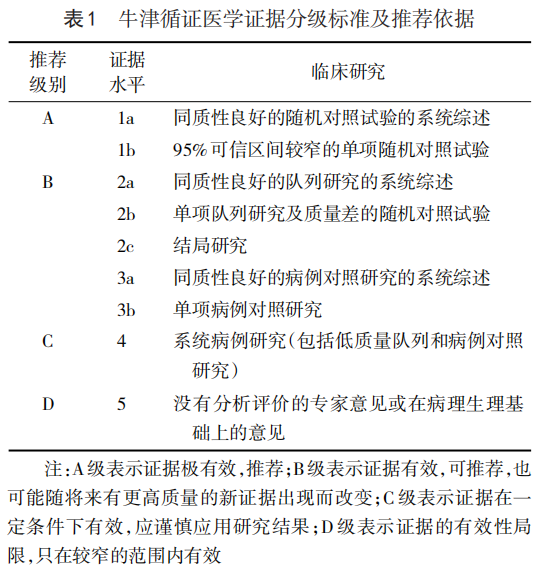
3. Recommendations of this Consensus
3.1 Definition and Diagnostic Criteria of RSA
Recommendation 1: RSA is defined as two or more consecutive pregnancy losses (including consecutive biochemical pregnancies) before 28 weeks of gestation. (Evidence Level: 5; Recommendation Grade: D; Agreement Score: 9.41)
Interpretation: Definitions of RSA vary among international guidelines. RCOG defines it as three or more consecutive losses before 24 weeks, including biochemical pregnancy. ASRM defines it as two or more losses before 20 weeks, excluding biochemical pregnancies and not emphasizing consecutiveness. ESHRE defines it as two or more consecutive losses before 24 weeks, including biochemical pregnancies. Biochemical pregnancy can reflect maternal pathological changes. Including it in the RSA definition promotes early assessment. Considering China's large population, declining birth rate, and rising miscarriage rates, active RSA prevention is crucial. Consensus experts agreed that defining RSA as two or more consecutive losses, including consecutive biochemical pregnancies, aligns with China's social needs.
Recommendation 2: Biochemical pregnancy in the RSA context refers to a pregnancy confirmed by medical institution testing (positive serum or urine hCG) that subsequently regresses spontaneously to non-pregnant levels, without ultrasound assessment or where ultrasound does not detect a gestational sac. Diagnosis should be made by a clinician after comprehensive judgment. (Evidence Level: 5; Recommendation Grade: D; Agreement Score: 9.18)
Interpretation: Lack of a clear definition and standardized diagnostic method for biochemical pregnancy in China, often relying on patient history, can lead to inaccurate RSA diagnosis. ESHRE defines it as positive serum/urine hCG that regresses spontaneously without ultrasound assessment. Before diagnosing RSA, clinicians should review the patient's hCG and ultrasound results.
Recommendation 3: Spontaneous abortion can be classified as early (<12 weeks) or late (12-28 weeks). For RSA patients, the type and number of previous spontaneous abortions should be recorded at the initial visit. (Evidence Level: 2b; Recommendation Grade: B; Agreement Score: 9.68)
Interpretation: Etiologies differ significantly. Fetal chromosomal abnormalities are found in ~60.4% of early miscarriages vs. ~15.3% of late miscarriages. Recurrent early RSA is often due to genetic, immune, thrombophilia, or endocrine factors. Late miscarriages may be associated with thrombophilia, amniotic fluid abnormalities, hematoma/placental abruption, severe congenital anomalies, or cervical insufficiency. Detailed history guides diagnosis and treatment.
Recommendation 4: Early spontaneous abortion can be diagnosed by ultrasound if any of the following criteria is met: 1) Fetal pole ≥7 mm with no cardiac activity; 2) Mean sac diameter ≥25 mm with no fetal pole; 3) Gestational sac without yolk sac, with no cardiac activity 14 days later; 4) Gestational sac with yolk sac, with no cardiac activity 11 days later. (Evidence Level: 2a; Recommendation Grade: B; Agreement Score: 9.85)
Interpretation: Ultrasound in early pregnancy assesses viability. This recommendation is based on systematic reviews, the Chinese "Expert Consensus on the Management of Early Missed Abortion," and the ACR "Appropriateness Criteria for Vaginal Bleeding in Early Pregnancy."
3.2 Target Population for RSA Etiological Screening
Recommendation 5: Patients with two or more consecutive spontaneous abortions are recommended to undergo etiological screening. Enhanced monitoring throughout subsequent pregnancies is advised for early identification and intervention to prevent complications. (Evidence Level: 2a; Recommendation Grade: B; Agreement Score: 9.85)
Interpretation: The risk of miscarriage after two consecutive losses is ~28.3%, significantly higher than the background risk (~11.3%). RSA patients also have increased risks of preeclampsia, placental abruption, and preterm premature rupture of membranes. Screening and monitoring are therefore recommended.
Recommendation 6: Patients with only one spontaneous abortion are generally not recommended for RSA etiological screening. However, screening may be considered if the patient is ≥38 years old or has a history of repeated implantation failure (RIF) with assisted reproductive technology (ART). (Evidence Level: 2a; Recommendation Grade: B; Agreement Score: 9.35)
Interpretation: A single miscarriage is often due to fetal chromosomal abnormality (~60%). The risk of recurrence is not significantly higher than the background risk. Screening is unlikely to provide substantial benefit. However, maternal age ≥38 years significantly increases miscarriage risk. For these patients, or those with RIF history (sharing some etiologies with RSA), screening may be considered to identify potential maternal factors.
3.3 Identification of Risk Factors in RSA Patients Before a Subsequent Pregnancy
Recommendation 7: At the initial visit, a detailed history (present illness, past history, menstrual/obstetric history, trauma/surgery, family history) should be taken. Assess height, weight, and perform a gynecological examination. (Evidence Level: 5; Recommendation Grade: D; Agreement Score: 9.94)
Interpretation: A detailed history (number/gestational age of losses, associated symptoms, treatment, live births, complications) helps in initial etiology assessment. Conditions like autoimmune/endocrine/metabolic diseases, uterine anomalies, cardiovascular/thrombotic diseases increase RSA risk. Family history is also important. Obesity is an independent risk factor. Gynecological examination assesses secondary sexual characteristics and pelvic organs.
Recommendation 8: Inquire about adverse lifestyle habits (smoking, alcohol abuse, long-term night shifts, high work stress) and negative psychological states (anxiety, depression). (Evidence Level: 3a; Recommendation Grade: B; Agreement Score: 9.91)
Interpretation: Adverse lifestyle factors increase miscarriage risk. The association between RSA and negative psychology is recognized. Although the causal relationship is unclear, assessing psychological state is recommended for overall health, with counseling/therapy provided if needed.
3.4 Content of RSA Etiological Screening
(1) Screening for Genetic Factors
Recommendation 9: Genomic copy number variation (CNV) testing (via chromosomal microarray analysis, CMA, or CNV sequencing via NGS) is recommended for products of conception (POC) from all RSA patients. If CNV testing is unavailable, karyotype analysis is an alternative. (Evidence Level: 2b; Recommendation Grade: B; Agreement Score: 9.38)
Interpretation: Fetal chromosomal abnormalities are common, accounting for ~67.8% of early miscarriages (~90% aneuploidy, <10% structural). Analysis of POC can exclude genetic causes and guide management. Karyotyping has limitations: lower resolution and ~20% culture failure rate. CMA/CNV-seq offer higher resolution without culture, but cannot detect balanced rearrangements (rare in POC). RCOG, ESHRE, and Chinese consensus recommend CNV testing. If unavailable, karyotyping is an alternative, with proper handling and counseling about culture failure risk.
Recommendation 10: Peripheral blood karyotype analysis is recommended for RSA couples if POC analysis shows unbalanced structural abnormalities, or if POC analysis was not performed. Routine CNV testing of couples is not recommended. (Evidence Level: 4; Recommendation Grade: C; Agreement Score: 9.74)
Interpretation: Parental chromosomal rearrangements are associated with RSA (found in ~12.6% of couples). Carriers have increased risk of abnormal gametes and miscarriage. Karyotyping remains the preferred method as it detects balanced rearrangements; CNV testing cannot. To avoid waste, it is only recommended for couples with abnormal POC results or no POC analysis.
Recommendation 11: Routine high-throughput genetic testing (whole-genome sequencing, whole-exome sequencing via NGS) on RSA patients, partners, or POC is not recommended. (Evidence Level: 5; Recommendation Grade: D; Agreement Score: 9.76)
Interpretation: RSA is not a monogenic disease. Such tests may identify variants of uncertain significance, are expensive, and do not typically clarify the etiology. They are not recommended routinely, except in clinical trials with informed consent and institutional oversight.
(2) Screening for Autoimmune Factors
Recommendation 12: Screen all RSA patients for lupus anticoagulant (LA), anticardiolipin (aCL) IgG/IgM, and anti-β2 glycoprotein I (aβ2-GPI) IgG/IgM antibodies. (Evidence Level: 2a; Recommendation Grade: B; Agreement Score: 9.97)
Interpretation: Antiphospholipid syndrome (APS) is strongly associated with thrombosis and adverse pregnancy outcomes (RSA, fetal death, preeclampsia, etc.), termed obstetric APS (OAPS). Persistent, high-titer antiphospholipid antibodies (aPLs) are key. LA, aCL, aβ2-GPI are standard laboratory criteria. ~10% of RSA is associated with APS/aPLs. Diagnosis requires positive tests on two occasions ≥12 weeks apart. The 2006 updated Sapporo criteria (still recommended in reproductive medicine/obstetrics) or 2023 ACR/EULAR criteria can be used. Non-criteria OAPS (NOAPS) also exists and should be considered.
Recommendation 13: LA testing should use at least two methods, one of which must be the dilute Russell's viper venom time (dRVVT). (Evidence Level: 5; Recommendation Grade: D; Agreement Score: 9.15)
Interpretation: LA is a key APS criterion. International guidelines recommend two methods. dRVVT is specific and stable; APTT (with low phospholipid/silica activator) is sensitive. A positive result by any method suggests LA presence. Local reference ranges and anticoagulant effects should be considered.
Recommendation 14: For RSA patients meeting OAPS clinical criteria but negative for LA, aCL, and aβ2-GPI, testing for anti-phosphatidylserine/prothrombin (aPS/PT) IgG/IgM and anti-β2GPI domain I (aβ2-GPID1) IgG is recommended. (Evidence Level: 3a; Recommendation Grade: B; Agreement Score: 9.26)
Interpretation: aβ2GPI-D1 and aPS/PT are associated with RSA and may increase APS detection. They can be considered for seronegative OAPS, but testing availability, standardization, and interpretation challenges exist. Use accredited labs and interpret cautiously with clinical context.
Recommendation 15: Screening for antinuclear antibody (ANA) is suggested for all RSA patients. The standard method is indirect immunofluorescence (IIF) on Hep-2 cells, with fluorescent pattern analysis. Solid-phase assays for specific ANA profiles are also suggested. (Evidence Level: 2a; Recommendation Grade: B; Agreement Score: 9.59)
Interpretation: Autoimmune diseases (SLE, SS, RA, SSc, APS) are linked to RSA. ANA screening (Hep-2 IIF) is useful. Specific antibodies (e.g., anti-SSA/SSB) are associated with adverse pregnancy outcomes. However, ANA has low specificity; low titers alone are not diagnostic for RSA etiology.
Recommendation 16: For RSA patients with autoimmune diseases, periodically monitor serum complement C3 and C4 levels to assess disease activity and prognosis. (Evidence Level: 2a; Recommendation Grade: B; Agreement Score: 9.21)
Interpretation: Complement levels are markers of disease activity in SLE, etc. EULAR guidelines recommend monitoring C3/C4 in pregnant SLE/APS patients. Useful for monitoring activity in other autoimmune diseases. Not recommended for RSA patients without autoimmune disease.
Recommendation 17: Routine testing for antisperm antibody, anti-endometrial antibody, and anti-ovarian antibody in RSA patients is not recommended. (Evidence Level: 3b; Recommendation Grade: B; Agreement Score: 9.97)
Interpretation: Evidence linking these antibodies to RSA is insufficient or controversial. Not recommended routinely, except in clinical trials.
(3) Screening for Alloimmune Factors
Recommendation 18: Routine testing for peripheral blood lymphocyte subsets, cytokines (e.g., TNF-α), blocking antibodies, HLA polymorphism, anti-HLA antibodies, and NK cell subsets/ratios in RSA patients is not recommended. (Evidence Level: 3a; Recommendation Grade: B; Agreement Score: 9.18)
Interpretation: Evidence supporting the clinical utility of these tests for RSA is insufficient. Not recommended routinely, except in clinical trials.
(4) Screening for Thrombophilia
Recommendation 19: Screen all RSA patients for serum homocysteine (Hcy). If Hcy ≤15 µmol/L, folate, vitamin B12, and MTHFR gene mutation screening are not recommended. If Hcy >15 µmol/L, these tests can be considered if resources allow. (Evidence Level: 3a; Recommendation Grade: B; Agreement Score: 9.26)
Interpretation: RSA patients have higher Hcy and lower vitamin B12 levels. Hyperhomocysteinemia (HHcy, Hcy >15 µmol/L) increases early miscarriage risk. Folate, B12, MTHFR are involved in Hcy metabolism. MTHFR C677T polymorphism is associated with RSA in Chinese populations. Screening is recommended; further tests for HHcy are optional.
Recommendation 20: For RSA patients with thrombophilia risk (autoimmune disease/positive autoantibodies, personal/family history of thrombosis), screening with thrombin time (TT), APTT, prothrombin time (PT), fibrin(ogen) degradation products (FDP), D-dimer, platelet aggregation test (PAgT), and thromboelastography (TEG) is recommended. If available, protein C, protein S, antithrombin (AT) activity, and "new thrombosis four items" (TAT, PIC, t-PAIC, TM) can be added. (Evidence Level: 5; Recommendation Grade: D; Agreement Score: 9.62)
Interpretation: The initial tests assess coagulation/fibrinolysis. Autoimmune diseases and pregnancy are hypercoagulable states. History increases thrombosis risk. Protein C/S/AT deficiency are common inherited thrombophilias in China. The "new four items" reflect early endothelial/coagulation/fibrinolysis changes. Screening is recommended for at-risk patients.
Recommendation 21: Routine screening for factor V Leiden (FVL) mutation in RSA patients is not recommended. It can be considered for URSA patients in clinical trials to identify activated protein C resistance (APCR). (Evidence Level: 3a; Recommendation Grade: B; Agreement Score: 9.32)
Interpretation: FVL is a major cause of APCR, associated with RSA. However, it is extremely rare in the Chinese population. Routine screening is not recommended. It can be part of clinical trials for URSA.
Recommendation 22: Routine screening for plasminogen activator inhibitor-1 (PAI-1) in RSA patients is not recommended. It can be considered for URSA patients in clinical trials. (Evidence Level: 5; Recommendation Grade: D; Agreement Score: 9.62)
Interpretation: Abnormal PAI-1 activity is rare, and evidence linking it to RSA is insufficient. Not recommended routinely.
Recommendation 23: Routine screening for plasma thrombin activity and prothrombin gene mutation in RSA patients is not recommended. It can be considered for URSA patients in clinical trials. (Evidence Level: 3b; Recommendation Grade: B; Agreement Score: 9.38)
Interpretation: Prothrombin gene mutation is associated with thrombosis and RSA, but is extremely rare in Chinese populations. Routine screening is not recommended.
(5) Screening for Anatomical Factors
Recommendation 24: Three-dimensional (3D) ultrasound of the reproductive tract is recommended for all RSA patients. If unavailable, conventional ultrasound can be considered. (Evidence Level: 2a; Recommendation Grade: B; Agreement Score: 9.88)
Interpretation:* Congenital uterine anomalies (e.g., septate, bicornuate) are found in ~13.3% of RSA patients and increase risk. Acquired anomalies (fibroids, polyps, adhesions) association is less clear. 3D ultrasound has higher detection rates for congenital anomalies than conventional ultrasound or hysterosalpingography.
Recommendation 25: Assess bilateral uterine artery Doppler flow (pulsatility index-PI, resistance index-RI, systolic/diastolic ratio-S/D) in RSA patients during the mid-luteal phase pre-pregnancy and after 10 weeks of gestation. Local reference ranges must be established. (Evidence Level: 5; Recommendation Grade: D; Agreement Score: 8.97)
Interpretation:* Uterine artery flow parameters may correlate with RSA, though evidence is limited. Pre-pregnancy assessment reflects endometrial receptivity; post-10 weeks reflects uteroplacental perfusion. Due to equipment/operator variability, each institution must establish its own reference ranges.
Recommendation 26: For RSA patients with a history of repeated intrauterine procedures, cervical surgery, late miscarriage, or preterm birth, enhanced cervical morphological assessment during pregnancy is recommended for timely detection of cervical insufficiency. (Evidence Level: 3a; Recommendation Grade: B; Agreement Score: 9.71)
Interpretation:* Cervical insufficiency is linked to late miscarriage/preterm birth. History of cervical trauma/surgery is a risk factor. Diagnosis is clinical; ultrasound (e.g., cervical length ≤25mm at 16-24 weeks) can be suggestive. Enhanced monitoring is advised for at-risk patients.
(6) Screening for Endocrine Factors
Recommendation 27: For RSA patients with symptoms of reproductive endocrine disorders (abnormal uterine bleeding, amenorrhea, acne, hirsutism), perform early-follicular phase sex hormone tests: FSH, LH, E2, P, T, PRL. (Evidence Level: 5; Recommendation Grade: D; Agreement Score: 9.79)
Interpretation:* Conditions like PCOS and hyperprolactinemia increase RSA risk and present with such symptoms. Screening aids diagnosis. For patients with regular cycles, routine baseline hormone testing is not recommended by international guidelines.
Recommendation 28: Anti-Müllerian hormone (AMH) testing is recommended for all RSA patients. (Evidence Level: 3b; Recommendation Grade: B; Agreement Score: 8.62)
Interpretation:* RSA patients may have a higher risk of diminished ovarian reserve. The exact relationship is unclear. Given China's fertility concerns, testing is recommended to assess ovarian reserve and guide management.
Recommendation 29: Screen all RSA patients for thyroid peroxidase antibody (TPOAb) and thyroglobulin antibody (TGAb). (Evidence Level: 2a; Recommendation Grade: B; Agreement Score: 9.82)
Interpretation:* Strong evidence links TPOAb/TGAb positivity with RSA. Screening is recommended.
Recommendation 30: Perform thyroid function tests (T3, T4, FT3, FT4, TSH) for all RSA patients. (Evidence Level: 2a; Recommendation Grade: B; Agreement Score: 9.82)
Interpretation:* Hypothyroidism, subclinical hypothyroidism, and hyperthyroidism are associated with RSA and require management in pregnancy. Screening is recommended.
Recommendation 31: For RSA patients with high-risk factors for glucose metabolism disorders (PCOS, diabetes, obesity), perform fasting blood glucose, oral glucose tolerance test (OGTT), and insulin release test. (Evidence Level: 3b; Recommendation Grade: B; Agreement Score: 9.68)
Interpretation:* Insulin resistance/glucose intolerance in PCOS/diabetes/obesity are RSA risk factors. Screening in high-risk patients allows for intervention.
(7) Screening for Infectious Factors
Recommendation 32: Screening for reproductive tract infections (e.g., vaginal discharge routine, Mycoplasma, Chlamydia, TORCH) is not recommended for determining RSA etiology. (Evidence Level: 2a; Recommendation Grade: B; Agreement Score: 9.5)
Interpretation:* Maternal infections can cause sporadic miscarriage/preterm birth but are not clearly linked to RSA. Screening can be part of preconception care but is not an etiological investigation for RSA.
(8) Screening for Male Factors
Recommendation 33: Routine semen analysis and sperm morphology testing for the male partners of RSA patients are not recommended. Sperm DNA fragmentation index (DFI) assessment can be considered. (Evidence Level: 2b; Recommendation Grade: B; Agreement Score: 8.65)
Interpretation:* Sperm DFI is associated with miscarriage and is higher in partners of RSA patients. No evidence links standard semen parameters to RSA or that treating abnormalities improves outcomes. DFI assessment may help explain etiology.
(9) Risk Assessment for Subsequent Pregnancy Loss in RSA Patients
Recommendation 34: Use prediction tools to assess the risk of subsequent pregnancy loss in RSA patients. (Evidence Level: 2b; Recommendation Grade: B; Agreement Score: 9.15)
Interpretation:* Risk assessment guides management. A Chinese retrospective study of 3,387 RSA patients developed a validated prediction model incorporating 9 factors: age, previous miscarriages, LA, aCL IgM, aPS/PT IgM, anti-dsDNA, PAgT, TT, and uterine artery S/D ratio. This tool is recommended for use in the Chinese population.
3.5 Graded Strategy for RSA Etiological Screening
Given the complex, heterogeneous etiology of RSA and the multitude of available tests, a graded screening strategy is proposed to optimize resource use (Evidence Level: 5; Recommendation Grade: D; Agreement Score: 9.74).
• Tier 1 (Basic): Recommended for all eligible RSA patients at initial visit. Positive findings can indicate etiology.
• Tier 2 (Advanced): Recommended for RSA patients with negative Tier 1 results. Positive findings can indicate etiology. URSA is diagnosed only after Tier 1 and 2 screenings are negative.
• Tier 3 (Clinical Trial): Not recommended for routine clinical practice. To be conducted only within approved clinical trials with informed consent and institutional oversight.
The rationale for the grading is summarized in Table 2, and the specific tests for each tier are listed in Table 3.
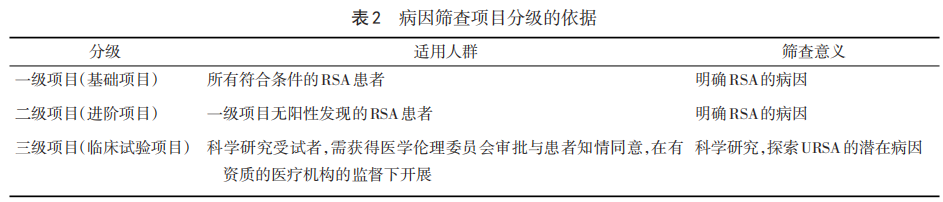
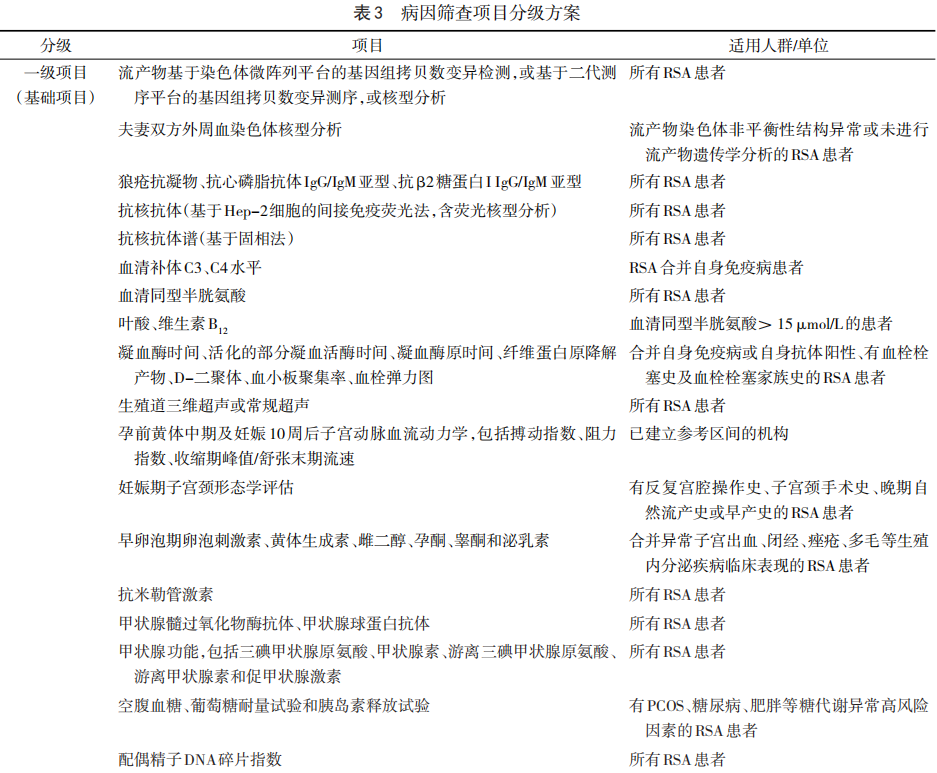
Image Source: Pregnancy Immunology Branch of Shanghai Medical Association, Reproductive Immunology Professional Committee of the National Health Industry Enterprise Management Association, Writing Group of the Chinese Expert Consensus on the Clinical Practice of Graded Etiological Screening for Recurrent Spontaneous Abortion. Chinese Expert Consensus on the Clinical Practice of Graded Etiological Screening for Recurrent Spontaneous Abruption (2025 Edition) [J]. Chinese Journal of Practical Gynecology and Obstetrics, 2025, 41(11): 1111-1123.
Editor: Lily