





















As a common surgical method in obstetrics, cesarean section has always attracted much attention for its suturing technique of uterine incision. In recent years, more and more studies have begun to explore the effects of different suture methods on uterine scar healing and long-term complications. Especially for women who need to have children again, cesarean section uterine suturing is not only related to postoperative recovery, but also directly affects the safety of the uterus in the next pregnancy.
A recent study published in the American Journal of Obstetrics & Gynecology examined the relationship between cesarean section uterine suturing technique and lower uterine segment (LUS) thickness and the risk of uterine scar dehiscence in the next pregnancy. This article will provide you with a detailed explanation of the core findings of this study and explore its implications for clinical practice.
In cesarean section, the suturing methods of uterine incision are mainly divided into single-layer sutures and double-layer sutures. In addition, whether or not the endometrium is sutured (decidua) is also a key variable. Earlier studies have found that different suturing methods have a significant effect on residual muscle thickness (RMT) at 6 months after surgery. For example, a randomized controlled trial showed that double-layer sutures without endometrium retained thicker residual muscle layer than single-layer sutures with endometrium (6.1±2.2 mm vs 3.8±1.6 mm; P<.001)[1]。 However, whether residual muscle thickness can accurately predict the state of uterine scarring in the next pregnancy has always been an unsolved mystery in clinical practice. To answer this question, the researchers followed up patients who had previously participated in randomized trials for a long time, focusing on their lower uterine thickness at the next pregnancy and uterine scar presentation at cesarean section. The study included 81 participants who had participated in a randomised trial of sutures. These participants were randomly assigned to three suture groups during a previous cesarean section: 1. Single-layer lock suture containing the endometrium (n=27) 2. First layer of double layer locking suture containing the endometrium (n=27) 3. First layer of double-layer non-locking suture without endometrium (n=27) At follow-up, a total of 41 (51%) participants experienced the next pregnancy (gestational > 20 weeks). Of these, 51% (21/41) of participants underwent ultrasound to assess lower uterine thickness at 35 to 38 weeks of gestation, and 80% (33/41) of participants ended up undergoing a second cesarean section. The researchers classified it into three risk levels based on the thickness of the lower segment of the uterus measured by ultrasound: • < 2.0mm: Very likely to occur dehiscence, high risk of uterine rupture • 2.0 to 2.4 mm: may occur with a moderate risk of uterine rupture • ≥2.5mm: less likely to occur and low risk of uterine rupture[2] The results showed that although there was a certain difference in the thickness distribution of the lower uterine segment measured by ultrasound between the different suture groups, this difference was not statistically significant (P=.48). This suggests that ultrasound evaluation in the third trimester alone may be difficult to fully distinguish the risk differences from different suture modalities. Although ultrasound evaluation failed to find a significant difference, the status of uterine scarring directly observed during re-cesarean section gave a clear answer. The researchers reviewed the surgical records and found that: • The incidence of complete scar dehiscence was as high as 38% in the single-layer suture group, compared to 9% in the double-layer suture group containing the endometrium in the first layer and 0% in the double-layer suture group without endometrium in the first layer (P<.01). • The incidence of thinning or partial dehiscence of the lower uterine segment was also highest in the single-layer suture group (38%), compared with 9% and 14% in the two-layer suture group (P=.02). Taken together, monolayer sutures containing the endometrium had a significantly higher risk of uterine scar dehiscence or thinning of the lower uterine segment in the next pregnancy than in the double-layer suture group. Table 1: Comparison of outcomes of different cesarean section uterine suturing methods in the next pregnancy Video: How does the technique of uterine suturing for cesarean section affect uterine scarring in the next pregnancy? The study also found that residual muscle thickness (RMT) measured 6 months after cesarean section did not accurately predict the state of uterine scarring in the next pregnancy. There was no significant difference between participants with partial or complete uterine scar dehiscence at 6 months postoperatively with a median RMT of 3.7 mm compared to 4.5 mm in participants who did not develop dehiscence (P=.19). This suggests that the results of ultrasound evaluation in the early postoperative period cannot be used as an absolute guarantee for the safety of the uterus in the next pregnancy. The results of this study provide an important reference for clinicians when choosing cesarean section sutures. Combining data from other large randomized trials, we can draw the following conclusions: Double-layer sutures are better than single-layer sutures: Double-layer sutures that do not contain the endometrium may significantly reduce the risk of uterine scar dehiscence in the next pregnancy compared to single-layer sutures. The importance of avoiding the endometrium: Avoiding the endometrium during multi-layer suturing can avoid the introduction of endometrial cells into scar tissue, thereby reducing the occurrence of scar defects[5]。 Layer-to-layer (intima to intima and myometry to myometry) sutures are more beneficial for the healing of uterine incisions. Need for long-term follow-up: Residual muscle thickness (RMT) in the early post-cesarean section is not a reliable predictor of uterine scar dehiscence in the next pregnancy. Future research and clinical practice should pay more attention to long-term follow-up and evaluation of pregnancy outcomes. The choice of uterine suturing method for cesarean section is not only related to the success of this operation, but also to the patient's future fertility safety. For women who intend to have another child, a double-layer suture technique that does not contain the endometrium may be the safer and recommended option at present. Of course, due to the relatively small sample size of ultrasound and childbirth follow-up data in this study, these conclusions still need to be further validated in larger studies. As obstetricians and gynecologists, we should continue to pay attention to the latest research advances in this field to provide patients with the most optimal and safest surgical options. [References] [1] Demers S, Girard M, Vikhareva O, et al. Impact of uterine closure on residual myometrial thickness after cesarean: a randomized controlled trial. Am J Obstet Gynecol 2016; 214:507.e1–6. [2] Jastrow N, Demers S, Chaillet N, et al. Lower uterine segment thickness to prevent uterine rupture and adverse perinatal outcomes: a multicenter prospective study. Am J Obstet Gynecol 2016; 215:604.e1–6. Editor-in-charge:lucy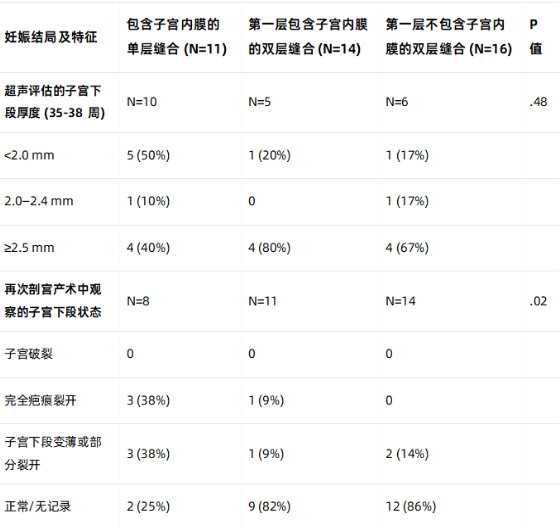
[3] Abalos E, Addo V, Brocklehurst P, et al. Caesarean section surgical techniques: 3 year follow-up of the CORONIS fractional, factorial, unmasked, randomised controlled trial. Lancet 2016; 388:62–72.
[4] Verberkt C, Stegwee SI, Huirne JAF. Hysterotomy closure at cesarean, beyond the number of layers; a response. Am J Obstet Gynecol 2024; 231:e45–6.
[5] Bujold E, Romero R. Uterine closure after cesarean delivery: surgical technique, biological rationale, and clinical implications. Am J Obstet Gynecol 2026; 233(6S):S82–102.