
Will the risk of stillbirth increase if you encounter extreme heat during pregnancy? This issue is becoming more and more concerned in the context of intensifying climate change. A prospective longitudinal study based on a Chinese birth cohort study involving more than 240,000 pregnant women gave a more refined answer: the key window period for high temperature exposure to increase the risk of stillbirth is not the entire pregnancy, but is concentrated at 32-36 weeks of gestation, especially at 35 weeks of gestation; What is even more surprising is that the high humidity environment did not exacerbate the harm of high temperatures, but showed an antagonistic effect - the risk of stillbirth in dry heat conditions was much higher than in humid heat conditions. This finding has important value for obstetric clinical guidance and public health policy formulation.
The latest research results of Professor Liu Ruixia's team from Beijing Obstetrics and Gynecology Hospital Affiliated to Capital Medical University were published in the authoritative journal "Environmental Research" in the field of environment. Based on the Chinese birth cohort study, the research team covered 334,924 pregnant women recruited from 52 hospitals in Chinese mainland between February 2018 and December 2022, and finally included 244,204 pregnancies after exclusion, including 243,262 live births and 942 stillbirths. Stillbirth is defined as a gestational age of ≥ 20 weeks and no signs of life at birth, excluding termination of pregnancy due to fetal abnormalities.
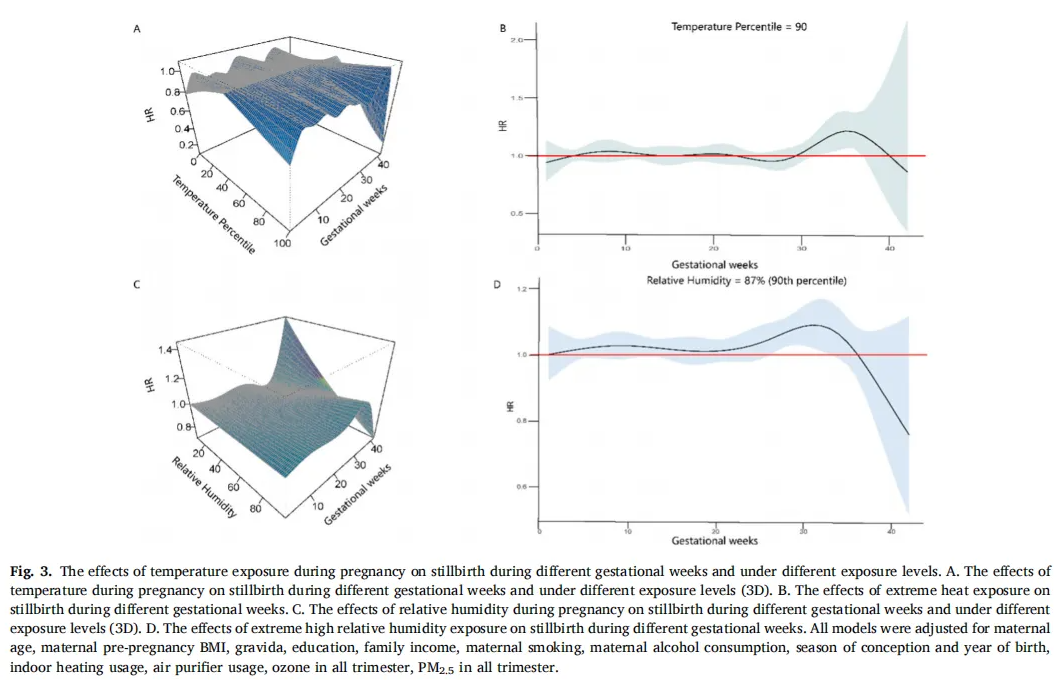
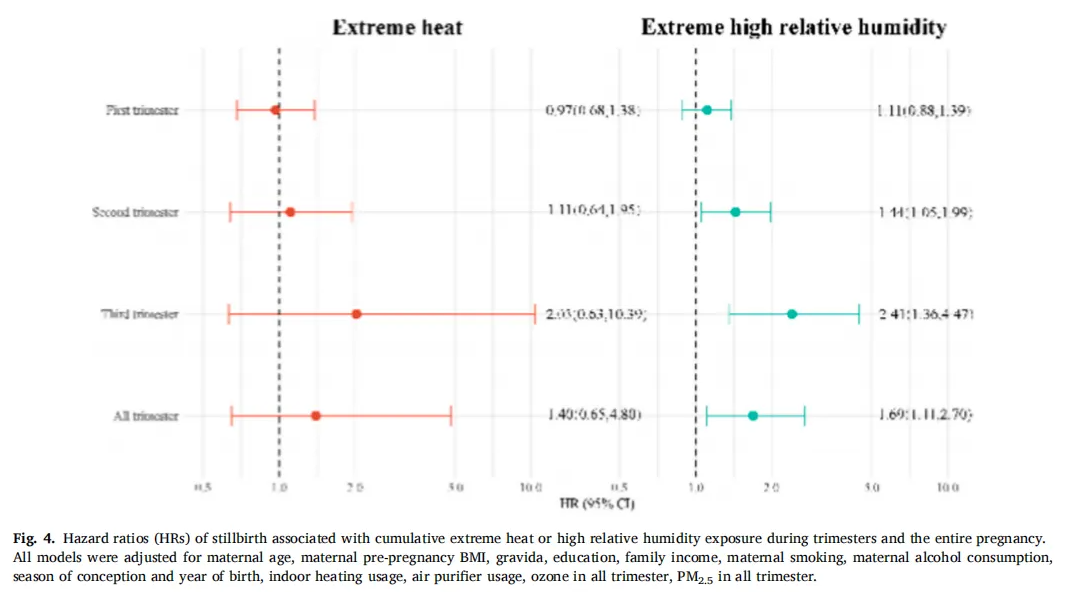
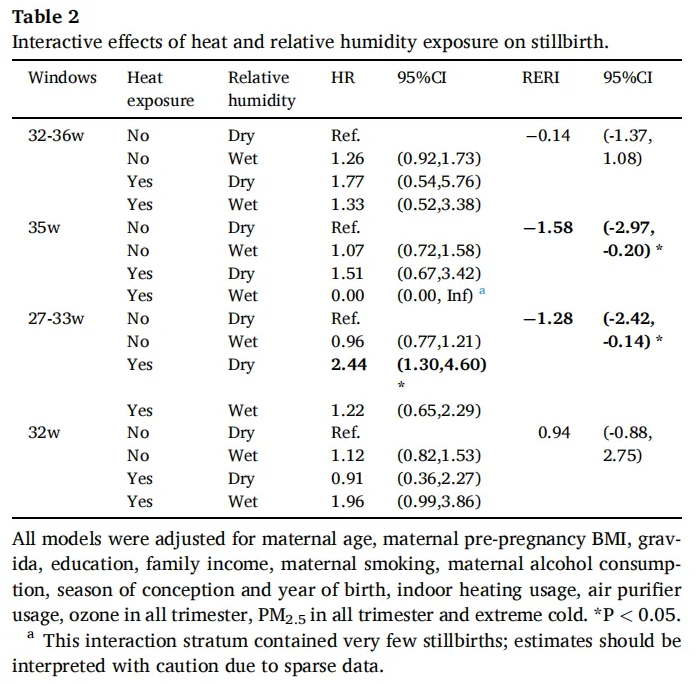
A distribution lag nonlinear model combined with time-dependent Cox regression was used to evaluate the relationship between weekly heat exposure and relative humidity exposure and stillbirth risk in pregnant women. Meteorological data is derived from the land surface data assimilation system of the China Meteorological Administration, including daily average temperature and relative humidity from 2017 to 2023. Extreme heat is defined as the 90th percentile ≥ temperature in the region. The study first determined that the minimum relative humidity for death is 55%, which is the level of relative humidity with the lowest incidence of stillbirths. The relationship between relative humidity and stillbirth showed a U-shaped curve, and too low or too high humidity increased the risk of stillbirth. The relative excess risk of interaction was also calculated to assess whether heat and humidity deviate from the additive combined effect. The study found that the key window period for extreme heat exposure to increase the risk of stillbirth was at 32-36 weeks of gestation, with the strongest risk ratio at 35 weeks of gestation, with an HR of 1.22 (95% CI: 1.06 to 1.39). This means that pregnant women exposed to extreme heat during the week had a 22% higher risk of stillbirth than in the reference group. For extremely high relative humidity (> 55% and ≥ 90th percentile), the critical window was at 27-33 weeks gestation, with the strongest risk ratio at 32 weeks of gestation, with an HR of 1.08 (95% CI: 1.00 to 1.17). The study did not find a clear critical window between extremely low relative humidity (≤ 10th percentile) exposure and stillbirths. The above figures A and C show the effect distribution of temperature and relative humidity on the risk of stillbirth at different gestational weeks and different exposure levels throughout pregnancy, respectively, and intuitively show the dynamic characteristics of risk changes with gestational age and exposure intensity. From the cumulative effect, exposure to extremely high relative humidity significantly increases the risk of stillbirth in the second, third and entire trimesters. Specifically, the HR for second-trimester exposure was 1.44 (95% CI: 1.05 to 1.99), the HR for third-trimester exposure was 2.41 (95% CI: 1.36, 4.47), and the HR for full-trimester exposure was 1.69 (95% CI: 1.11, 2.70). It is important to note that studies have not found a significant association between the cumulative effects of extreme heat exposure and the risk of stillbirth at different gestational periods. This seemingly contradictory result shows that the effects of extreme heat are highly timescale-dependent, and the effect is diluted when exposure averages over longer periods of pregnancy, such as the entire pregnancy or the third trimester; and week-specific analysis can accurately capture the short but biologically critical window of thermal effects. This is the first study to investigate the effects of high temperature and relative humidity interaction on stillbirths. During the critical window period, the study evaluated the combined effects of heat and high humidity. The results showed that there was an antagonistic effect between heat and high humidity, and the relative excess risk of the interaction was -1.28 (95% CI: -2.42 to -0.14), suggesting that the combined effect of the two was less than the sum of their respective effects. Specifically, the risk of stillbirth with extreme heat and low humidity (dry heat) was significantly increased at the critical window of 32 weeks gestation, with an HR of 2.44 (95% CI: 1.30 to 4.60); However, the HR of extreme heat with high humidity (humid heat) was only 1.22 (95% CI: 0.65 to 2.29), and it was not statistically significant. This suggests that the risk of stillbirth in dry heat is much higher than that in humid and hot environments, and high humidity weakens the adverse effects of high temperature. The study also adjusted for extreme cold (temperature ≤ 10th percentile) and air pollutants such as PM2.5 and ozone as time-dependent variables. In the sensitivity analysis, the definitions of extreme heat and humidity were changed to the 85th or 95th percentile, or the degrees of freedom of the nonlinear model with distribution lag were changed, and the results remained robber. In the discussion, the researchers proposed that the underlying pathophysiological mechanisms of stillbirth caused by high temperature include increased maternal body temperature, electrolyte disturbances due to dehydration, endocrine system disorders, altered glucose metabolism, release of antidiuretic and stress hormones, and upregulation of heat shock proteins, etc., which may impair placental growth and function. The increase in maternal cardiac output and plasma volume in the third trimester, coupled with fetal metabolic thermogenesis and fat deposition, makes the mother more sensitive to heat exposure and constitutes a susceptibility window. For high humidity, it may induce heat stress by inhibiting sweat evaporation, reducing heat dissipation efficiency, and increasing core body temperature, which in turn affects placental perfusion and oxygen delivery. In addition, high humidity may also promote microbial proliferation and increase the risk of infection in pregnant women. As to why high humidity antagonizes the effect of high temperature, the researchers caution that the negative value of the interaction relative to excess risk should be interpreted as a statistical interaction rather than an exact biological antagonist evidence. Possible causes include inconsistent estimates due to small subgroup sample sizes, exposure to mis-bias, and residual confounding. There are several limitations to this study. First, the lack of information on the daily activity patterns and changes of residence of pregnant women, and the assessment of exposure based solely on the home address at the time of enrollment, may lead to misscore bias. However, previous studies have shown that pregnant women spend most of their time at home and in the community, and the longer the gestational age increases, the longer they stay at home. second, environmental epidemiological research can only reveal the association, but cannot prove the causal relationship; Third, there are unmeasured confounding factors, such as indoor humidifier use, infection, etc.; Fourth, only 457 cases (48.5%) of the etiology classification data of stillbirths are available, and stable estimation by subtype cannot be made. The research team pointed out that more complete data on the etiology of stillbirths are needed in the future to assess whether there is heterogeneity in the effects of heat and humidity exposure on stillbirths of different etiologies. The study clarified that the sensitive windows for extreme high temperature and extreme high humidity during pregnancy to increase the risk of stillbirth were 32-36 weeks of gestation and 27-33 weeks of gestation, respectively, and the risk of stillbirth in dry and hot environments was higher than that in humid and hot environments. In the context of global warming, these findings provide a new scientific basis for understanding the health effects of extreme weather conditions on pregnancy outcomes and protecting pregnant women, a vulnerable population. Content sources: Zhan Li, Yuxin Bi, Shuangying Li, Shaofei Su, Lebing Wang, Juan Li, Shuanghua Xie, Enjie Zhang, Minhui Hu, Shaowen Wu, Jianhui Liu, Chenghong Yin, Alexander E.P. Heazell, Guang-Hui Dong, Ruixia Liu,Critical windows and joint effects of prenatal heat and relative humidity exposure on stillbirth: A prospective longitudinal cohort study,Environmental Research,Volume 297,2026,124155,ISSN 0013-9351,https://doi.org/10.1016/j.envres.2026.124155.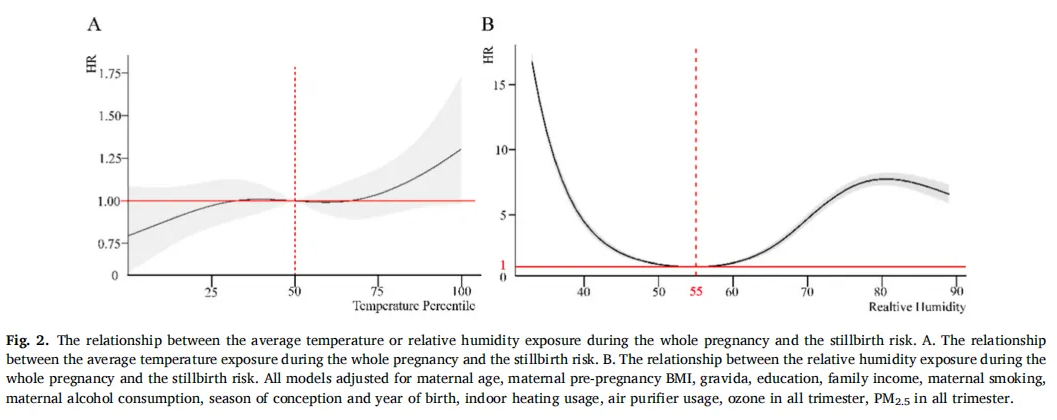
Editor-in-charge:lucy