





















Guideline Alert | Interpretation of the 2026 ACOG Cervical Cancer Screening Guidelines: Prefer HPV Primary Screening, Exercise Prudent Oversight of HPV Self-Sampling
In April 2026, the American College of Obstetricians and Gynecologists (ACOG) updated its cervical cancer screening guidelines, adopting the Women's Preventive Services Initiative (WPSI) updated recommendations from January 2026. This new guidance replaces the 2021 Practice Advisory and serves as the current core clinical basis for cervical cancer screening in the average-risk population in the United States.
Rooted in evidence-based medicine while accounting for disparities in medical resources across different regions, this guideline systematically adjusts screening strategies for various age groups. Clinician-collected high-risk HPV (hrHPV) primary screening is designated as the preferred option for women aged 30–65, and patient-collected (self-collected) hrHPV testing is included for the first time under specific conditions. The guideline explicitly states that the primary obstacle to cervical cancer control is not the screening technology itself, but the non-standardized implementation of screening.
PART 01: Scope of Application — Distinguishing Average Risk from Special High-Risk Populations
These recommendations apply exclusively to individuals at average risk for cervical cancer. The following populations are excluded from this screening standard:
• Individuals with Human Immunodeficiency Virus (HIV);
• Immunocompromised individuals without HIV;
• Individuals with in-utero exposure to diethylstilbestrol (DES).
Furthermore, this guideline regulates primary cancer screening for healthy populations only. It does not cover the management of abnormal screening results, surveillance after cervical precancer treatment, or post-operative monitoring for cervical cancer. Related management should follow the 2019 ASCCP Risk-Based Management Consensus Guidelines and subsequent enduring consensus guidelines.
For individuals who have undergone a total hysterectomy with removal of the cervix:
• Routine cervical cancer screening is not recommended if there is no history of cervical cancer or high-grade precancerous lesions.
• If such a history exists, regular follow-up as directed by a physician is still required.
PART 02: Standardized Age-Specific Screening Protocols
01 | Ages 21–29: Continuation of Cytology-Only Screening
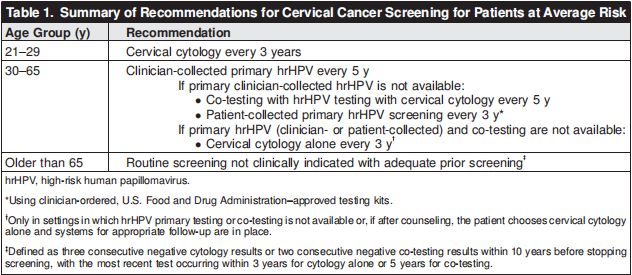
This age group should uniformly undergo cervical cytology (commonly TCT/LBC) alone every 3 years. Routine inclusion of HPV testing in primary screening is not recommended.
• Supplement: While the American Cancer Society (ACS) suggests HPV-only screening as an option for ages 25–29, ACOG does not list this as a universal recommendation.
02 | Ages 30–65: Core Reform — Four-Tiered Stratified Screening
This age group is the focus of the revision. The previous model—where cytology, HPV testing, and co-testing held "equal status"—has been replaced. Clinician-collected FDA-approved hrHPV testing is now the preferred strategy, performed every 5 years. Other strategies serve as alternatives based on specific scenarios:
• Co-testing (HPV + Cytology): Acceptable when hrHPV primary screening is unavailable, or when the patient chooses co-testing after informed counseling. Interval: every 5 years.
• Qualified Self-Collected HPV Screening (New Addition): Permitted only if systems are in place for documentation, notification, and follow-up. Must use FDA-approved kits and be authorized by a clinician. Interval: fixed at every 3 years. Due to a lack of U.S. domestic evidence supporting a 5-year interval, the 5-year standard is not applied to self-sampling.
• Cytology Alone: Retained strictly as a "safety net" option. Used only when HPV-related testing is unavailable or if the patient insists after counseling. Interval: every 3 years.
Evidence shows that the sensitivity of cytology alone is significantly lower than that of hrHPV primary screening or co-testing; thus, it steps down from the preferred position.
03 | Older Than 65: Screening May Cease If Criteria Are Met
Routine screening may stop if the individual meets the following criteria: Within the 10 years before stopping, they have had either three consecutive negative cytology results OR two consecutive negative co-testing results; AND the most recent test was within 3 years (for cytology alone) or 5 years (for co-testing).
If prior screening is inadequate or high-risk factors are present, screening should continue regardless of age.
PART 03: HPV Self-Sampling — Bridging Gaps with Strict Implementation
Global cervical cancer screening coverage is uneven, with low rates among remote and hard-to-reach populations. HPV self-sampling is included to fill these gaps and improve accessibility. It serves only as a supplement and must not replace clinician-collected hrHPV primary screening. ACOG maintains a cautious stance:
• Evidence Gap: Most large-scale data supporting self-sampling come from outside the U.S., lacking long-term domestic follow-up data. Unregulated at-home self-testing is not recommended.
• Access Restrictions: All self-sampling kits must be FDA-approved and ordered/evaluated by a clinician, ideally implemented under institutional oversight.
• System Prerequisites: Safe implementation hinges on robust systems for positive result notification and follow-up tracking. Without such systems, cases may be missed. Given the minimum 3-year screening interval, latent lesions could progress undetected, delaying optimal intervention.
• Risk Management: Self-sampling risks overscreening (too frequent or outside age limits), for which no standardized protocols exist. Therefore, self-sampling must occur entirely within a clinical framework and under medical guidance.
PART 04: Rationale Behind the Revision — Balancing Evidence with Reality
While fully adopting the WPSI framework, ACOG added practical provisions acknowledging regional resource disparities in the U.S. Inadequate laboratory infrastructure, incomplete insurance coverage for FDA-approved hrHPV tests, and cost barriers prevent a nationwide rollout of hrHPV primary screening alone. Retaining co-testing and cytology as alternatives is a pragmatic adjustment to current medical realities.
PART 05: Conclusion — Standardized Screening is Key to Control
The 2026 ACOG guidelines mark a formal transition in cervical cancer screening from "cytology-led" to "HPV-first." The conditional expansion of self-sampling is a significant step toward universal screening coverage, yet its strict implementation requirements reflect a baseline principle: relaxing the collection method does not mean relaxing screening management.
Moving forward, promoting new technologies while simultaneously perfecting quality control and follow-up systems is the only way to truly reduce the incidence and mortality of cervical cancer.
*
Disclaimer: [This article is intended for medical professionals for academic exchange and learning purposes only. It does not constitute specific clinical operation guidelines. Actual clinical decisions must integrate patient conditions, hospital resources, and the latest guidelines. Multidisciplinary consultation is recommended when necessary.]
Source: American College of Obstetricians & Gynecologists. Screening for Cervical Cancer: Committee Statement No.28[J]. Obstetrics & Gynecology, 2026. https://doi.org/10.1097/AOG.0000000000006257.
Editor: Lily