





















In recent years, the incidence and mortality rates of endometrial cancer have continued to rise, with a notable trend toward younger onset. It is no longer the traditionally perceived "early-stage, generally good prognosis" tumor. A landmark review published in JAMAin April 2026, synthesizing top-tier evidence from the past 15 years—including 31 RCTs and 17 international guidelines—clearly outlines a critical shift in endometrial cancer management: from reliance solely on FIGO staging toward a precision-based stratified approach integrating "histopathology + molecular classification + clinical risk."
Source: JAMA
I. Disease Trends: Three Essential Updates in Clinical Understanding
The disease profile of endometrial cancer is evolving, necessitating a more comprehensive risk-awareness among clinicians.
Rising incidence and mortality, increasing the overall disease burden.
Pronounced younger onset, with the fastest incidence growth in women aged 20–39; obesity, metabolic abnormalities, and delayed childbirth are significant contributing factors.
Pronounced tumor heterogeneity: while endometrioid carcinomas generally have a relatively favorable prognosis, aggressive subtypes (serous, clear cell, carcinosarcoma) can recur or metastasize early, with markedly different outcomes.
II. Diagnosis: Histopathology as the Gold Standard, Not Relying Solely on Endometrial Thickness
Diagnostic thinking should return to clinical fundamentals: symptoms as clues, imaging for initial screening, and histopathology as the definitive basis, avoiding misjudgment due to overreliance on single indicators.
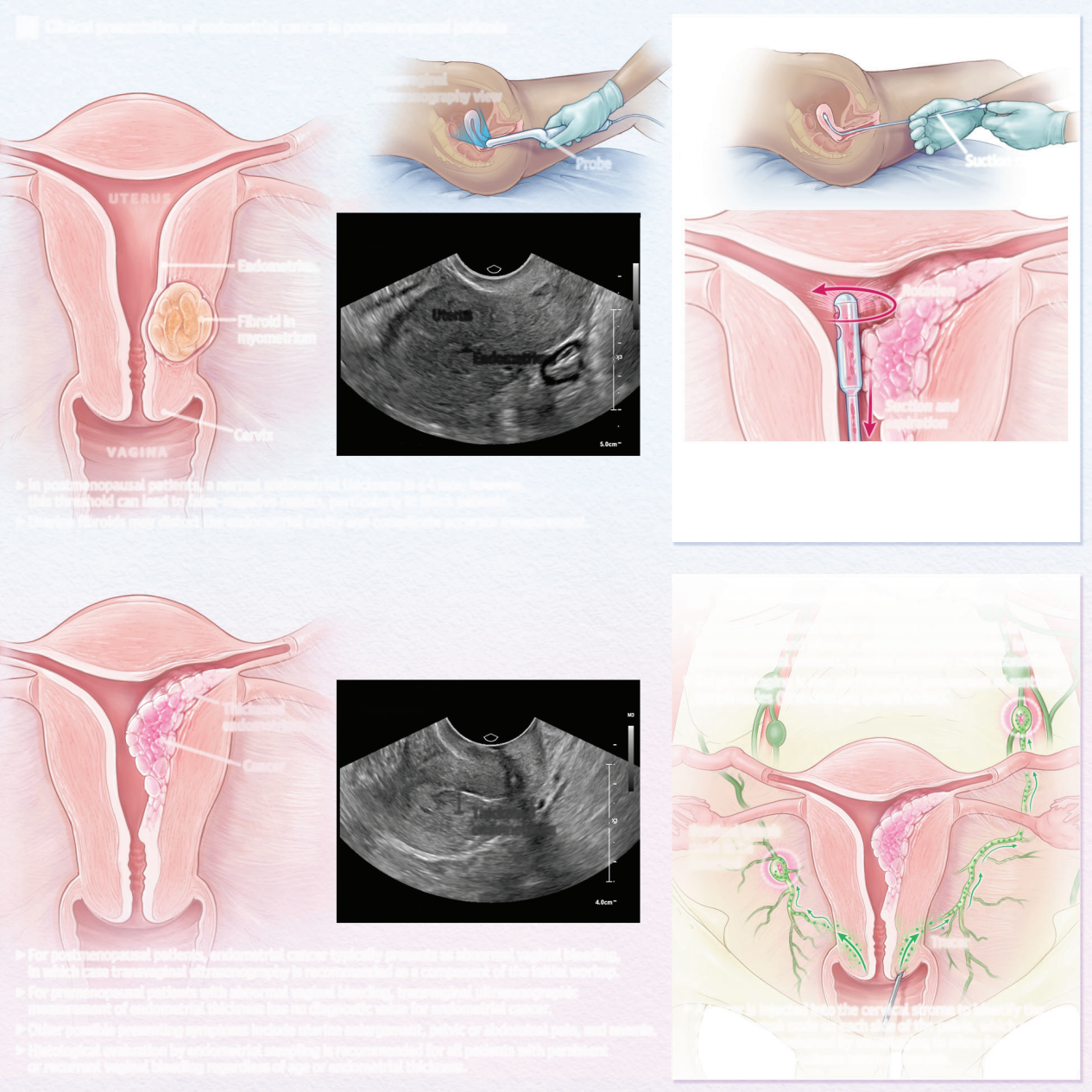
Key symptom: Postmenopausal bleeding is the most warning sign; perimenopausal and younger women present mainly with irregular bleeding or prolonged menstruation; advanced stages may involve pelvic pain, anemia, or intrauterine fluid.
Imaging localization: Transvaginal ultrasound is the preferred initial screening; postmenopausal endometrial thickness ≥4 mm warrants further evaluation, but <4 mm does not rule out malignancy or aggressive subtypes. MRI assesses myometrial invasion and cervical involvement; high-risk cases should undergo chest/abdominal/pelvic CT.
Definitive diagnosis: Endometrial biopsy is the first-line outpatient procedure. For inadequate sampling, persistent bleeding, or high clinical suspicion, hysteroscopy-guided biopsy or D&C is indicated. Asymptomatic patients without vaginal bleeding generally do not require routine biopsy. However, any persistent or recurrent bleeding, regardless of endometrial thickness, mandates histopathological sampling.
Source: JAMA
III. Surgical Treatment: Standardized Approach, Minimally Invasive Priority, Precise Lymph Node Management
Surgery remains the primary curative treatment for early-stage endometrial cancer, with high consensus on core procedures and strategies.
Standard procedure: Total hysterectomy + bilateral salpingo-oophorectomy + regional lymph node assessment.
Surgical approach: Minimally invasive surgery (laparoscopy/robotics) is preferred, offering less morbidity and faster recovery without inferior oncologic outcomes compared to open surgery.
Lymph node management: Sentinel lymph node biopsy is first-line, with high detection rates and fewer complications; systematic lymphadenectomy is reserved for failed mapping or high-risk scenarios.
Young patients: Individuals with stage I, grade 1 endometrioid carcinoma and no high-risk features may be considered for ovarian preservation on an individualized basis, without compromising overall survival.
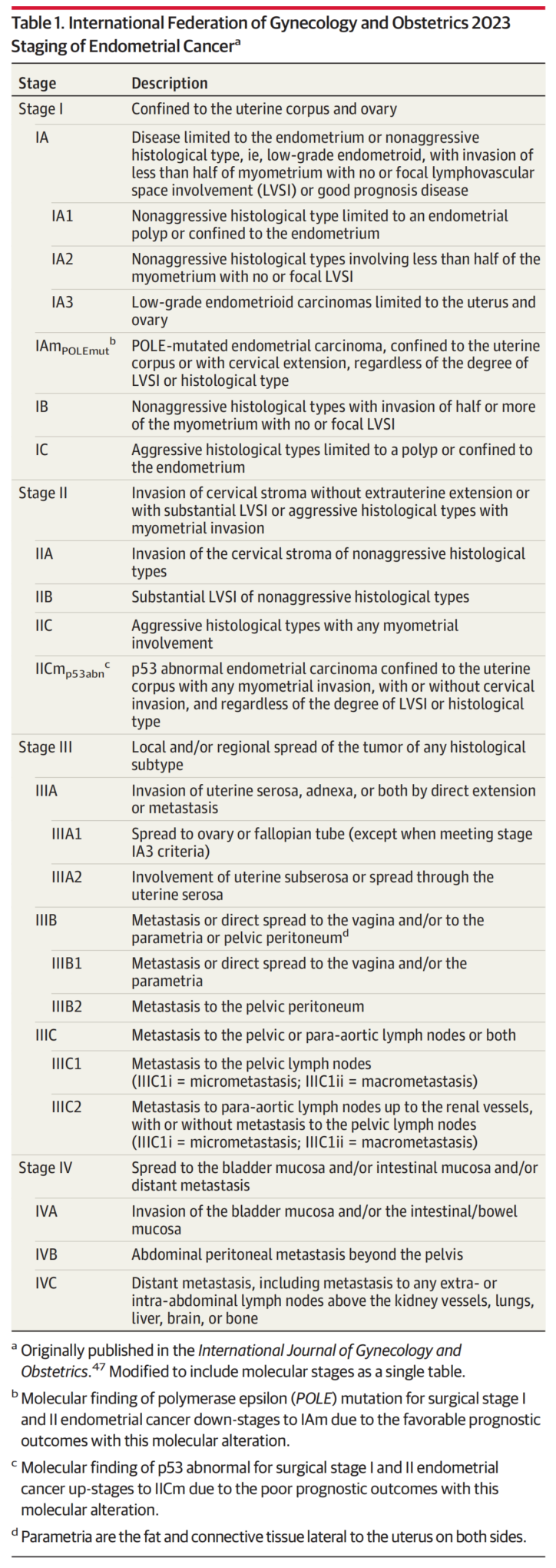
Note: While the 2023 FIGO staging system for endometrial cancer (first to integrate molecular features) is in clinical use, current NCCN guidelines are still based on the 2009 FIGO staging for treatment recommendations and have not fully adopted the 2023 update.
➱ Key innovation of 2023 FIGO staging: molecular classification directly alters stage:
POLE-mutant: Stage I–II may be downstaged to IAm, indicating excellent prognosis.
p53-abnormal: Stage I–II are upstaged to IICm, indicating high aggressiveness and necessitating intensified treatment.
Source: JAMA
IV. Core Revolution: Molecular Classification Determines Prognosis and Treatment Intensity
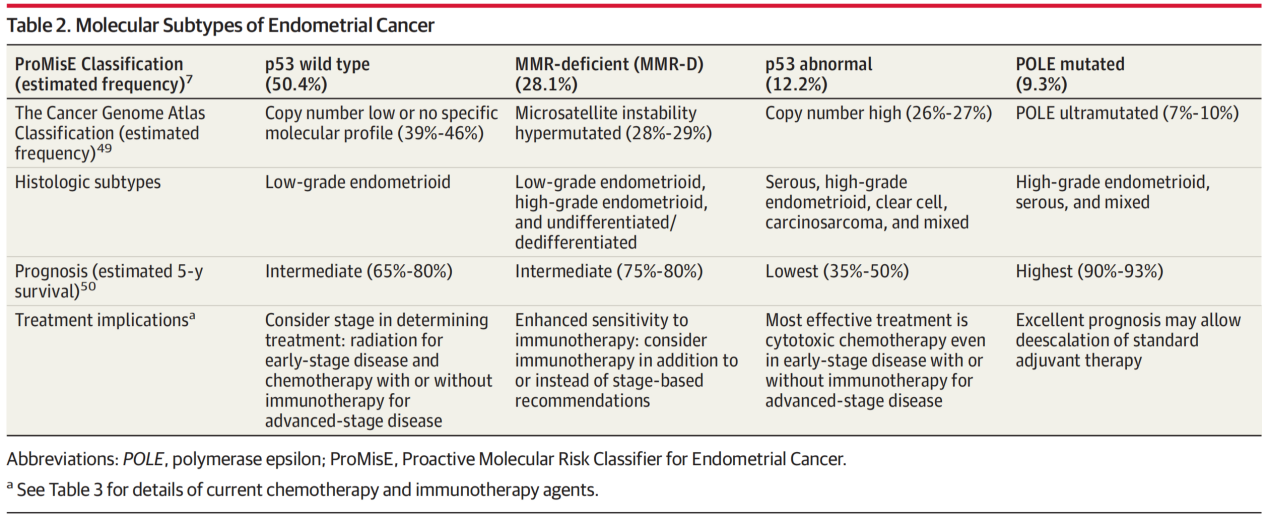
Routine molecular classification is now recommended for all endometrial cancers, with results directly guiding prognosis and adjuvant therapy intensity.
Source: JAMA
POLE-mutant: Best prognosis; early-stage patients may forgo adjuvant therapy ("de-escalation").
MMR-deficient (MMR-D): Intermediate-high risk; highly responsive to immunotherapy.
p53-wildtype: Most common subtype; treatment based on traditional staging and risk factors.
p53-abnormal: Highly aggressive; even early-stage cases should be considered for intensified chemotherapy.
V. Adjuvant Therapy: Precise Stratification, Moving Away from "One-Size-Fits-All"
Adjuvant therapy is no longer uniform; it is selected based on histology, stage, and molecular subtype.

Source: JAMA
Endometrioid carcinoma
Low-risk: Observation only.
Intermediate-high risk: Vaginal brachytherapy is first-line.
High-risk: Pelvic radiotherapy ± systemic therapy.
Aggressive histologies (serous/clear cell/carcinosarcoma)
Stage I: Consider carboplatin/paclitaxel chemotherapy ± radiotherapy.
Observation may be cautiously considered only if no myometrial invasion and negative peritoneal cytology.
Molecular-guided de-escalation: POLE-mutant intermediate-high risk patients may be managed with surveillance alone, omitting radiotherapy.
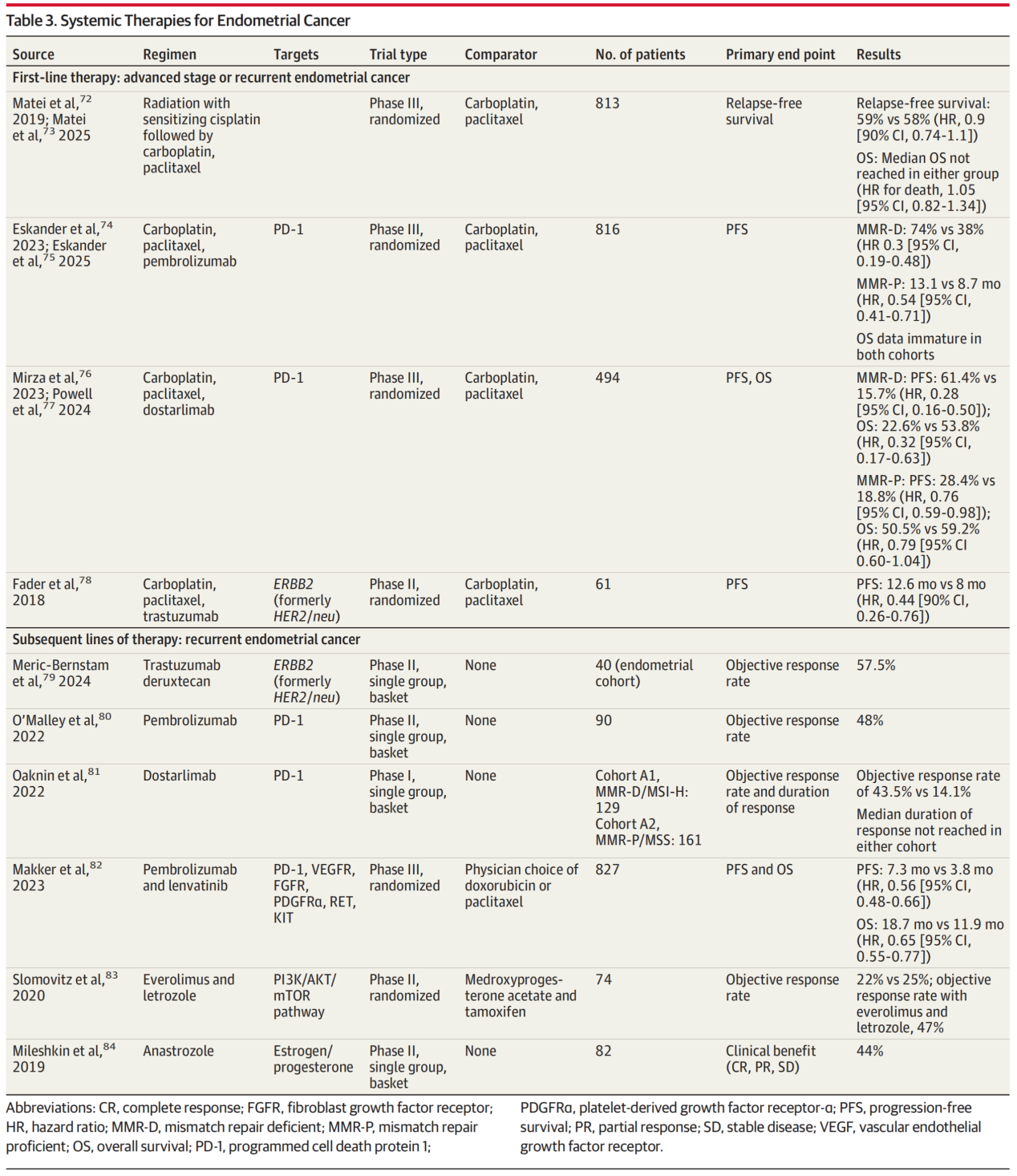
VI. Advanced/Recurrent First-Line: Immunotherapy Now a Standard Option
The treatment paradigm for advanced and recurrent endometrial cancer has shifted significantly, with immunotherapy moving to the forefront.
First-line standard: Carboplatin/paclitaxel + PD-1 inhibitor (e.g., pembrolizumab, dostarlimab).
Greatest benefit in MMR-D patients, with significant improvements in PFS and OS.
Immunotherapy has advanced from "later-line salvage" to a first-line cornerstone.
➱ Later-line options:
Lenvatinib + pembrolizumab
Trastuzumab deruxtecan (for HER2-positive disease)
Everolimus + letrozole
Anastrozole or other endocrine therapies
Source: JAMA
VII. Prognostic Data (Per 2023 FIGO Staging)
Stage I: 5-year survival >86%
Stage II: 5-year survival >75%
Stage III: 5-year survival >41%
Stage IV: 5-year survival >18%
➱ 5-year survival by molecular subtype:
POLE-mutant: 90%–93% (best prognosis)
MMR-D: 75%–80%
p53-wildtype: 65%–80%
p53-abnormal: 35%–50% (worst prognosis)
VIII. Special Populations: Standardized Conservative and Alternative Therapies
Strict selection and standardized management ensure efficacy while preserving quality of life.
Fertility preservation: Age ≤40, stage I, grade 1, confined to endometrium, no myometrial invasion. Use progestins (oral or LNG-IUD) with endometrial biopsy every 3 months. Pursue conception promptly upon remission, followed by definitive surgery.
Inoperable patients: First-line: intracavitary brachytherapy (excellent local control and safety). Progestin therapy is an alternative option.
IX. Follow-up: Simplified and Standardized, Avoiding Overmedicalization
Follow-up duration: ≥2 years for low-risk; ≥5 years for high-risk.
Routine repeated CT, PET-CT, or CA125 screening is not recommended.
Focus on recurrence-related symptoms and long-term quality of life:
Post-treatment sexual dysfunction affects ~75% of patients.
Interventions: vaginal lubricants, pelvic floor rehabilitation, specialized sexual health clinics.
Minimally invasive surgery, sentinel lymph node biopsy, and vaginal brachytherapy significantly improve quality of life.
X. Summary
The 2026 JAMAreview marks endometrial cancer’s formal entry into the era of molecularly guided precision medicine. Clinical decision-making no longer relies solely on staging but is evolving into a multidimensional stratification model centered on molecular classification, integrated with histopathology and clinical risk factors. This encompasses pathologic sampling in diagnosis, minimally invasive and standardized surgery, precise selection of adjuvant radiotherapy/chemotherapy/immunotherapy, and evidence-based conservative management for special populations—truly achieving individualized care.
This systemic advancement is key to improving cure rates, reducing recurrence, and enhancing long-term survival in endometrial cancer, representing a critical direction for contemporary gynecologic and gynecologic oncology practice.

Scan the QR code to access the original article.
Source: Mager KL, McLean K. Endometrial Cancer: A Review. JAMA. 2026;325(15):1536-1548. doi:10.1001/jama.2026.2248
Editor: Lily