Case History
Chief complaint: A 44-year-old female presented with a 3-year history of vaginal prolapse accompanied by urine leakage during coughing.
Present illness history: The patient self-reported discovering a vaginal prolapsed mass 3 years ago, which worsened with weight-bearing and coughing, accompanied by involuntary urine leakage upon coughing. The above symptoms recurred and progressively aggravated without medical attention or treatment. Frequent micturition and urgent urination became markedly exacerbated over the past year; urine leakage occurred during coughing, sneezing or slight increase in abdominal pressure, severely affecting daily life. In addition, the vaginal mass prolapsed obviously after heavy physical labor with friction and pain, and retracted after rest. Pelvic floor gynecological ultrasound performed in an outside hospital showed:
- Heterogeneous endometrial echo; multiple cervical nabothian cysts;
- Abnormal uterine body echo, suspected adenomyosis;
- Urethral calcification;
- Significantly increased bladder neck mobility; severe (Grade III) posterior bladder wall prolapse;
Grade II uterine prolapse.
Surgical treatment was recommended. The patient came to our hospital for further diagnosis and treatment, and was admitted to our department with outpatient diagnoses:
- Anterior vaginal wall prolapse;
- Uterine prolapse;
Stress urinary incontinence.
Since onset, the patient had good mental status, normal defecation and appetite, poor sleep, and no significant weight change.
Menstrual and reproductive history: Regular menstruation, menarche at age 13, menstrual cycle 6 days / 28–30 days, moderate menstrual volume, dark red blood, normal vaginal discharge. Last menstrual period: May 20, 2023. G3P3.
Physical Examination
Gynecological physical examination: Stable vital signs, no obvious abnormalities in cardiopulmonary and abdominal examination.
Gynecological examination: Normal vulvar development, no dermatitis or neoplasms; patent vagina with a small amount of odorless white discharge. The anterior vaginal wall prolapsed outside the vaginal introitus; smooth cervix; anteverted uterus with normal size, regular shape, soft texture and no tenderness. Uterine descent was observed, with the cervix located at the vaginal introitus; the cervix descended 3 cm below the hymen ring during Valsalva maneuver. Involuntary urine leakage occurred during coughing, and positive Bonney test.
POP-Q staging: Aa +2, Ba +2, C +3, D -6, Ap -1, Bp -2, gh 5 cm, bp 3 cm.
Auxiliary Examinations
Pelvic floor gynecological ultrasound indicated:
- Heterogeneous endometrial echo; multiple cervical nabothian cysts;
- Abnormal uterine body echo, suspected adenomyosis;
- Urethral calcification;
- Significantly increased bladder neck mobility; severe (Grade III) posterior bladder wall prolapse;
Grade II uterine prolapse.
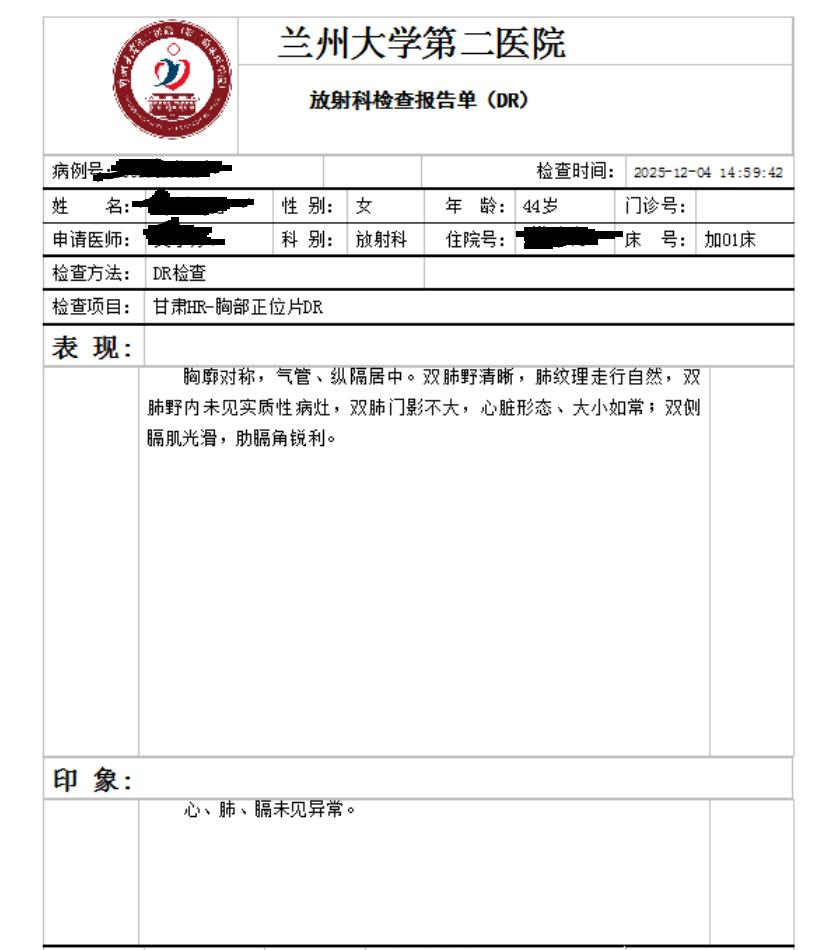
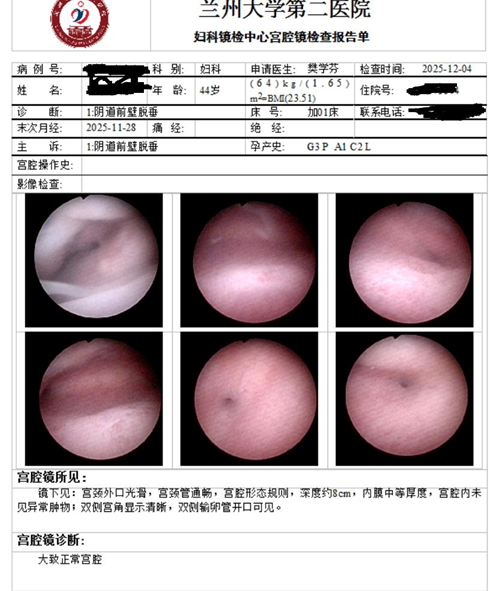
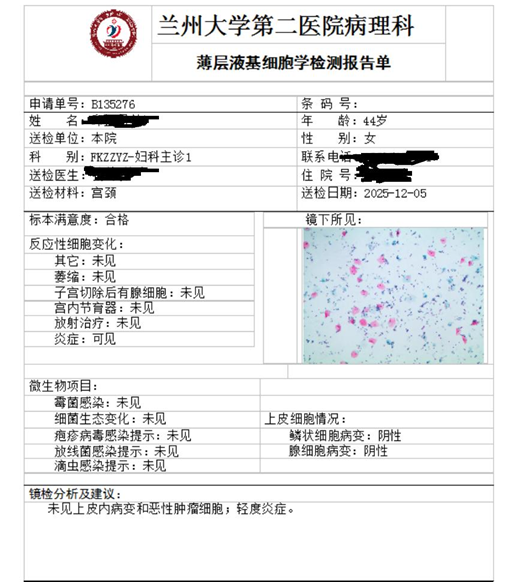
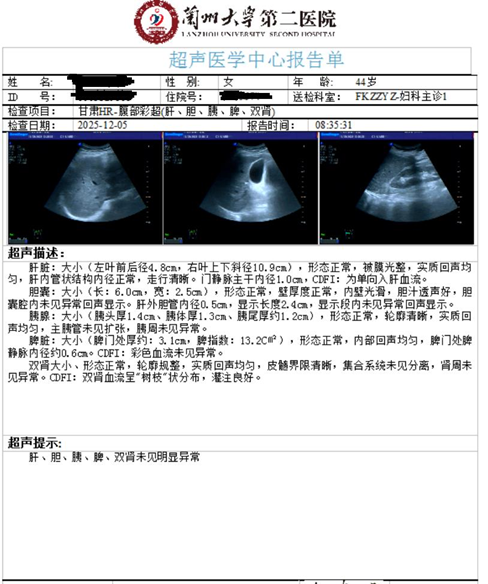
Electrocardiogram, blood routine, biochemical tests, TCT and HPV tests all showed no abnormalities.
Diagnosis, Treatment and Postoperative Follow-up
- Anterior vaginal wall prolapse;
- Grade III uterine prolapse;
- Stress urinary incontinence.
Surgical procedure: Laparoscopic lateral uterine abdominal wall suspension combined with TVT-O (the video only demonstrates laparoscopic lateral uterine abdominal wall suspension).
Surgeon: Zhang Haibin; Assistant: Fan Xuefen.
Anesthesia mode: Intravenous anesthesia.
Operation duration: 2 hours; intraoperative blood loss: approximately 10 mL; the operation proceeded smoothly. The urinary catheter was removed 3 days after surgery, and the patient had normal urination.
Follow-up:Reexamination 1 month after surgery showed no obvious discomfort, no frequent micturition, urgent urination or dysuria, no urine leakage during coughing, and normal defecation. POP-Q results: Aa -3, Ba -3, C -7, D -8, Ap -3, Bp -3, gh 5 cm, bp 3 cm, TVL 8 cm.
Surgical Steps
Under general anesthesia, the patient was placed in lithotomy position. Puncture sites were marked at 3 cm above the left anterior superior iliac spine, 3 cm above the right anterior superior iliac spine, and 4 cm left lateral to 1 cm below the umbilicus. Routine disinfection and draping were performed, a uterine manipulator was placed into the vagina, and an indwelling urinary catheter was inserted. Trocars were placed through the marked puncture sites.
A laparoscope was inserted to explore the abdominal cavity. The vesicouterine peritoneal reflection was transversely incised with an ultrasonic scalpel, extending bilaterally below the round ligaments. The ultrasonic scalpel was used to dissect and separate the space between the bladder and the anterior cervicovaginal wall, extending bilaterally to the uterine arteries and inferiorly close to the bladder neck to fully expose the anterior vaginal wall while minimizing bleeding.
A T4 mesh was manually trimmed to remove one pair of supporting legs, retaining the middle tongue-shaped segment and the other pair of supporting legs. The mesh was inserted into the abdominal cavity and further trimmed according to the actual area of the dissected anterior vaginal wall. The mesh was intermittently sutured and fixed to the anterior vaginal wall; the tongue-shaped mesh segment was smoothly secured to the dissected anterior vaginal wall with 9 sutures, avoiding penetration through the vaginal mucosa as much as possible.
A 5 mm small incision was made at the pre-marked abdominal puncture sites with a scalpel. Separating forceps were passed 5 mm subcutaneously, then guided by laparoscopy toward the pelvic cavity without penetrating the peritoneum. The forceps advanced along the extraperitoneal tunnel below the round ligament until penetrating into the pre-opened space between the bladder and anterior vaginal wall. The trimmed mesh leg was clamped with separating forceps and pulled out through the abdominal puncture site; the contralateral leg was managed in the same manner.
The uterine manipulator was removed. The length and tension of bilateral mesh legs were adjusted based on the distance from the cervix to the hymen ring palpated by the assistant’s finger to maintain point C at -6. Excess mesh outside the abdominal wall was excised.
The wound surface was inspected, bleeding was aspirated and hemostasis achieved. Absorbable barbed sutures were used to close the vesicouterine peritoneal reflection for complete peritonealization.
Surgeon Profile

Zhang Haibin
Chief Physician, MD, Director of Ward 1, Department of Gynecology, Second Hospital of Lanzhou UniversityMaster’s Supervisor, Visiting Scholar at Rabin Medical Center, IsraelCertified Mentor of GESEA Program, European Academy of Gynaecological Surgery; Reviewer of Journal of Biomedical Translational Research
Social Positions
Editor-in-Charge: QinghuanReviewer: Ma Ye