
At 17:00 Beijing Time on October 5, the Karolinska Institutet in Sweden announced that the 2026 Nobel Prize in Physiology or Medicine has been awarded to Karl Deisseroth, Peter Hegemann and Georg Nagel for their discoveries of light-gated ion channels and optogenetics.
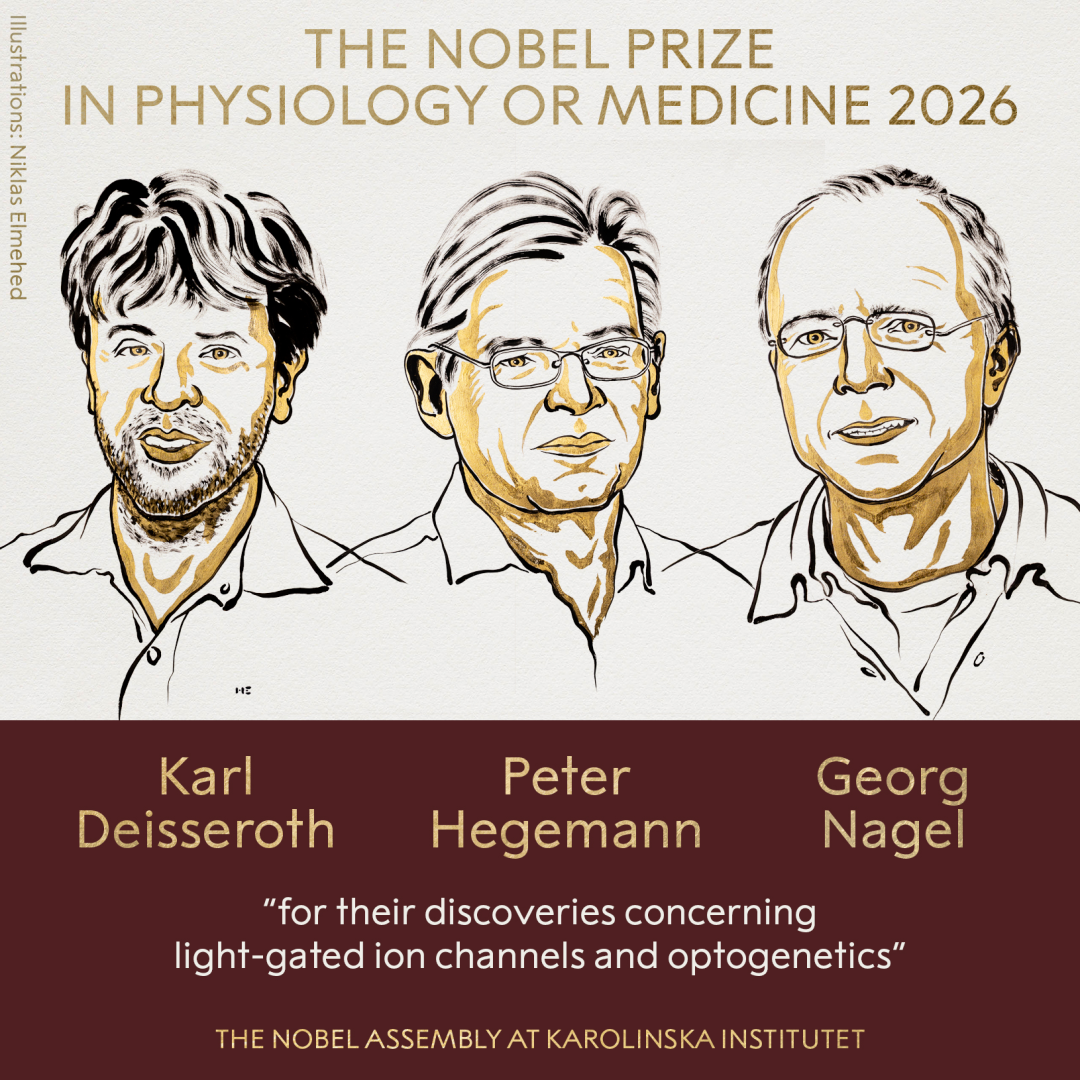
Karl Deisseroth, born in the United States in 1971, earned his bachelor’s degree in biochemistry from Harvard University and his PhD in neuroscience from Stanford University in 1998. He established his own laboratory at Stanford University in 2004. In 2005, Edward Boyden, a postdoctoral researcher in Deisseroth’s lab, and Zhang Feng, a student, co-authored a paper that first achieved millisecond-scale control of action potentials in nerve cells using channelrhodopsin. In 2006, Deisseroth named this approach “optogenetics”. Their method was quickly adopted across diverse biological fields, enabling biologists to manipulate a wide range of biological activities with light.
Peter Hegemann was born in Münster, western Germany, in 1954. He obtained his doctorate in Munich in 1984. His doctoral research focused on the structure and function of halorhodopsin. From 1984 to 1985, Hegemann conducted postdoctoral research in the laboratory of Dieter Oesterhelt. He set up his own lab at the Max Planck Institute in Germany in 1986 and has served as a professor at Humboldt-Universität zu Berlin since 2004.
Georg Nagel is a German biophysicist born on August 24, 1953, in Weingarten, Germany. He studied biology and biophysics at the University of Konstanz, where he was supervised by biophysicist Ernst Bamberg, who would become his long-term collaborator. After graduation, he briefly worked as a secondary school teacher in Switzerland. In 1984, he began his doctoral studies at Goethe University Frankfurt and the Max Planck Institute of Biophysics, receiving his PhD in 1988. He then moved to the United States to complete around five years of postdoctoral training at Yale University and Rockefeller University.
The Nobel Prize in Physiology or Medicine was established under the will of Swedish chemist Alfred Nobel, to recognise scientists who have made important discoveries and outstanding contributions in the field of physiology or medicine in the preceding year.
First awarded in 1901, the prize is selected by the Karolinska Institutet, a medical university in Stockholm, Sweden. The award ceremony takes place every year on 10 December, the anniversary of Alfred Nobel’s death.
Discoveries of Decisive Significance
Contributions of the three laureates: Peter Hegemann and Georg Nagel discovered ion channels that can be directly activated by light. Karl Deisseroth then adapted this naturally occurring molecular mechanism found in algae into a tool to control nerve cells. The research started from exploring “why algae swim toward light”, and later evolved into the ability to control neurons in the living brain with light. This work ultimately gave rise to an entirely new research field.
The Nobel Committee states that optogenetics has fundamentally transformed how humans study the brain and laid a new experimental foundation for understanding the neural mechanisms underlying memory, emotion and behaviour.
The laureates will share the prize sum of 12 million Swedish kronor (approximately 8.02 million Chinese yuan).
Source: Official website of the Nobel Prize Committee