





















The effect of aspirin on the risk of preeclampsia based on the Fetal Medicine Foundation first-trimester risk
Preeclampsia is one of the most critical obstetric complications, significantly increasing maternal and perinatal mortality rates as well as the long-term risk of cardiovascular disease in women. Severe cases often require emergent iatrogenic preterm delivery. The Fetal Medicine Foundation (FMF) first-trimester combined screening has become the gold standard for predicting preterm preeclampsia, demonstrating significantly superior screening efficacy compared to traditional risk factor scoring. Existing evidence confirms that initiating 150 mg of aspirin before 16 weeks of gestation can significantly reduce the risk of preterm preeclampsia in high-risk populations, with benefits becoming clearer as medication adherence improves. However, whether the initial risk level affects the preventive efficacy of aspirin and how to implement precise surveillance for high-risk populations remain key clinical challenges. A recent secondary analysis of the ASPRE trial published in the American Journal of Obstetrics & Gynecology (AJOG) clarifies the direct link between risk stratification and therapeutic efficacy, providing robust evidence for the precision prevention of preeclampsia.
(Image 1.png Source: AJOG)
01 Study Design
This study was a post-hoc secondary analysis of the ASPRE trial. It included pregnant women at 11–14 weeks of gestation with an FMF-assessed preterm preeclampsia risk ≥1%. Participants were randomly assigned to receive either daily 150 mg of aspirin or a placebo until 36 weeks of gestation.
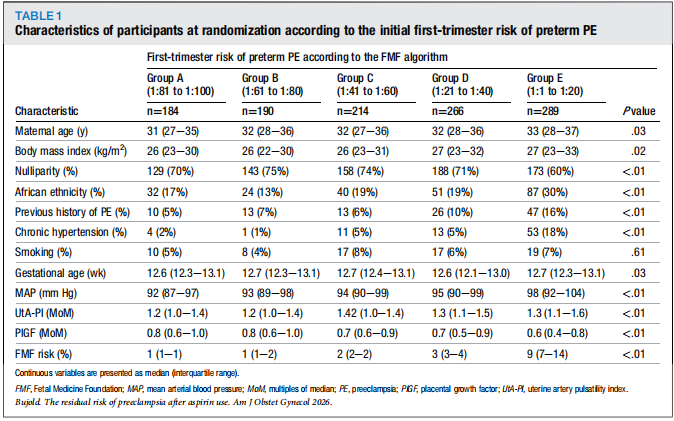
To ensure result reliability, the analysis only included subjects with medication adherence ≥90% (totaling 1,143 participants). Subjects were divided into two groups based on the FMF risk threshold of 5% (1/20): <5% and ≥5%, to compare the hemostatic and preventive effects of aspirin across different risk levels.
Table 1: Baseline characteristics of subjects grouped by first-trimester FMF risk
(Image 2.png Source: AJOG)
02 Core Results
1. Pregnancy Outcomes in the Placebo Group by Risk Level
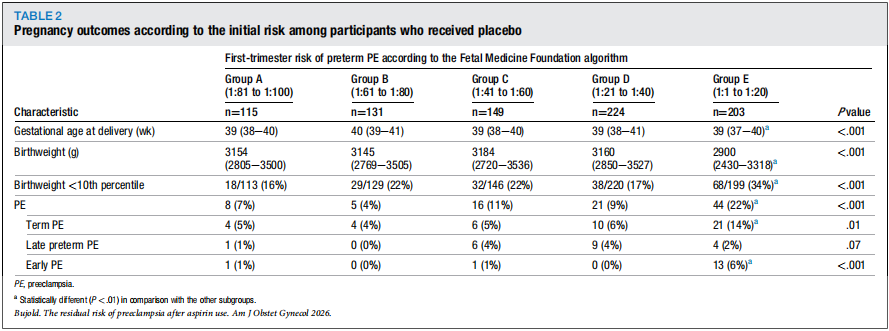
Data from the placebo group showed that the incidence of preeclampsia, preterm preeclampsia, and early-onset preeclampsia in the population with an FMF risk ≥5% (1/20) was significantly higher than in those with <5% risk, with statistically significant differences.
Table 2: Pregnancy outcomes stratified by initial FMF risk in the placebo group
(Image 3.png Source: AJOG)
2. Overall Preventive Effect of Aspirin
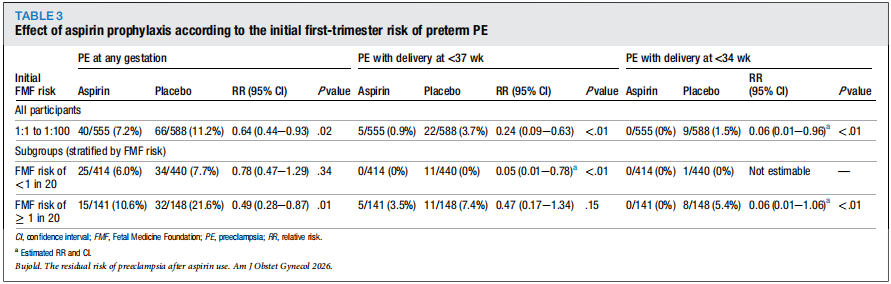
Under the premise of high adherence, aspirin compared to placebo achieved:
• 36% reduction in the risk of preeclampsia at any gestational age.
• 76% reduction in the risk of preterm preeclampsia (<37 weeks).
• >94% reduction in the risk of early-onset preeclampsia (<34 weeks).
Table 3: Preventive effect of aspirin stratified by initial FMF risk
(Image 4.png Source: AJOG)
3. Stratified Effects: Protection Varies Significantly by Risk
(1) FMF Risk <5% (Moderate-Low Risk)
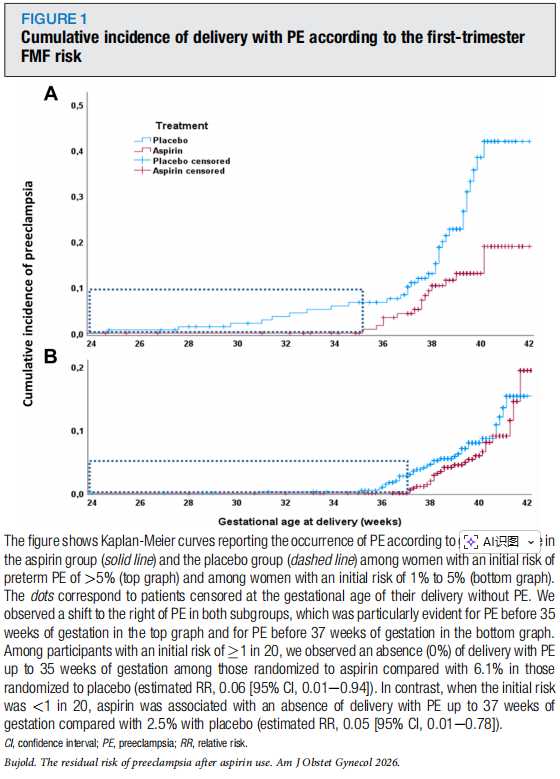
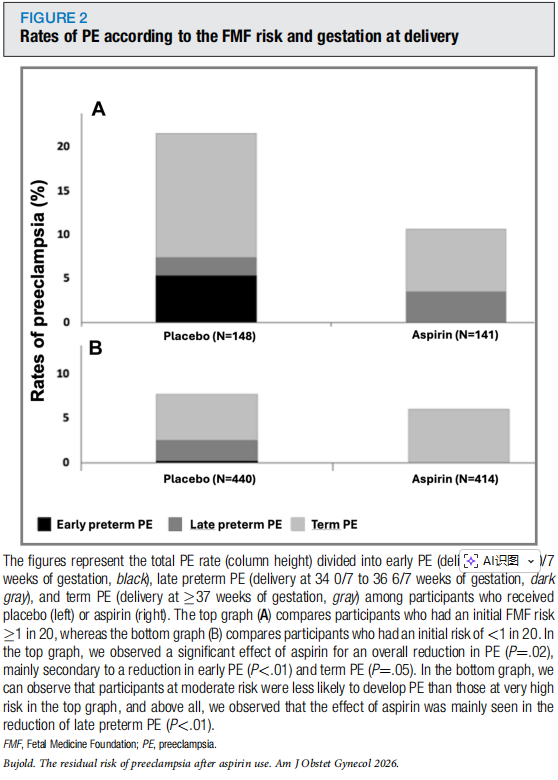
Under high adherence, aspirin nearly completely prevented preeclampsia before 37 weeks. There were zero cases in the intervention group before 37 weeks, compared to 2.5% in the placebo group.
(2) FMF Risk ≥5% (Very High Risk)
Aspirin completely blocked early-onset preeclampsia. There were zero cases of onset before <34 weeks in the intervention group, compared to 5.4% in the placebo group. However, residual risk of late preterm preeclampsia persisted between 35–37 weeks. Notably, the median delivery gestational age shifted significantly from 32.1 weeks in the placebo group to 36.0 weeks in the aspirin group.
Figure 1: Cumulative incidence of preeclampsia delivery stratified by first-trimester FMF risk (Kaplan–Meier curves)
(Image 5.png Source: AJOG)
Figure 2: Distribution of preeclampsia incidence grouped by FMF risk and gestational age at delivery
(Image 6.png Source: AJOG)
03 Clinical Implications
1. Mandatory First-Trimester FMF Combined Screening
Complete the assessment of maternal factors, mean arterial pressure, uterine artery Doppler, and placental growth factor at 11–14 weeks of gestation. Initiate aspirin if the risk is ≥1%.
2. Standardized Medication Regimen
Daily dose of 150 mg, initiated between 11–14 weeks of gestation (no later than 16 weeks), continued until 36 weeks. "Adherence ≥90%" is the key guarantee of efficacy.
3. Enhanced Surveillance for Very High-Risk Populations
For individuals with FMF ≥5%, although early-onset preeclampsia can be avoided, monitoring should be intensified starting at 34–35 weeks of gestation, focusing on preventing late preterm preeclampsia.
Conclusion
Based on a secondary analysis of the ASPRE trial, this study confirms that first-trimester FMF risk stratification directly determines the efficacy of aspirin in preventing preeclampsia. Daily 150 mg of aspirin with adherence ≥90% significantly reduces the risk of all types of preeclampsia, particularly offering stronger protection against early-onset and preterm subtypes. For those with an FMF risk <5%, aspirin nearly completely prevents preeclampsia before 37 weeks. For those with a risk ≥5%, aspirin blocks early-onset disease but residual risk remains at 35–37 weeks, necessitating enhanced surveillance. These results provide crucial evidence for clinical precision prevention and individualized management.
Source: Bujold E, Rolnik D, Poon L ... The effect of aspirin on the risk of preeclampsia based on the Fetal Medicine Foundation first-trimester risk. American Journal of Obstetrics & Gynecology, 2025; 234, 770-778.
[This article is intended for medical professionals for academic exchange and learning purposes only. It does not constitute specific clinical operation guidelines. Actual clinical decisions must integrate patient conditions, hospital resources, and the latest guidelines. Multidisciplinary consultation is recommended when necessary.]
Editor: Lily